
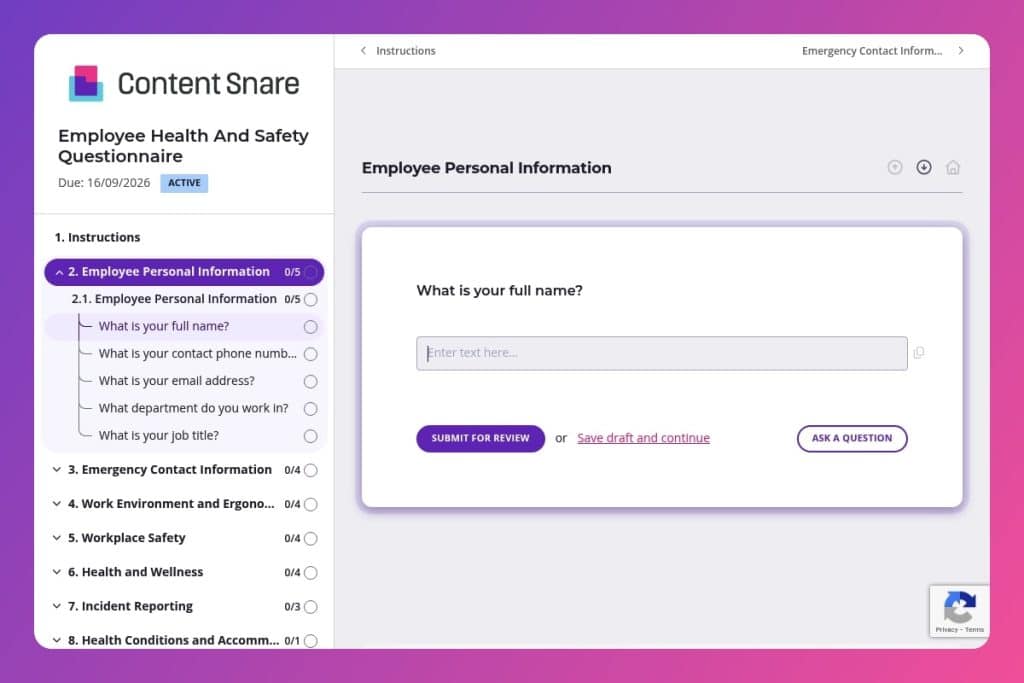


A comprehensive questionnaire that systematically collects employee safety knowledge, emergency contacts, health accommodations, ergonomic concerns, and incident reports to identify workplace risks before they become liabilities.

HR professionals and safety coordinators in human resources companies who need to maintain compliance, document accommodation requests, and gather actionable feedback on workplace conditions across client organizations.

Deploy during onboarding for new employees, annually as part of safety audits, after workplace incidents to assess awareness gaps, or when updating emergency preparedness protocols.
68% of workplace injury costs stem from preventable hazards that employees noticed but never reported. The gap between what your workforce knows and what you capture creates risk, liability, and unnecessary expenses. Missing emergency contacts, unreported ergonomic issues, and employees unaware of safety protocols - these aren't minor oversights. They're compliance failures waiting to happen.
An employee health and safety questionnaire closes that gap. It systematically collects critical information - from emergency contacts to accommodation needs - while surfacing risks before they become incidents. This post covers what belongs in an effective questionnaire, how to deploy it across your organization, and includes a ready-to-use template that saves you hours of setup time. Let's get started.
Employee Personal Information
Collect core identifiers to link responses to employee records and route follow-up accurately.
Emergency Contact Information
Confirm emergency contact details are current and complete for rapid escalation.
Work Environment and Ergonomics
Surface ergonomic risks and training coverage to target workstation adjustments and coaching.
Workplace Safety
Assess awareness of safety policies, training recency, and situational risk.
Health and Wellness
Gauge perceived support for physical health and stress drivers within the work environment.
Incident Reporting
Check literacy on reporting procedures and the effectiveness of the response cycle.
Health Conditions and Accommodations
Identify current and unmet accommodation needs to maintain compliance and enable performance.
Training and Development
Map participation, gaps, and resource access for health and safety learning.
Feedback and Suggestions
Capture targeted ideas to strengthen safety, wellness, and communications.
Schedule distribution during low-stress periods: Send this questionnaire at the start of a quarter or during slower work weeks, not during performance review season or major project deadlines. Employees are more likely to provide thoughtful responses about workspace ergonomics and stress levels when they're not already overwhelmed.
Frame it as a two-way conversation, not compliance theater: In your introduction email, emphasize that you're collecting this information to actually improve working conditions - not just to check a regulatory box. Reference specific sections like "Work Environment and Ergonomics" and "Feedback and Suggestions" to show you're listening. When employees see their input leads to real changes, response quality improves dramatically.
Verify emergency contact information is current before you need it: The emergency contact section seems straightforward, but outdated information is surprisingly common. Cross-reference responses with your existing HR records and flag any discrepancies for immediate follow-up. A disconnected phone number discovered during an actual emergency is a nightmare you can prevent now.
Create a response workflow for accommodation requests: When employees disclose health conditions requiring workplace accommodations, you need a clear next step. Assign someone to review these submissions within 48 hours and initiate the interactive accommodation process. Delayed responses don't just frustrate employees - they expose you to legal risk.
Mine the feedback sections for systemic issues: Don't just file away individual responses. Look for patterns in the "Workplace Safety" and "Feedback and Suggestions" sections. If multiple employees mention the same safety concern or suggest similar improvements, you've identified a priority issue that demands immediate attention and resources.
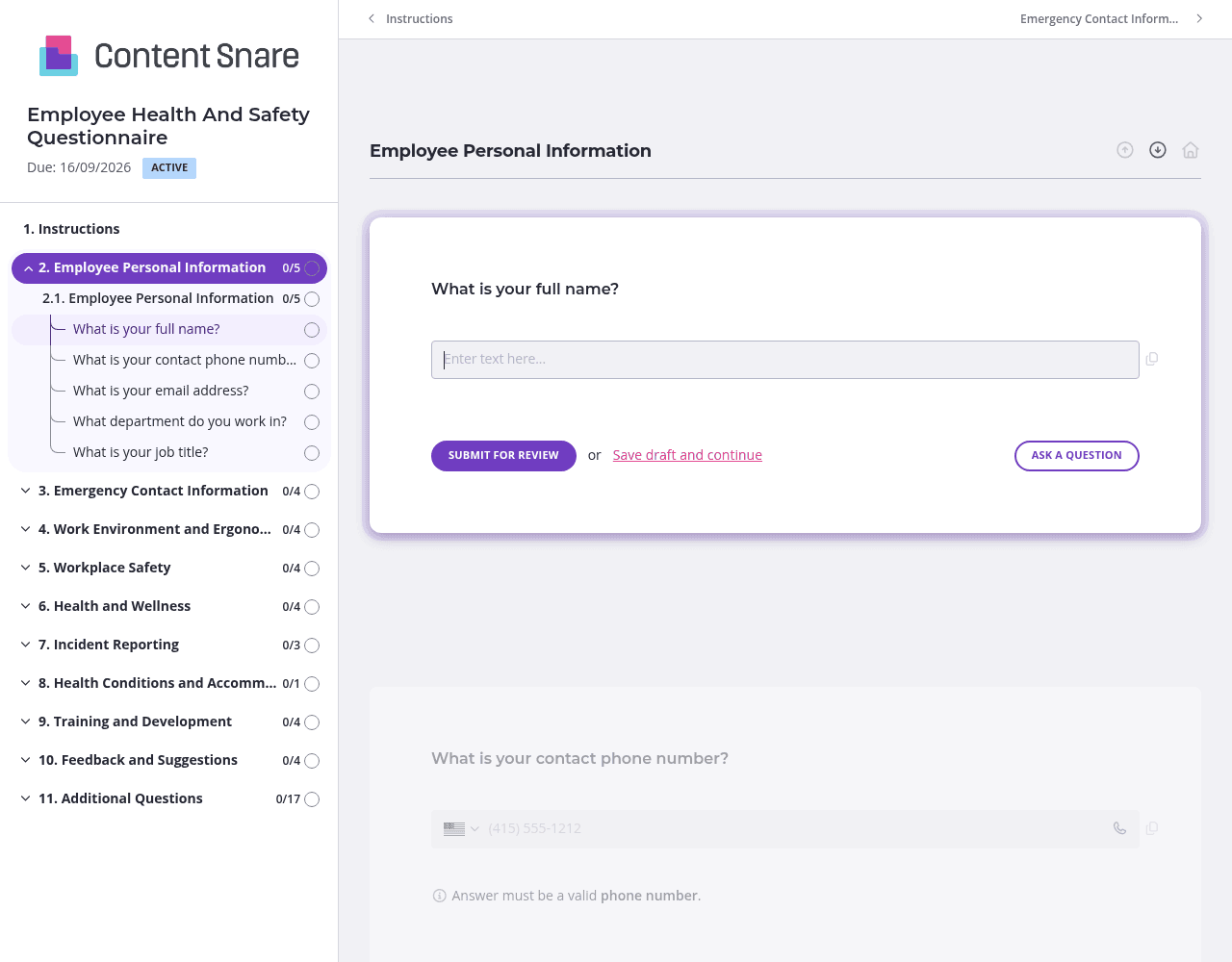
Your HR system already has names, departments, job titles, and email addresses. Pre-populate those fields before sending the questionnaire. Employees appreciate not re-entering information you already know, and you'll get faster completion rates. They can focus their energy on the questions that actually matter - like ergonomic concerns and safety feedback.
Not every employee needs to answer every question. Someone without health conditions requiring accommodations doesn't need to see follow-up questions about satisfaction with those accommodations. Set up conditional logic so the "Health Conditions and Accommodations" section expands only when relevant. You'll reduce form fatigue and get cleaner data.
The "Incident Reporting" and "Health Conditions and Accommodations" sections touch on sensitive topics. Use instruction areas to clarify how you'll handle this information, who has access to it, and what happens next. A brief note like "This information is reviewed only by HR and used to ensure your safety and comfort at work" builds trust and encourages honest responses.
Health and safety questionnaires often get pushed aside when work gets busy. Automatic reminders ensure completion without you sending manual follow-ups. Configure a sequence - maybe a gentle nudge after three days, another after a week. You maintain momentum without being the person constantly chasing submissions.
Spreadsheets get ignored. Email chains create confusion. Paper forms disappear into desk drawers. Content Snare gives you a single system to collect information, track progress, and follow up automatically - without the chaos of managing employee responses across multiple channels.
Security matters when you're collecting sensitive health information and emergency contacts. Content Snare is ISO 27001 certified and trusted by thousands of businesses worldwide to handle confidential data. Your employees can submit accommodation requests and incident reports knowing their information is protected.
Content Snare integrates with the tools you already use - your HRIS, project management software, and communication platforms. You're not adding another disconnected system to your tech stack. Responses flow directly where you need them.
Employees actually complete forms in Content Snare. The interface is clean and mobile-friendly. Automatic reminders handle follow-up so you're not the one sending "just checking in" emails. With hundreds of 5-star reviews across G2, Capterra, and Trustpilot, it's proven to work for organizations managing complex information collection.
This form is just one way HR teams use Content Snare. You can also collect:
The same system that streamlines your health and safety questionnaire works across your entire employee lifecycle.


