content snare

Templates

Tax advisory questionnaire template (32 questions)

Industry
|
Country
Global
|
Reviewed by
James Rose
|
Last Updated
November 20, 2026

At a glance

WHAT this is

A pre-consultation form that collects client financial information, income sources, deductions, investments, and tax compliance status before your first meeting.


WHO this is for

Tax advisors, CPAs, and accounting professionals who conduct tax planning consultations and need complete client financial data upfront.


WHEN to use this

Send it at least one week before initial consultations or annual tax planning sessions so clients arrive prepared with documentation and you can focus on strategy instead of data gathering.


Template preview

Here's what this template looks like in Content Snare.
Start your free trial to send this template in minutes.

Your clients arrive with scattered receipts, vague recollections of deductible expenses, and zero documentation of that rental property income. You spend the first hour of every consultation just gathering basic information - time you could spend on actual tax strategy. A tax advisory questionnaire fixes this problem before clients walk through your door.

This simple form collects everything upfront: income sources, investment changes, deductions, compliance issues, and future plans. You get complete information. Clients feel prepared. Consultations become strategic instead of administrative. This post covers what belongs in an effective tax advisory questionnaire, how to use it in your practice, and includes a free template you can customize. Let's break it down.

Tired of chasing people to fill out your forms? Try Content Snare

Content Snare is like a forms tool on steroids. Autosaving forms mean no progress is lost. Automatic reminders mean you can relax knowing your forms will get finished without you having to chase people down. 
Start My Free Trial

Questions to include on your tax advisory questionnaire

Personal Information
Collect baseline identity and household data to set filing status and dependency profile.

  • What is your full name?
  • What is your contact information (phone and email)?
  • What is your current residential address?
  • What is your marital status?
  • Do you have any dependents? If so, how many and what are their ages?
    Dependent count and ages drive filing status, credits, and documentation requirements.

Financial Overview
Establish total income, ancillary income streams, banking relationships, and liabilities to scope complexity and cash-flow considerations.

  • What was your total income for the last fiscal year?
  • Do you have any additional sources of income? If so, please specify.
  • What is your primary bank account information?
  • Do you have any outstanding loans or debts? If yes, please provide details.
    Additional income and debt details influence estimated taxes, deductibility, and risk screening.

Employment and Business Income
Differentiate wage income from self-employment and identify new ventures that change reporting and tax exposure.

  • Who is your current employer, and what is your job title?
  • What is your employment status (full-time, part-time, contractor)?
  • Have you started any new businesses this year?
  • If self-employed, what kind of business do you operate?
    Contractor and new business details affect SE tax, entity filings, and quarterly payment requirements.

Investments and Assets
Surface taxable accounts, real property, and any cross-border exposure impacting specialized filings.

  • Do you have any investment accounts such as stocks, bonds, or real estate?
  • Have there been any changes to your investment portfolio in the past year?
  • Do you own any rental properties?
  • Are there any international investments or assets you hold?
    International assets and rentals trigger forms and disclosures (e.g., FBAR/FATCA, Schedule E) and require basis, depreciation, and lot tracking.

Deductions and Credits
Identify high‑value deduction and credit opportunities and the substantiation needed.

  • Are you eligible for any education or student loan deductions?
  • Do you have any charitable donations you'd like to declare?
  • Have you incurred any significant medical expenses this year?
  • Are you claiming any home office or business-related expenses?
    These items are threshold- and documentation-sensitive and materially affect liability.

Tax Filing History
Pull forward data, elections, and risk indicators from prior filings.

  • Can you provide your tax returns from the previous year?
  • Have you experienced any issues with past tax filings?
  • Are there any back taxes or audits pending?
    Prior returns and any issues inform carryforwards, notices, audit posture, and remediation steps.

Plans and Future Considerations
Anticipate life events and income shifts to time strategies and manage cash taxes.

  • Are you planning any major life changes such as buying a home or retiring soon?
  • Do you anticipate significant income changes in the future?
  • Are you planning to make any large financial gifts or inheritances?
    Advance visibility enables timing, entity selection, basis planning, and withholding/estimated tax adjustments.

Legal and Compliance Concerns
Identify matters that escalate risk or require special reporting and disclosures.

  • Are there any ongoing legal issues that might affect your tax situation?
  • Have you been involved in any litigation related to your finances?
  • Are you up-to-date on all tax compliance matters?
    Litigation and compliance gaps can drive penalties, disclosures, and protective filings.

Additional Notes
Capture edge cases and nuances that shape positions or workflow.

  • Is there any other information that is relevant to your tax advice needs that we should be aware of?
  • Are there any specific concerns or questions you have about your tax situation that you would like to discuss?
    Use this to surface atypical facts that affect positions, elections, and deadlines.

Other question ideas

When you are creating your tax advisory questionnaire, here are some additional questions you may want to consider. These won't apply in every case, but should give you some ideas as you build out your form.
  1. Do you have any cryptocurrency investments or transactions we should be aware of?
  2. Have you made any green energy or sustainable living improvements to your home that could qualify for tax credits?
  3. Do you participate in any sharing economy activities such as Uber, Airbnb, or freelance gigs?
  4. Have you received any income from online sales or e-commerce platforms?
  5. Are you receiving any type of social security or government assistance benefits?
  6. Have you incurred any unusual expenses related to the COVID-19 pandemic?
  7. Are there any trusts, wills, or estate plans that could potentially affect your tax situation?
  8. Did you make any significant financial transactions using digital payment platforms?
  9. Are you involved in any gig work or side businesses not covered in previous questions?
  10. Do you have any goods or property located overseas that could affect your tax status?
  11. Have you earned or spent any loyalty or reward points that might have tax implications?
  12. Do you have any debts that were forgiven this year?
  13. Have you taken advantage of any government stimulus packages or grants this year?
  14. Are you involved in any partnerships or joint ventures that could possibly affect your tax filing?
  15. Do you have any offshore bank accounts or assets?
  16. Have you made any major changes to your retirement savings or pension plans?

Tips to get the best results

  • Send it before the initial consultation: Get the questionnaire to clients at least a week before your first meeting. They'll need time to gather tax documents, review their investment portfolio changes, and dig up those charitable donation receipts. The more complete their responses, the less time you waste on basic fact-finding during billable hours.

  • Flag incomplete sections immediately after submission: Don't wait until the consultation to discover they skipped the entire "Investments and Assets" section or left international holdings blank. Review submissions within 24 hours and send a quick follow-up asking for missing details - especially critical areas like outstanding audits, legal issues, or anticipated income changes that directly impact your tax strategy.

  • Use their responses to structure your consultation agenda: Client mentioned they're planning to retire soon and sell a rental property? That's your meeting focus right there. Review their answers and build a prioritized discussion list that addresses their specific situation - whether it's maximizing deductions for a new home office, navigating compliance issues from prior filings, or planning for that large inheritance they disclosed in the future considerations section.
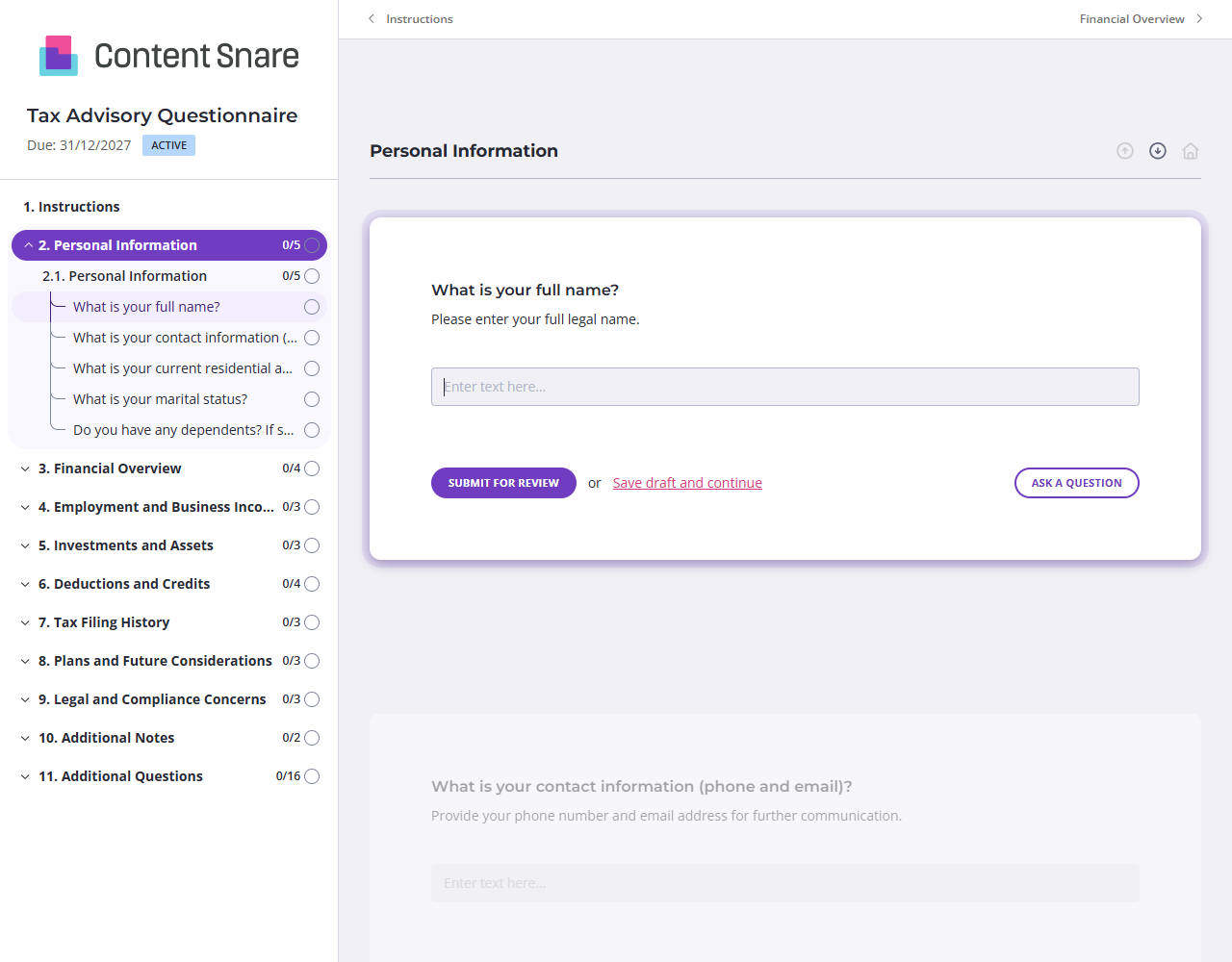
How to use Content Snare for your tax advisory questionnaire

Tax advisory questionnaire template in Content Snare

Break complex sections into digestible pages

Tax information overwhelms clients fast. Split your questionnaire into logical pages - Personal Information, Financial Overview, Investments and Assets, Deductions and Credits. Clients can save progress and return later when they need to hunt down that rental property documentation or dig through investment statements. They'll complete more fields accurately instead of abandoning halfway through or guessing at numbers.

Add instructions where clients typically stumble

The "international investments" question? Most clients don't know if their mutual fund counts. Add a brief explanation directly below the field: "This includes foreign bank accounts, overseas real estate, or stocks traded on international exchanges." Same goes for business expense deductions - drop in a quick note about what qualifies as home office use. Clear instructions mean fewer follow-up emails asking what you actually meant.

Show only relevant questions with conditional logic

Not every client has rental properties, outstanding audits, or self-employment income. Set up conditional questions that appear only when applicable. If someone selects "employed full-time" for employment status, skip the entire self-employment business section. If they answer "no" to investment accounts, hide the portfolio changes questions. Clients see a shorter, personalized form that respects their time.

Pre-fill information you already have

Returning clients shouldn't re-enter their name, address, marital status, and contact details every year. Pre-populate those fields before sending the questionnaire. Better yet, delete questions entirely if nothing's changed - you already have last year's employer information and bank details on file. Jump straight to what's new: income changes, investment updates, and upcoming life events that affect this year's strategy.


Why use Content Snare

Email attachments get lost. Shared documents turn into version-control nightmares with multiple drafts floating around. Phone tag wastes your time, and manual follow-ups make you feel like you're nagging clients. Content Snare eliminates all of that. Clients get a clean, professional form with automatic reminders. You get complete information without chasing anyone down.

The platform is ISO 27001 certified and trusted by accounting firms handling sensitive financial data every day. It integrates with tools you already use and has earned hundreds of 5-star reviews across G2, Capterra, and Trustpilot for making client onboarding actually painless.

Beyond tax advisory questionnaires, accounting professionals use Content Snare for:

  • Year-end financial statement preparation – Collect all necessary documentation and disclosures from clients in one organized request
  • Business incorporation and setup – Gather entity formation details, shareholder information, and initial financial data
  • Audit preparation questionnaires – Streamline information gathering for internal or external audits
  • Bookkeeping client onboarding – Collect access credentials, historical records, and account details efficiently
  • Estate and trust tax filings – Gather beneficiary information, asset details, and distribution records without endless email threads

Get the information you need without chasing people

Content Snare is the stress-free way to get information from anyone. Break free of your inbox and reclaim your time. Let Content Snare chase your clients for you.
Start My Free Trial

Related templates

lockcrossmenuchevron-uparrow-right