


A standardized questionnaire that collects comprehensive audit information covering financial statements, internal controls, revenue and receivables, payables, inventory, fixed assets, cash management, liabilities, equity, taxation, compliance, and audit history.

Accounting firms, internal audit departments, and external auditors who need to systematically gather financial documentation and control assessments from clients or business units during audit engagements.

At the start of an audit engagement to collect foundational information before fieldwork begins, ensuring all documentation, procedures, and control assessments are organized and available for review.
How many hours does your audit team waste tracking down missing documentation, chasing unclear answers, and piecing together incomplete information? Disorganized audit processes don't just drain time - they increase compliance risk, frustrate stakeholders, and delay critical financial insights.
An internal audit questionnaire solves this problem by standardizing your data collection from day one. Instead of scattered emails and follow-up meetings, you get structured responses covering financial controls, compliance requirements, and operational procedures - all in one place. This post covers what an internal audit questionnaire should include, best practices for implementation, and a free template you can customize for your organization. Let's get started.
Company Information
Start with the basics so you can scope the audit and know who to deal with.
The org chart and key contacts tell you who owns each area and who to chase when documents go missing.
Financial Statements and Records
This group collects the core financial documents and shows how reporting is produced.
Ledger access and a documented reporting process let you trace figures back to source instead of relying on summaries.
Internal Controls
These questions show how the company protects assets and how well those controls are monitored.
Separation of duties and transaction authorization are where control gaps most often show up, so the answers here shape the rest of your testing.
Revenue and Receivables
This group covers how revenue is recorded and how well receivables are managed.
Purchases and Payables
These questions cover how the company buys, approves and pays.
Inventory Management
This group covers how stock is counted, valued and written down.
Fixed Assets
These questions show how capital spending is approved and how assets are tracked and depreciated.
Banking and Cash Management
This group confirms where the cash sits and how it is reconciled.
The question on unrecorded cash equivalents helps you catch balances that sit outside the books.
Liabilities and Debt
These questions map what the company owes and the conditions attached.
Debt covenants can trigger reclassification or disclosure issues if breached, so flag them early.
Equity
This group covers how equity changes are recorded and any limits on distributions.
Taxation
These questions establish tax compliance and any open exposure.
Compliance and Legal
This group surfaces regulatory obligations and legal exposure.
Audit History
These questions show what previous audits found and whether the company acted on it.
Unresolved prior findings give you a ready list of areas to retest.
Other Considerations
This group covers timing and anything management wants looked at.
Management's own areas of concern help you set priorities before fieldwork starts.
Pre-populate company basics before sending: Fill in fields like legal name, employee count, and primary business activity yourself if you already have this information from engagement letters or previous work. This shows you've done your homework and lets recipients focus on substantive questions about controls, procedures, and documentation - the areas where you actually need their input.
Frame the questionnaire as a roadmap, not an interrogation: When introducing the form to clients, explain that it ensures you cover everything systematically and prevents last-minute scrambles for missing information. Emphasize sections like Internal Controls and Audit History upfront - clients often underestimate how much documentation they'll need to gather for these areas, and early warning helps them prepare properly.
Schedule a brief review call after submission: Don't just collect responses and disappear into your analysis. Book 30 minutes to walk through any flagged items - unclear revenue recognition policies, missing bank reconciliations, or concerning findings from previous audits. This catches ambiguities early and builds trust by showing you're actively engaged with their answers, not just checking boxes.
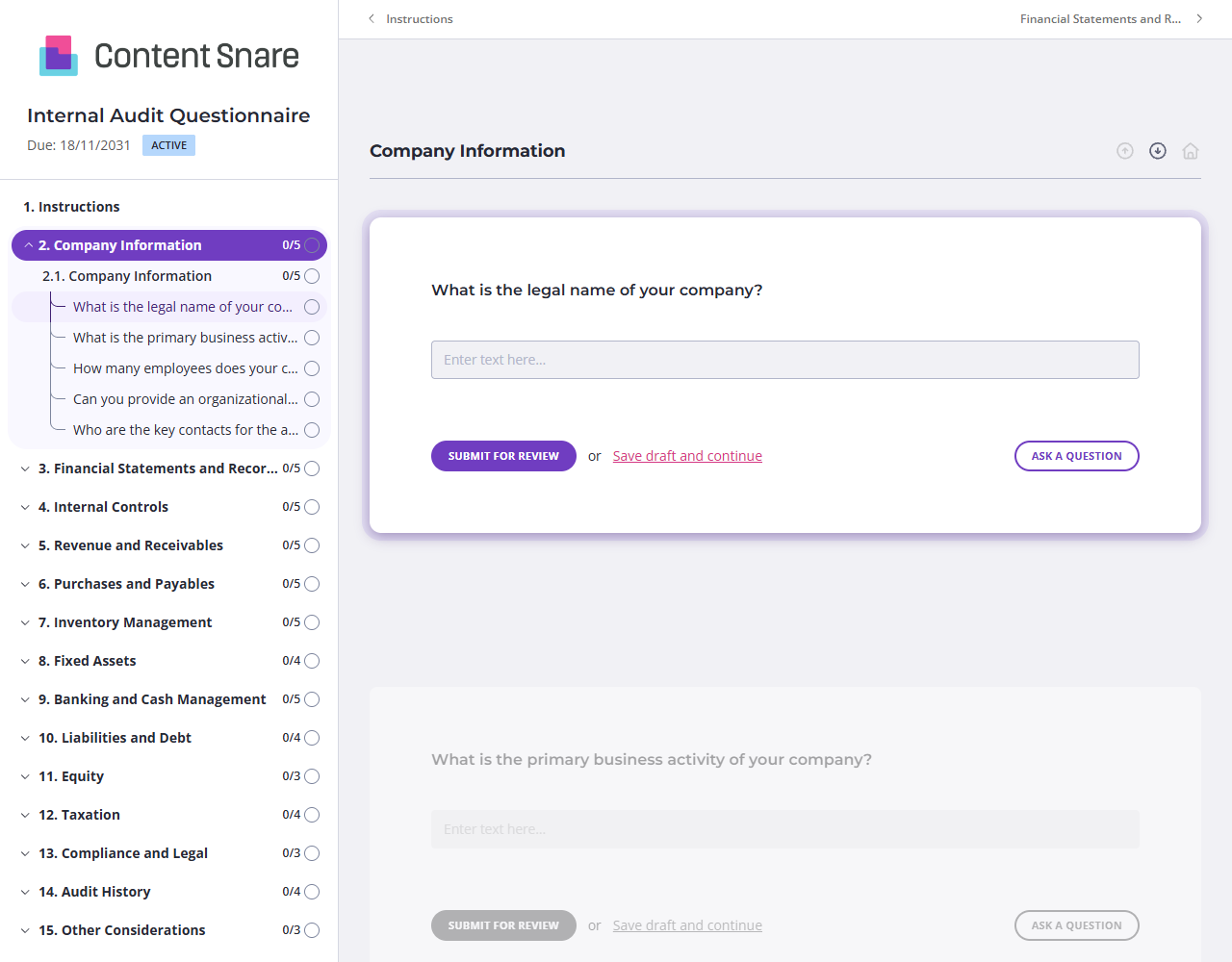
Internal audits cover sprawling territory - from financial controls to inventory procedures to tax compliance. Content Snare lets you organize questions into logical pages like "Financial Statements," "Internal Controls," and "Revenue & Receivables." Clients can tackle one section at a time rather than facing an overwhelming 50-question list. They'll complete more accurately, and you'll get better responses when people aren't rushing through to reach the end.
Questions about separation of duties or revenue recognition methods sound straightforward to you - but clients often stumble on audit terminology. Use instruction areas to clarify exactly what you're asking for. Under "Can you provide the most recent internal control assessments?" add a note explaining acceptable formats or what to do if formal assessments don't exist. A two-sentence explainer prevents the "I'm not sure what you mean" emails that derail timelines.
You likely have basic company information, previous audit reports, or financial statements on file already. Pre-populate those fields before sending, or delete questions entirely if they're not relevant to this engagement. Your client sees a streamlined questionnaire focused on what you actually need, and you avoid redundant data entry. It's faster for everyone and signals you're running an efficient process.
Audit deadlines aren't negotiable, but chasing clients for overdue documentation feels awkward. Content Snare sends automatic follow-ups on your behalf, so clients get gentle nudges without you playing enforcer. You can customize timing and messaging - maybe a friendly reminder at 3 days, a more urgent one at 7. Responses come in faster, and you preserve the collaborative relationship instead of becoming the person sending "just following up" emails.
Email threads lose attachments. Spreadsheets get overwritten. Shared drives become black holes where critical audit documentation disappears. Content Snare centralizes everything in one secure portal, tracks exactly what's outstanding, and eliminates the follow-up chaos that derails audit timelines.
ISO 27001 certified and trusted by accounting firms worldwide, Content Snare treats sensitive financial data with the security your clients expect. It integrates seamlessly with tools you already use, and hundreds of 5-star reviews across G2, Capterra, and the Xero App Store confirm what thousands of accounting professionals already know: this is how you run efficient engagements.
Internal audit questionnaires are just one use case. Accounting firms use Content Snare for:
The platform adapts to however you work with clients. You build the process once, then reuse it across every engagement.


