
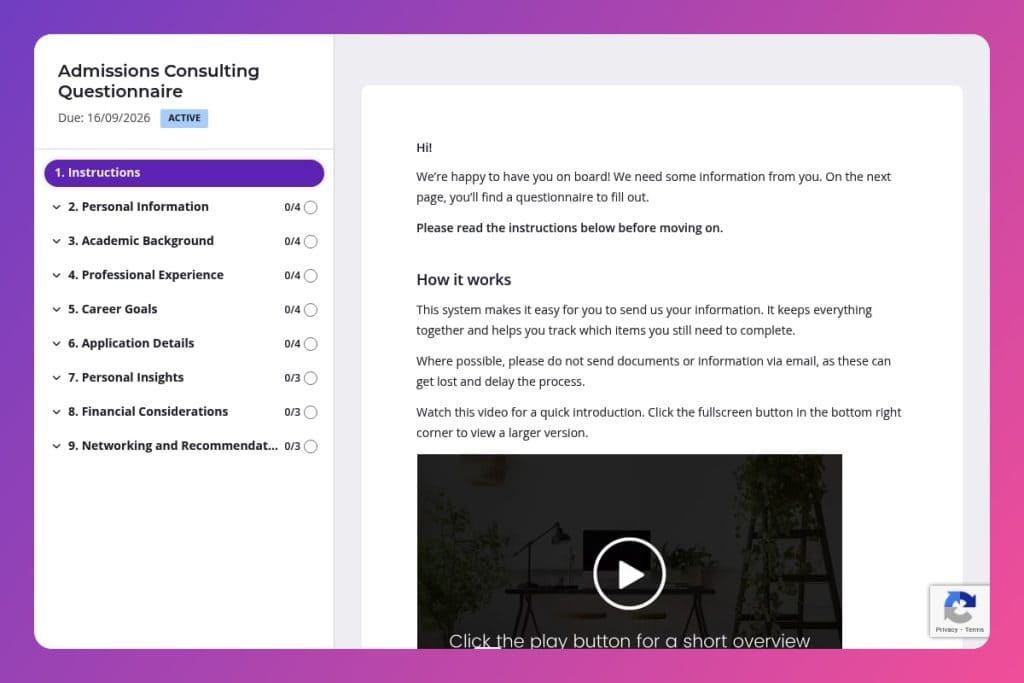


A comprehensive intake form that captures a prospective student's academic credentials, test scores, work history, career goals, target programs, and financial situation before your first consulting session.

Admissions consultants working with clients applying to MBA programs, graduate schools, or other competitive academic programs who need complete background information to provide strategic guidance.

Send this 48 hours before your initial consultation call so you can review the client's profile, assess their application readiness, and prepare targeted advice instead of spending billable time gathering basic information.
You're juggling ambitious clients who want to break into top MBA programs, but every intake call feels like starting from scratch. One applicant hasn't checked their GPA in years, another can't articulate their career goals, and a third forgot to mention they already took the GMAT twice. Sound familiar?
An admissions consulting questionnaire solves this chaos. It captures everything you need upfront - academic history, test scores, career milestones, target schools, and financial considerations - so you can skip the guesswork and start delivering strategic advice immediately. This post covers what to include in your form, how to use it effectively with clients, and gives you a free template to customize. Let's break it down.
Personal Information
Capture baseline identifiers to tie responses to a client record and set initial context.
Academic Background
Establish academic profile and performance signals to assess competitiveness and program fit.
Professional Experience
Map career trajectory and scope of responsibility to calibrate positioning and recommenders.
Career Goals
Define target outcomes to align school selection, story themes, and workback timelines.
Application Details
Pin down the working school list, geography, and application status to drive planning.
Personal Insights
Elicit material for personal narrative, voice, and values that humanize the profile.
Financial Considerations
Clarify funding constraints and opportunities to shape school targeting and timeline.
Networking and Recommendations
Assess recommender pipeline and network assets to plan outreach and value-add touchpoints.
Send the form before your first consultation call: Give clients at least 48 hours to complete it. They'll need time to dig up test scores, calculate their GPA, and think through career goals. You'll walk into that initial conversation with a complete picture instead of spending billable time on basic fact-finding.
Flag the "Personal Insights" section as optional but encouraged: Questions about strengths, weaknesses, and transformative experiences often feel intimidating on a form. Let clients know they can skip these initially or keep answers brief - you'll explore them together during your sessions. This lowers the barrier to completion while still giving you valuable starter material for essay development.
Use their responses to pre-assess application readiness: Before your kickoff meeting, review their standardized test scores, work experience, and target programs. If someone's aiming for Harvard with a 640 GMAT and two years of experience, you can prepare that reality-check conversation in advance rather than scrambling mid-call.
Circle back on incomplete financial sections: Many clients skip questions about scholarships, budgets, and company sponsorships because they seem secondary. They're not. A quick follow-up email asking them to revisit financial considerations can open doors to funding strategies they hadn't considered and prevent sticker shock later in the process.
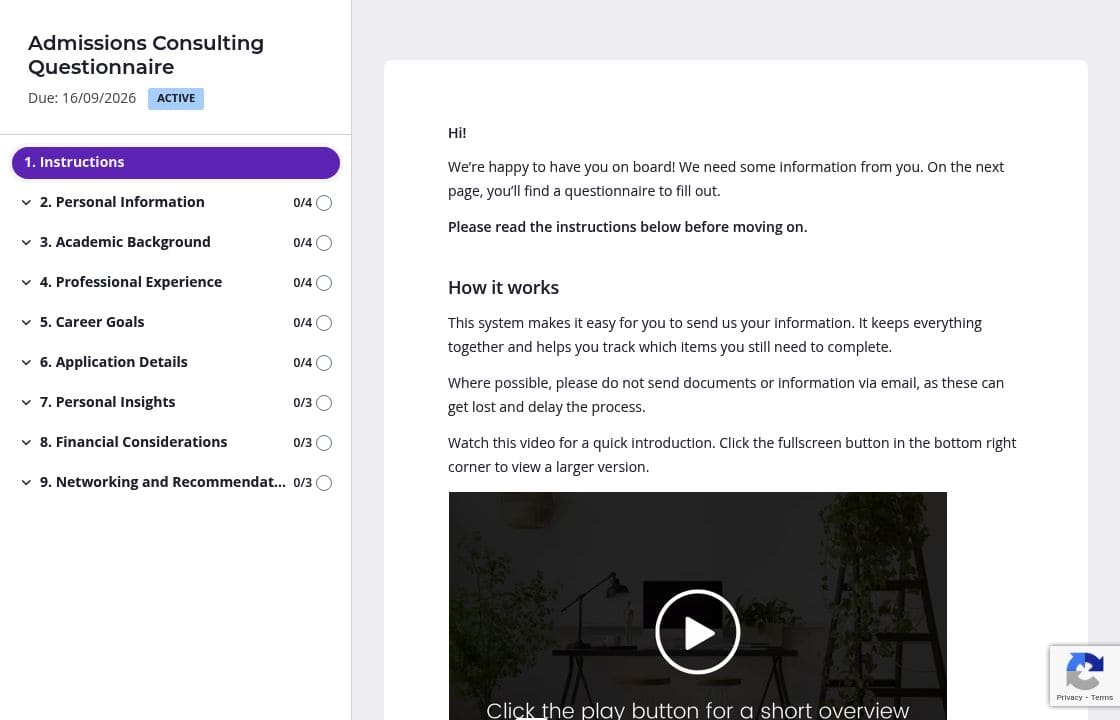
An admissions consulting questionnaire covers a lot of ground - academic history, test scores, career achievements, financial considerations, and personal insights. That's overwhelming in one long scroll. Split it into logical sections: Personal Information, Academic Background, Professional Experience, Career Goals, and so on. That way, respondents can complete one page at a time and come back later. You'll see higher completion rates when the form feels manageable instead of marathon-length.
Some questions need context to get useful answers. Under "standardized test scores," clarify whether you want official scores or practice test results - and mention if they should include multiple attempts. For the "significant projects or achievements" question, add a quick note: "Think specific metrics or outcomes, not just job duties." A few lines of guidance upfront saves you from vague responses and endless back-and-forth later.
You've probably collected basic details during your sales call or initial inquiry - name, email, current company. Delete those questions or pre-populate the answers before sending the form. Clients appreciate not repeating themselves, and you shave minutes off their completion time. It's a small touch that signals you're paying attention and respect their time.
Clients get busy. They start the form, get interrupted hunting down their undergraduate transcripts, and forget to finish. Automatic reminders nudge them without you having to send awkward "just checking in" emails. Schedule a gentle follow-up three days after sending, then another a few days later. You stay off their bad side while keeping your intake process moving.
Email and Word docs create chaos. Clients lose attachments, forget questions, and send incomplete information in random formats. You waste time chasing answers and reformatting their responses. Content Snare eliminates that friction with a purpose-built questionnaire platform that keeps everything organized, automated, and professional.
Your clients get a clean, branded experience that feels like an extension of your consulting practice - not a generic Google Form. Automatic reminders handle follow-ups without you lifting a finger. You collect structured responses in one place, ready to review and act on. It's trusted by thousands of businesses worldwide and holds ISO 27001 certification, so sensitive client data stays protected.
Beyond admissions consulting questionnaires, you can use Content Snare for other intake needs: onboarding new corporate clients, collecting information for executive coaching engagements, gathering data for market research projects, or requesting documentation for compliance audits. Any situation where you need detailed information from clients becomes faster and more professional.


