
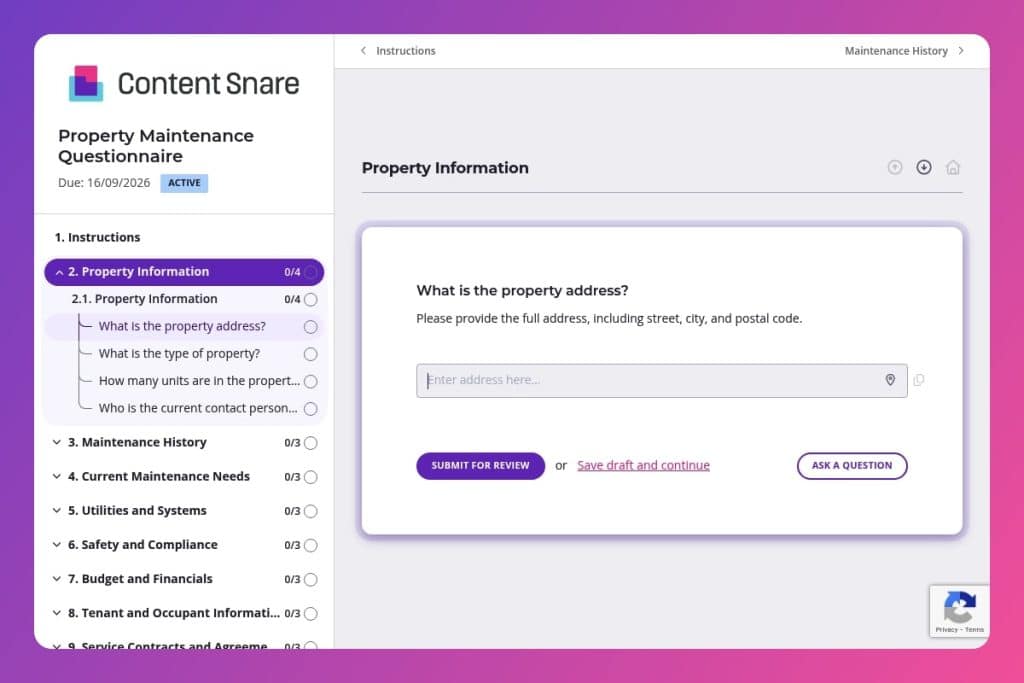


A comprehensive questionnaire that documents property details, maintenance history, service contracts, compliance records, budgets, and planned projects for each managed site.

Property managers and real estate companies overseeing multiple residential or commercial properties who need to centralize maintenance records and prevent costly gaps in service schedules.

Before annual planning cycles (typically Q4), when onboarding new properties, or when conducting periodic reviews to update service contracts, compliance deadlines, and maintenance budgets.
A tenant complaint about a broken HVAC system reveals there's no record of the last inspection. Your landscaping contract expired three months ago. Nobody knows if the fire alarms were tested this year. Sound familiar? Property managers juggling multiple sites face these gaps daily - costing time, money, and tenant satisfaction.
A property maintenance questionnaire solves this chaos. It captures everything from system details and service contracts to compliance dates and recurring issues in one organized place. This post covers what the form includes, how to use it effectively with tenants and vendors, and a free template you can customize. Let's dive in.
Property Information
Capture essential identifiers and contacts to anchor records and route communications.
Maintenance History
Document recent work and patterns to anticipate issues and avoid rework.
Current Maintenance Needs
Surface immediate risks and planned work to drive prioritization and scheduling.
Utilities and Systems
Map critical systems and service providers to set maintenance protocols and response paths.
Safety and Compliance
Confirm inspection cadence and life-safety status to reduce regulatory and liability exposure.
Budget and Financials
Align scope with available funding and upcoming cost pressures.
Tenant and Occupant Information
Clarify responsibilities and reporting routes to manage expectations and SLAs.
Service Contracts and Agreements
Inventory active agreements to prevent overlap, missed renewals, and scope gaps.
Environmental Considerations
Identify constraints and sustainability commitments that affect methods and materials.
Feedback and Suggestions
Capture client insights to refine process and target improvements.
Send it before annual planning cycles: Distribute the property maintenance questionnaire in Q4 so you have complete data on budgets, expiring contracts, and planned projects before the new year. You'll avoid scrambling for information when tenants ask about next year's assessments or when service agreements need renewal.
Pre-fill what you already know: Don't make clients answer questions you can answer yourself. Enter the property address, unit count, and existing contractor names before sending. This shows you're organized and cuts their completion time in half - they'll focus on what you actually need from them, like recurring issues or compliance concerns.
Create a maintenance calendar immediately after submission: Use the responses to build a master schedule. Plot safety inspections, contract expiration dates, and planned projects on one timeline. This turns scattered information into a proactive maintenance plan you can share with owners and use to prevent the "we didn't know it was due" emergencies.
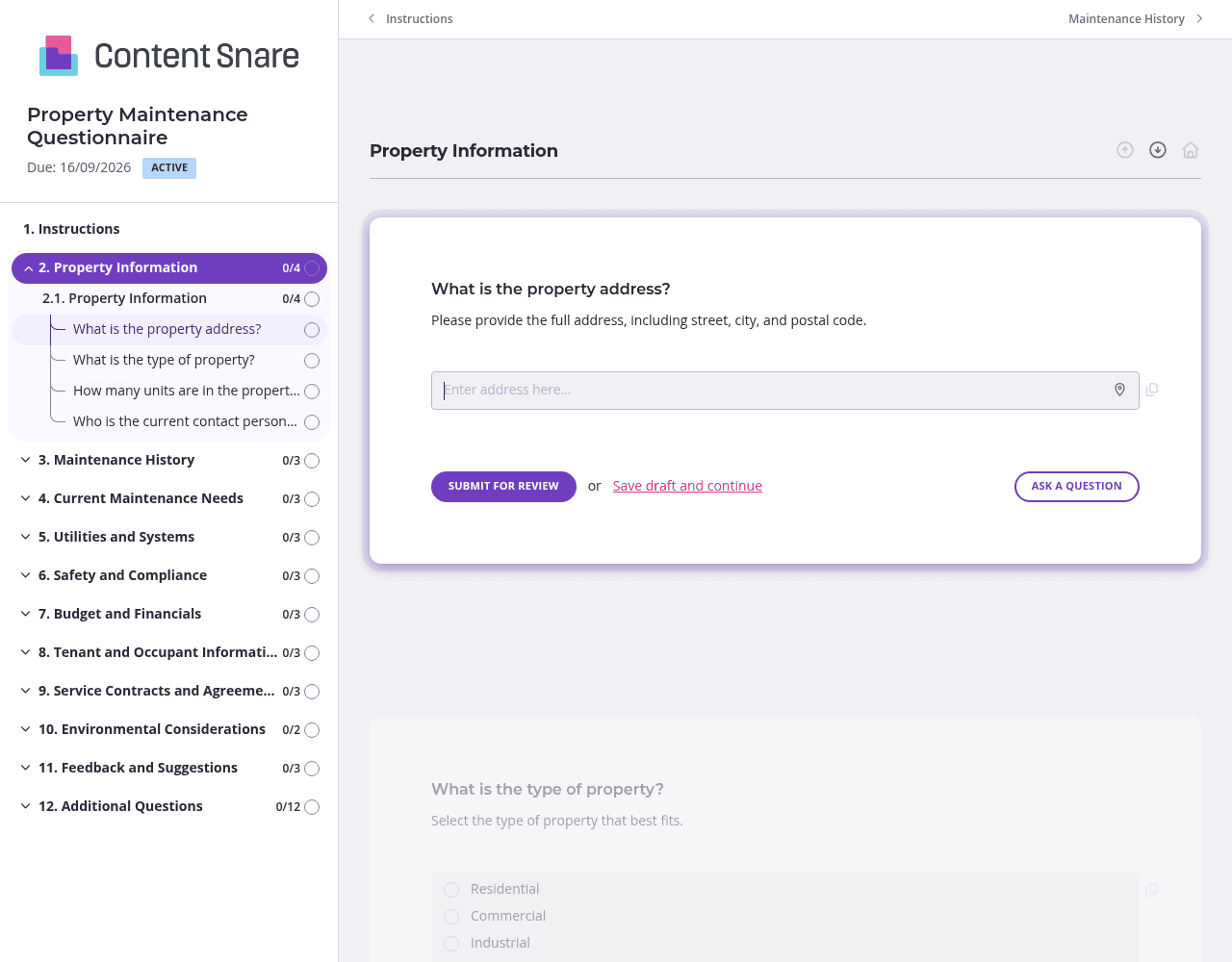
Property maintenance covers a lot of ground. Dumping 40+ questions on one screen overwhelms clients and leads to incomplete answers.
Split your questionnaire into logical pages: Property Information, Current Maintenance Needs, Safety & Compliance, Service Contracts, and Budget. Clients can tackle one area at a time, save their progress, and return later. This structure also mirrors how they'll need to gather information - pulling financial data from accounting, contractor lists from operations, and compliance records from facilities.
"What type of heating and cooling systems are in place?" seems straightforward until you get responses like "good" or "works fine."
Use instruction fields to specify what you actually need. For HVAC questions, add: "Include the system type (central air, heat pump, etc.), age, and last service date." For maintenance history, clarify: "List company name, service performed, and approximate date - last 2 years only." Clear instructions mean usable data the first time, not vague answers that require follow-up emails.
Not every property needs every question answered. A single-family home doesn't have common areas. A commercial building won't have tenant maintenance responsibilities like a residential complex.
Set up conditional logic based on property type. When someone selects "Multi-family residential," show questions about tenant reporting processes and common area maintenance. For commercial properties, reveal questions about waste management providers and compliance requirements. Clients see a streamlined form that respects their time and applies to their specific situation.
Email chains lose attachments. Spreadsheets get outdated the moment someone saves a new version. Word documents come back half-finished with no way to track what's missing. Content Snare centralizes everything in one secure place, with automatic reminders that keep projects moving without you playing the bad guy.
Thousands of businesses worldwide trust Content Snare to collect critical information professionally. It's ISO 27001 certified, which matters when you're handling property financials, tenant data, and compliance records. The platform integrates with your existing tools and has earned hundreds of 5-star reviews across G2, Capterra, and Trustpilot for actually making information collection painless.
Property maintenance questionnaires are just the start. Real estate professionals use Content Snare for:
Each form is fully customizable to your process, so you collect exactly what you need the first time.


