
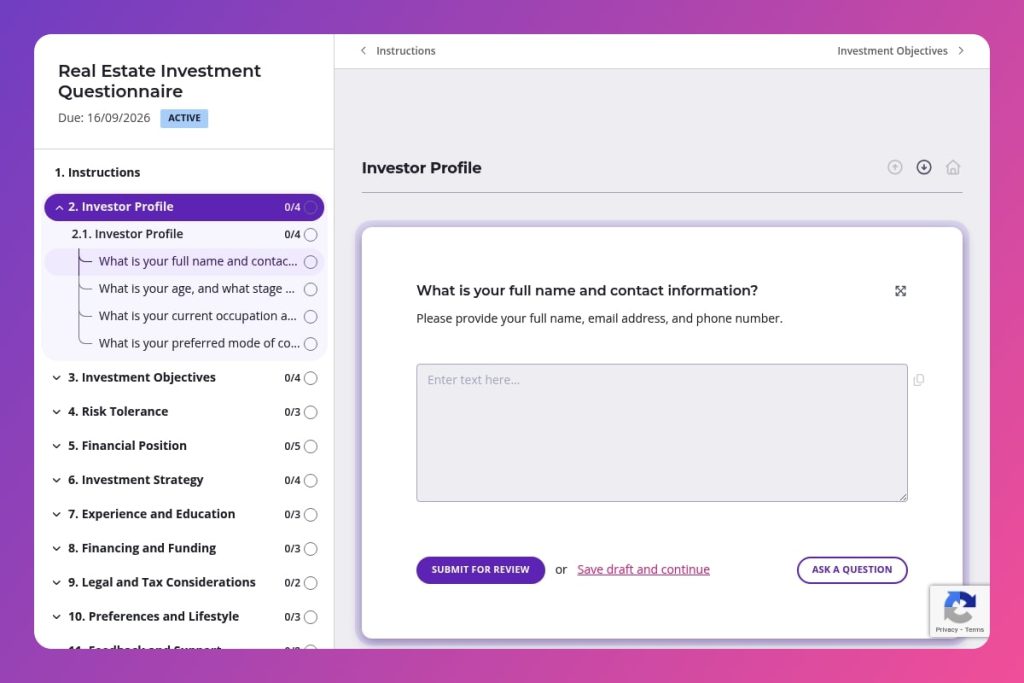


A structured questionnaire that captures a client's financial position, risk tolerance, investment goals, property preferences, tax situation, and funding capacity to determine their readiness for real estate investing.

Financial planners and advisors who need to assess whether clients are suitable for direct property ownership, REITs, or real estate partnerships before recommending specific investment strategies.

Send this before initial consultations or when existing clients express interest in adding real estate to their portfolio, so you can arrive at meetings with a complete picture and move directly into strategic planning.
Your clients want real estate exposure, but are they actually ready for it? Without a structured assessment, you're piecing together their risk tolerance, liquidity, and investment goals across multiple meetings - wasting time and missing critical details that could derail their strategy later.
A real estate investment questionnaire solves this. It captures everything upfront: financial position, experience level, property preferences, tax considerations, and funding plans. You'll quickly identify whether a client suits direct ownership, REITs, or partnerships - and spot red flags before they commit capital. This post covers what the form includes, how to use it effectively with clients, and a free template to get started. Let's dive in.
Investor Profile
Capture identifiers and communication preferences to anchor records and set expectations for outreach. Age and financial stage add context for suitability screens.
Investment Objectives
Pin down goals, time horizon, and focus areas to align deal flow and underwriting assumptions. Target ROI calibrates risk, leverage, and hold strategy.
Risk Tolerance
Establish risk posture and behavioral history to set guardrails on product fit. Diversification appetite informs portfolio construction.
Financial Position
Confirm capacity and constraints for acquisition and hold costs. Credit, debt, and liquidity drive financing options and timing.
Investment Strategy
Document preferred vehicles, asset classes, and structures to filter opportunities. Risk-area openness signals value-add vs core profile.
Experience and Education
Gauge sophistication and support needs during diligence and asset management. Prior advisor relationships indicate collaboration channels.
Financing and Funding
Map capital stack and readiness to transact. Opex funding plans reduce post-close friction.
Legal and Tax Considerations
Surface compliance posture and advisory coverage. Tax awareness shapes structure selection and exit planning.
Preferences and Lifestyle
Capture qualitative constraints that influence sourcing and leasing outcomes. Renovation tolerance and management involvement define the operator model.
Feedback and Support
Identify enablement needs for ongoing engagement and education. Resource gaps suggest content or tooling to provide.
Send it before the first meeting: Get clients to complete the real estate investment questionnaire ahead of your initial consultation. You'll arrive prepared with a complete picture of their financial position, risk tolerance, and property preferences - turning what would've been a fact-finding session into a strategic planning conversation.
Use the risk tolerance and experience sections together: Don't evaluate risk appetite in isolation. Cross-reference how clients describe their risk tolerance with their actual real estate experience and past investment reactions. A client who says they're "risk-seeking" but has never invested in property needs a very different approach than someone with multiple holdings.
Flag financing gaps early: Pay close attention to the liquidity, debt obligations, and financing questions. If someone has limited cash available but hasn't explored mortgage pre-approval or doesn't have a plan for ongoing property costs, address this immediately. Real estate requires more capital reserves than many clients anticipate.
Clarify the management involvement question: When clients answer how involved they want to be in property management, follow up during your meeting. Many underestimate the time commitment of direct ownership or overestimate their ability to stay hands-off. This insight shapes whether you recommend turnkey properties, property managers, or REITs instead.
Create a summary sheet from their responses: After submission, pull key details - goals, timeline, budget, property preferences, and tax considerations - into a one-page reference document. Share it with the client at your next meeting to confirm accuracy. It keeps everyone aligned and becomes a touchstone as you build their investment strategy.
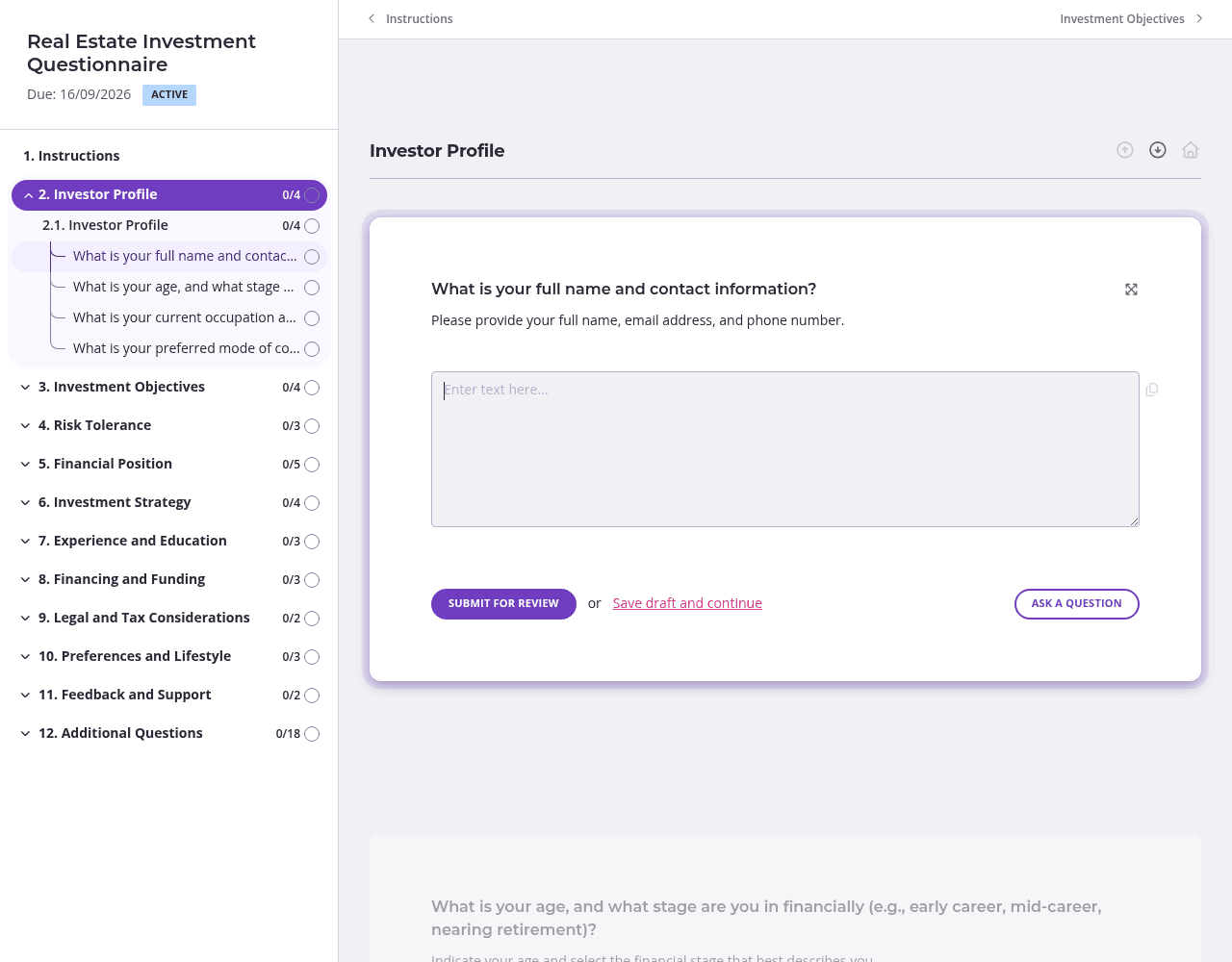
Real estate investment questionnaires cover a lot of ground - from financial position to property preferences to tax considerations. Split your form into logical pages: one for investor profile and objectives, another for financial details and risk tolerance, a third for investment strategy and preferences. Clients can complete one section at a time without feeling overwhelmed, and you'll get more thoughtful responses instead of rushed answers.
Not every question applies to every client. Someone interested in REITs doesn't need detailed questions about property management involvement or renovation preferences. Use conditional logic to display questions based on previous answers. If a client selects "indirect investment via REITs" in the investment strategy section, skip the property-specific questions entirely. You'll respect their time and keep the form focused on what actually matters for their situation.
You likely have basic client information on file - name, contact details, occupation, current portfolio value. Pre-fill these fields before sending the questionnaire. Your clients won't waste time re-entering information you already have, and they'll appreciate that you've done the homework. It also lets them focus on the questions that actually require thought: their investment goals, risk tolerance, and property preferences.
Real estate decisions involve significant capital, so clients often need time to gather information about their credit score, existing debts, or liquidity. Automatic reminders ensure they don't forget to complete the questionnaire without you having to chase them down. Schedule gentle follow-ups at intervals that make sense - maybe after three days, then a week later - and your form gets completed without awkward phone calls.
Email threads and static PDFs don't cut it when you're gathering sensitive financial data from clients. You need responses organized, secure, and complete - without constant follow-ups. Content Snare handles all of this automatically while maintaining the professionalism your clients expect.
Content Snare is ISO 27001 certified and trusted by financial professionals who can't afford security gaps. Your clients' income details, credit scores, and portfolio values stay protected. The platform integrates with the tools you already use, so information flows directly into your existing workflow without manual data entry.
Clients get a clean, branded experience that feels like an extension of your practice - not a generic form. Automatic reminders keep things moving without awkward check-ins. You'll save hours per client while actually improving response quality.
Hundreds of 5-star reviews across G2, Capterra, and Trustpilot confirm what thousands of businesses already know: Content Snare makes client information gathering painless.
This real estate investment questionnaire is just one application. Financial planners also use Content Snare for retirement planning intake forms, annual client review questionnaires, estate planning documentation requests, new client onboarding packets, and tax preparation data collection - anywhere you need complete, accurate information from clients without the back-and-forth.


