
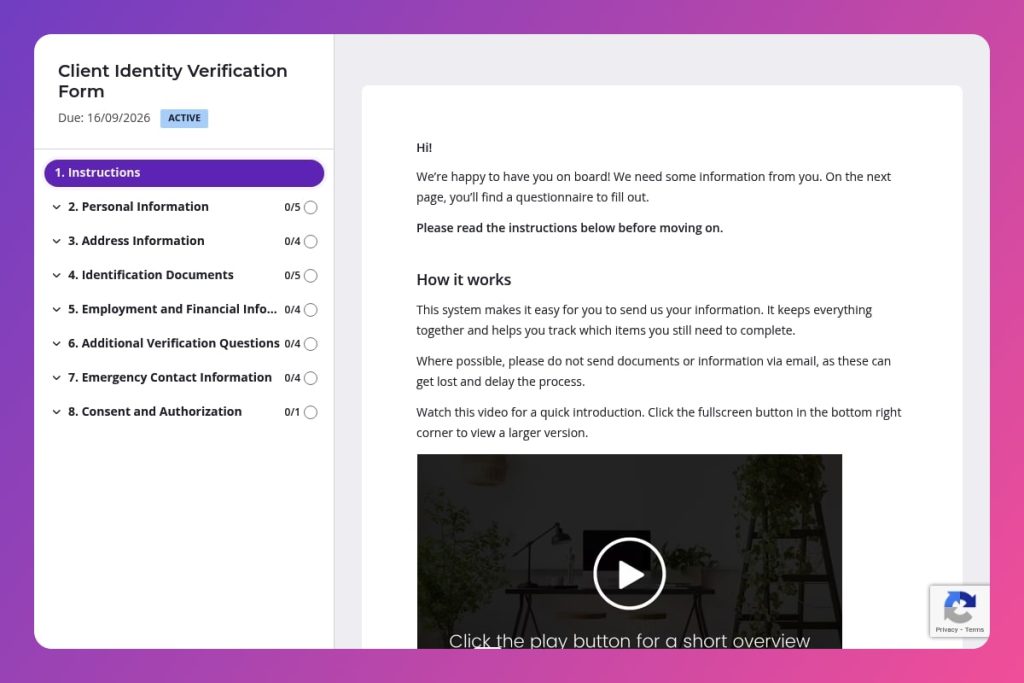


A digital intake form that collects personal details, government-issued identification, employment information, and legal authorization to satisfy AML compliance and client due diligence requirements.

Law firms, attorneys, and lawyers who need to verify new client identities before representation while maintaining compliance with regulatory standards.

Send this form before the initial client meeting so prospects arrive with verified credentials ready, allowing you to begin representation without intake delays.
A new client walks into your office, ready to retain your services. Before you can represent them, you need to verify their identity - but scattered documents, missing information, and follow-up emails slow everything down. Client intake shouldn't be this complicated.
Law firms face strict compliance requirements under anti-money laundering (AML) regulations and client due diligence rules. A client identity verification form streamlines the entire process. Collect personal details, review government IDs, confirm employment information, and secure proper authorization - all in one organized workflow. This post covers what the form includes, how to use it effectively, and a free template you can customize. Let's break it down.
Personal Information
Gather core identifiers used for record matching and initial screening.
Address Information
Capture current and prior address history for verification, geolocation checks, and risk signals.
Identification Documents
Collect government ID data and metadata to support documentary verification and automated validation.
Employment and Financial Information
Confirm professional status and employer details to corroborate identity and licensing where applicable.
Additional Verification Questions
Surface factors that influence due diligence scope, sanctions/PEP screening, and jurisdictional controls.
Emergency Contact Information
Keep a secondary contact for urgent communications or escalations during onboarding.
Consent and Authorization
Secure explicit permissions required to run verifications, contact third parties, and store sensitive data.
Send the form before the first meeting: Give clients time to gather documents like government-issued IDs, social security numbers, and employment details. They'll arrive prepared, and you'll avoid delays chasing down missing information during intake.
Explain why you're asking for sensitive information: Clients may hesitate to provide social security numbers or details about prior legal proceedings. A brief note at the top of your form - explaining AML compliance and client due diligence requirements - builds trust and increases completion rates.
Use the previous address field to catch red flags early: Clients who've moved frequently or recently may require additional verification. This simple data point helps you identify potential compliance issues before you're deep into representation.
Request both mailing and residential addresses upfront: You'd be surprised how often these differ. Collecting both now prevents service delivery problems and ensures correspondence reaches your client - especially important for court documents and time-sensitive communications.
Review uploaded ID documents immediately after submission: Don't wait until you need them. Check that photos are clear, documents aren't expired, and names match exactly across all fields. Catching discrepancies early means you can request corrections while details are fresh in your client's mind.
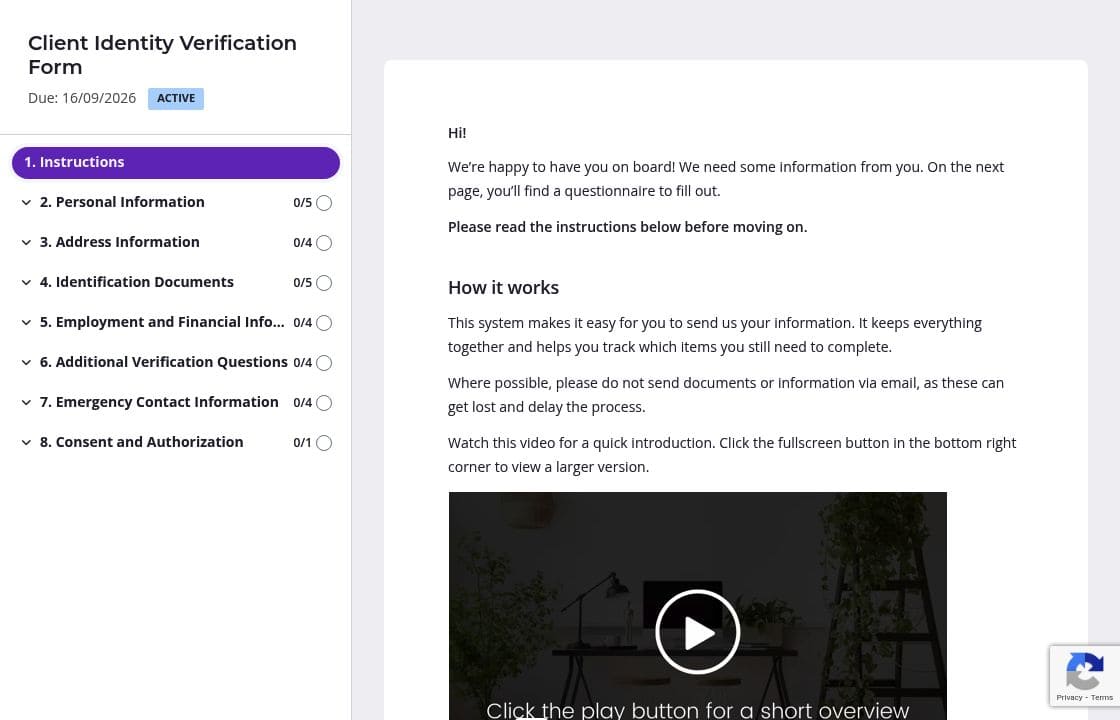
Identity verification covers a lot of ground - personal details, financial information, legal history, and consent forms. Organize your form into clear sections like "Personal Information," "Identification Documents," and "Employment Details." Clients feel less overwhelmed when they can tackle one category at a time, and you'll see higher completion rates on sensitive fields like social security numbers and prior legal proceedings.
Government-issued IDs are critical for compliance, but clients often submit blurry photos or expired documents. Add brief instructions above the upload field: "Please ensure your ID is current, all text is legible, and the photo shows all four corners of the document." A simple note saves you from the back-and-forth of requesting resubmissions.
You likely collected basic details - name, email, phone number - during the initial consultation. Prefill these fields before sending the form. Clients appreciate not repeating themselves, and you reduce the risk of mismatched information across your systems. Delete any questions that don't apply to a specific client before hitting send.
Clients get busy and forget to complete verification forms, but compliance deadlines don't wait. Automatic reminders handle the follow-up for you - no awkward emails or manual tracking required. You stay on schedule without becoming the person who nags clients three times a week.
Email attachments get lost. Spreadsheets create version control nightmares. Phone calls to chase missing documents waste billable hours. Content Snare centralizes everything in one secure location, with automatic reminders that do the follow-up for you. Clients complete forms faster, you maintain compliance effortlessly, and nothing falls through the cracks.
Law firms handling sensitive client data need bulletproof security. Content Snare is ISO 27001 certified and trusted by thousands of businesses worldwide to protect confidential information. You get enterprise-level security without the enterprise-level complexity.
The platform has earned hundreds of 5-star reviews across G2, Capterra, and Trustpilot for good reason - it actually works the way lawyers need it to work.
Client identity verification is just one use case. Law firms use Content Snare to collect discovery materials from clients, gather information for estate planning documents, onboard corporate clients with multi-step questionnaires, request financial records for divorce proceedings, and collect witness statements. Any time you need information from clients, Content Snare handles it better than email or paper forms.


