
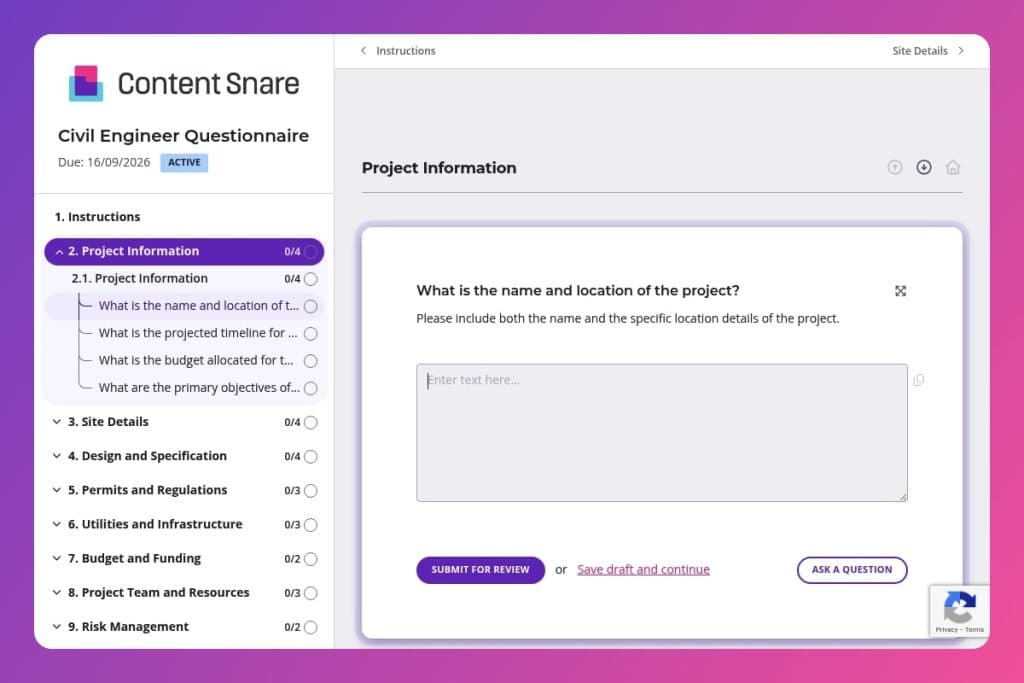


A pre-project intake form that collects site conditions, design specifications, permit status, budget details, and risk factors from clients before construction begins.

Construction firms, general contractors, and project managers who work with civil engineers and need complete project information before developing scopes, estimates, or breaking ground.

Send it when first engaging a client or engineering partner - before the kickoff meeting - so you can turn discovery calls into strategic planning sessions with answers already documented.
How many hours do you lose each week chasing down project details, clarifying site conditions, or discovering permit issues halfway through a build? For construction firms working with civil engineers, missing information costs time, money, and credibility.
A civil engineer questionnaire solves this problem upfront. It captures everything you need - site details, design specs, permit status, budget constraints, and risk factors - before work begins. This post covers what makes an effective questionnaire, how to use it with clients and engineering partners, and includes a free template you can customize. Let's dive in.
Project Information
Capture baseline scope, timing, budget, and objectives to anchor feasibility and delivery strategy.
Site Details
Confirm site scale, existing conditions, zoning, and environmental constraints that drive feasibility, permitting, and design.
Design and Specification
Align on standards, materials, sustainability targets, and design responsibility so engineering assumptions match the client’s expectations.
Permits and Regulations
Validate permit status and governing codes to set compliance boundaries and sequence approvals.
Utilities and Infrastructure
Establish utility loads, existing services, and required upgrades to coordinate with providers and avoid late redesign.
Budget and Funding
Confirm funding source and constraints to align design options, procurement, and value engineering.
Project Team and Resources
Map decision-makers, available resources, and preferred vendors to streamline coordination and procurement.
Risk Management
Surface known risks and preferred mitigation to build a realistic plan and contingency model.
Communication and Reporting
Set communication channels and cadence to keep decisions moving and record-keeping clean.
Additional Information
Capture out-of-scope asks and edge cases to avoid surprises.
Send it before the kickoff meeting: Share the civil engineer questionnaire when you first engage a potential client or engineering partner. You'll walk into your first conversation with answers about site conditions, zoning requirements, and budget constraints already documented - turning a discovery call into a strategic planning session.
Flag the risk management section early: Most clients gloss over questions about known site challenges or potential risks, but these answers are gold. Follow up directly on any vague responses in this area. A simple "you mentioned drainage concerns - can you share previous studies or reports?" can prevent costly surprises during excavation or foundation work.
Use responses to build your scope and estimate: Don't let completed forms sit in your inbox. Map answers from the Design and Specification section and Utilities and Infrastructure questions directly into your proposal. When clients see their specific requirements - preferred materials, sustainability goals, utility connections - reflected back in your scope, it builds confidence that you actually listened.
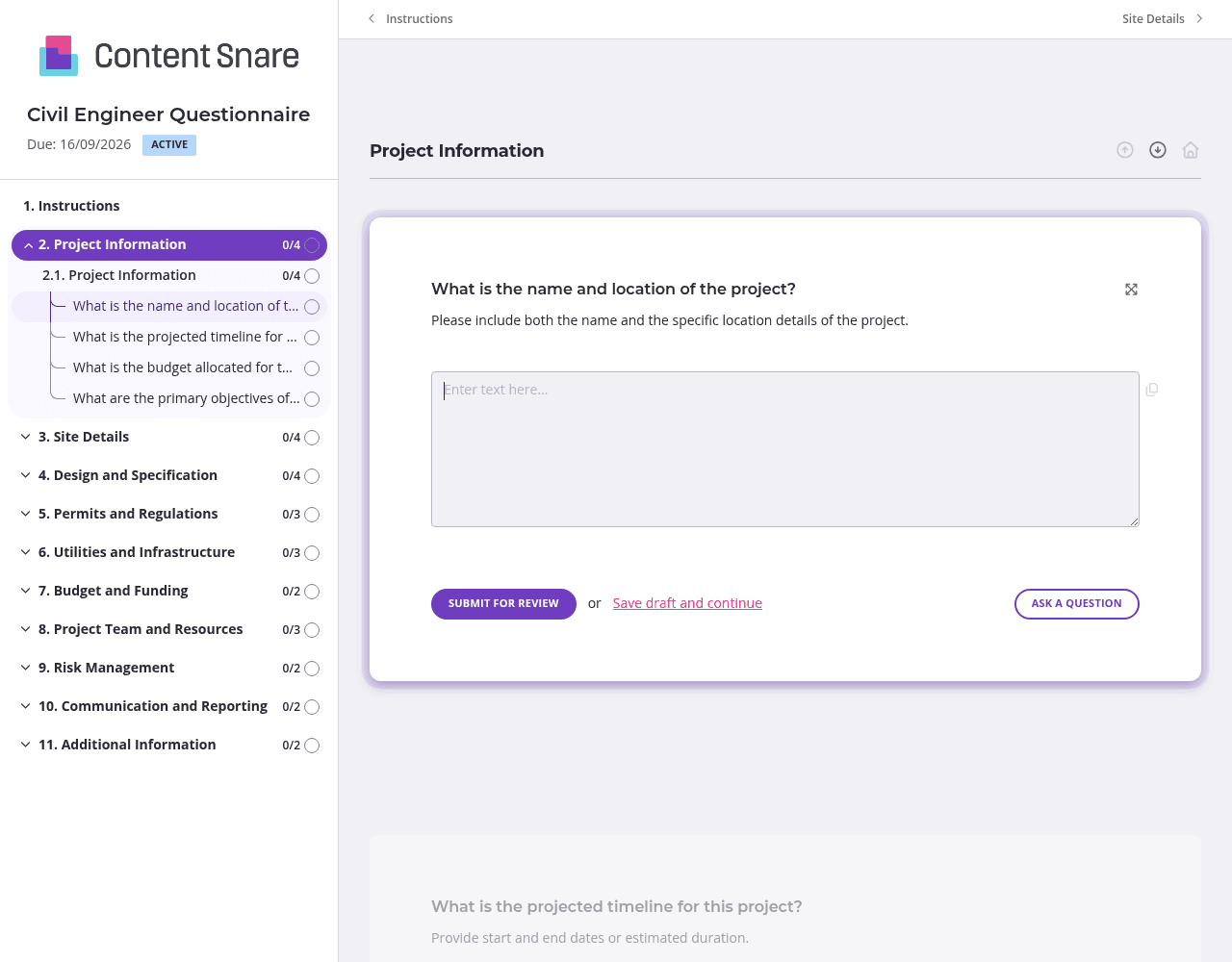
Civil engineer questionnaires cover a lot of ground - from site details to permits to risk management. Clients get overwhelmed when they see 30+ questions at once. Content Snare lets you split the form into logical pages: Project Information, Site Details, Design Requirements, and so on. Clients complete one section at a time, save their progress, and come back later. You get better, more thoughtful answers instead of rushed responses.
Questions about zoning requirements, environmental restrictions, or utility connections often stump clients. They're not sure what you need or where to find the information. Drop instruction text directly above these questions. Explain what "special zoning requirements" means in plain language, or tell them to check with their municipal planning office. A quick clarification saves three back-and-forth emails.
Not every project needs the same questions. A site with existing structures requires different information than a greenfield development. Set up conditional logic so follow-up questions only appear based on previous answers. When someone indicates existing structures on-site, you can automatically ask about demolition plans or structural assessments. Clients see only what applies to them, and you still capture every detail you need.
Clients forget. It's not personal - they're juggling contractors, budgets, and deadlines. Content Snare sends automatic reminders when sections sit incomplete, so you don't have to chase anyone down. Set the frequency, customize the message, and let the system handle it. You stay top of mind without being the person sending "just checking in" emails every few days.
Email threads get messy. Word documents bounce back and forth with conflicting versions. Spreadsheets arrive half-completed with cells left blank. Content Snare gives you a single, organized system to collect project information from clients and engineering partners - no chasing, no confusion, no lost details. It's trusted by thousands of businesses worldwide and has hundreds of 5-star reviews across G2, Capterra, and Trustpilot.
You get automatic reminders so clients actually finish what they start, while customizable templates let you reuse the same questionnaire across projects while tweaking questions as needed.
Content Snare is also ISO 27001 certified, which matters when you're handling sensitive project budgets, site plans, and stakeholder information. Clients trust the process because it looks professional and feels secure.
This civil engineer questionnaire is just one application. Construction firms use Content Snare for subcontractor onboarding forms, site safety compliance checklists, pre-construction client intake, architect and consultant briefing documents, and project closeout documentation. Any time you need information from someone else, Content Snare makes it faster and more reliable.


