
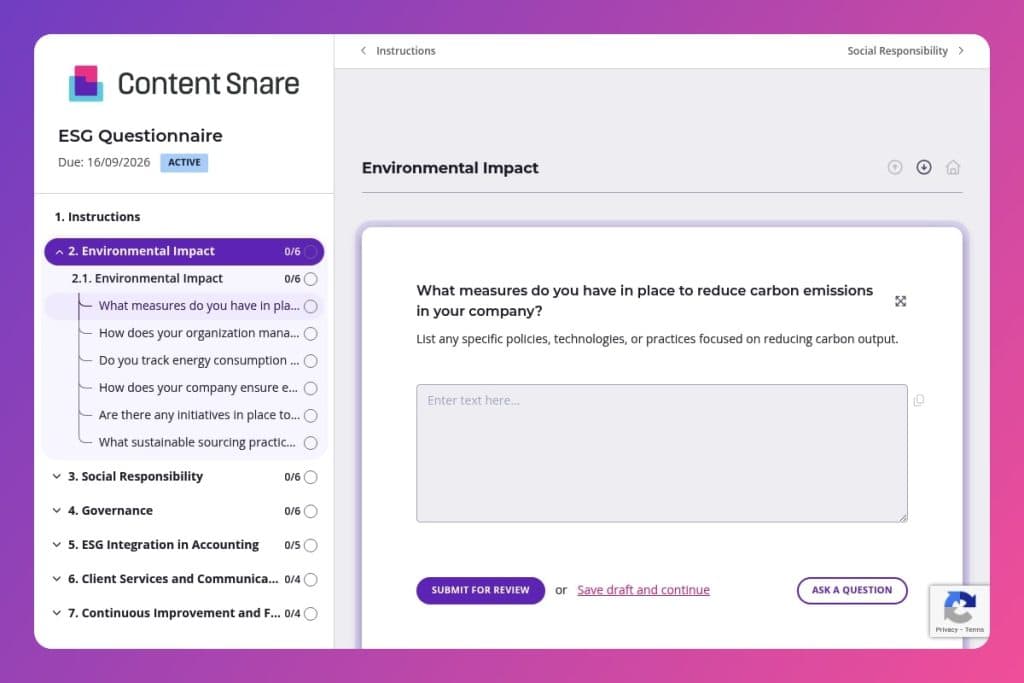


A structured questionnaire that collects environmental, social, and governance data from clients covering emissions, waste management, labor practices, board structure, compliance policies, and ESG reporting frameworks.

Accounting firms and practitioners who need to gather standardized ESG information from clients for audits, compliance reporting, risk assessments, and advisory services.

During client onboarding, annual audit preparation, regulatory compliance reviews, or when clients need assistance meeting ESG disclosure requirements and reporting standards.
Your clients are demanding ESG data. Regulators are tightening disclosure requirements. And your firm needs clear, consistent answers - fast. Without a structured approach, you're left chasing down information, second-guessing data quality, and risking compliance gaps.
An ESG questionnaire solves this. It standardizes how you collect environmental, social, and governance data from clients and across your own operations. Less back-and-forth. More reliable reporting. Better risk assessments. This post covers what an ESG questionnaire includes, how to use it effectively in your accounting practice, and where to grab a free template. Let's dive in.
Environmental Impact
Use this section to assess environmental management maturity and quantify operational impacts across carbon, energy, water, waste, biodiversity, and sourcing.
Social Responsibility
Use this group to capture social performance across labor rights, DEI, community engagement, health and safety, supply chain human rights, and people development.
Governance
Establish oversight quality, integrity controls, compliance discipline, disclosure practices, conflict management, and ESG’s role in strategy.
ESG Integration in Accounting
Clarify how ESG factors enter accounting and reporting workflows, how data is controlled and assured, which standards guide disclosures, and how financial impacts are measured.
Client Services and Communication
Use this group to understand the respondent’s ESG advisory model, client challenges, risk methodologies, and service alignment with market demand.
Continuous Improvement and Future Goals
Surface target setting, progress management, stakeholder input, and external communications to evaluate trajectory and credibility.
Pre-fill what you already know: Before sending the ESG questionnaire to clients, review their existing documentation - prior audits, sustainability reports, or public disclosures. Pre-populate answers where possible. This saves them time, shows you've done your homework, and increases completion rates.
Guide clients on data sources upfront: ESG questions often require input from multiple departments - HR for DEI initiatives, operations for carbon emissions, legal for governance policies. Include a brief note when you send the form identifying which teams should weigh in on which sections. It prevents bottlenecks and incomplete responses.
Use responses to inform your audit scope: Once you receive completed questionnaires, map the answers to potential risk areas. A client with limited board independence or weak anti-corruption policies? Flag those governance sections for deeper review. Spotty energy tracking? Dig into their environmental data accuracy during fieldwork.
Schedule a debrief call for complex answers: Don't just collect and file. For nuanced sections like ESG integration in financial reporting or supply chain human rights protections, hop on a call to clarify responses. You'll catch inconsistencies early and demonstrate advisory value beyond compliance.
Track year-over-year changes: Save each client's submission and compare their ESG progress annually. Did they launch new DEI programs? Adopt SASB standards? Highlighting improvements strengthens your relationship and positions you as a strategic partner, not just a box-checker.
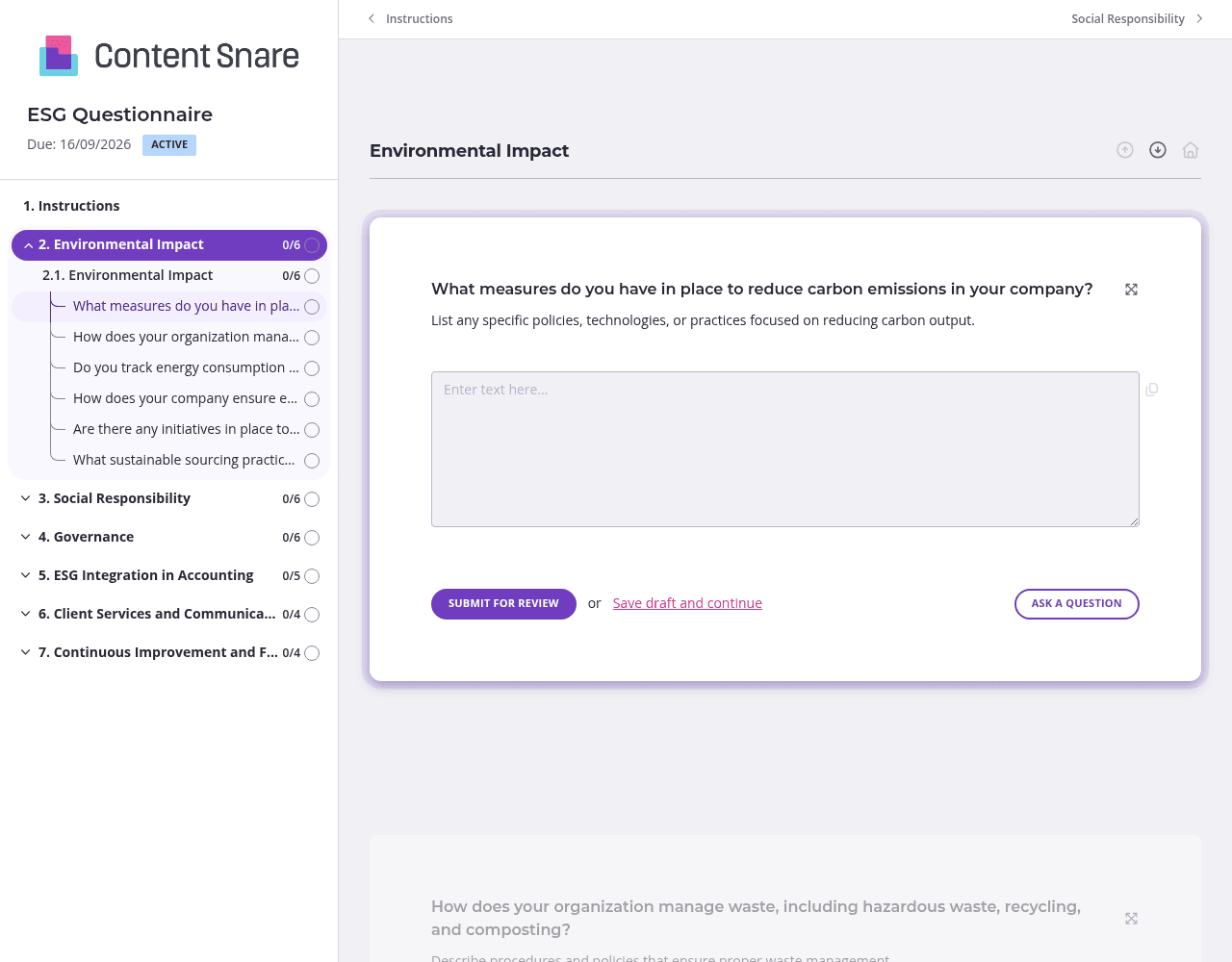
ESG questionnaires cover a lot of ground - environmental impact, social responsibility, governance, reporting standards. Dump 50 questions on a client at once and you'll get overwhelmed silence. Content Snare lets you organize questions into clear pages and sections. Group all carbon emissions and waste management questions together. Put DEI and labor practices in their own section. Clients can tackle one topic at a time, and you'll get more complete, thoughtful responses.
Questions about ESG frameworks (GRI vs. SASB) or supply chain human rights assessments can confuse clients who aren't ESG experts. Use instruction areas to clarify what you're asking for and why it matters. Drop in a quick explainer video about board independence requirements. Add a screenshot showing what good ESG data documentation looks like. The clearer you are upfront, the less back-and-forth you'll face later.
ESG data collection involves multiple stakeholders - finance pulls energy consumption data, HR gathers DEI metrics, operations tracks waste management. Someone will inevitably forget. Content Snare sends automatic reminders so you don't have to chase people down or feel like you're nagging. Set it once and let the system handle follow-ups while you focus on actual advisory work.
Not every client needs every question. A small manufacturing client won't have the same governance structure as a multinational corporation. Use conditional logic to show board composition questions only when relevant, or skip renewable energy sourcing for clients who've already indicated they don't track consumption. You'll reduce friction and get faster completions by keeping the questionnaire lean and targeted.
Email threads get messy. Spreadsheets bounce back and forth with unclear version control. Word documents sit unopened in client inboxes. Content Snare centralizes ESG data collection in one secure platform, tracks exactly what's been completed, and automatically follows up so nothing falls through the cracks.
Content Snare is ISO 27001 certified and trusted by accounting firms worldwide who need to handle sensitive client data with confidence. Your clients get a professional, branded experience. You get clean, organized responses without the chaos.
ESG questionnaires are just one use case. Accounting professionals use Content Snare to streamline tax preparation document collection, gather information for financial statement audits, collect monthly bookkeeping documents, onboard new clients with engagement letters and KYC forms, and manage year-end close checklists.
The platform integrates with tools you already use - your practice management software, cloud storage, and workflows. Customize forms to match your firm's exact processes. With hundreds of 5-star reviews across G2, Capterra, and Trustpilot, it's built specifically for professionals tired of chasing clients for information.


