


A comprehensive intake questionnaire that captures client aspirations and priorities across eight life areas - personal values, career, health, finances, relationships, travel, community contribution, and personal growth.

Life coaches, business coaches, and consultants who need clients to arrive at sessions with clarity about their goals, challenges, and priorities rather than spending billable time on basic discovery.

Send immediately after a client books their first session so they complete it before you meet, then revisit quarterly to track progress and maintain accountability throughout the coaching relationship.
Your clients want transformation, but most show up to their first session without clarity on what they actually want to achieve. They know they need change - better health, financial freedom, stronger relationships - but can't articulate the specifics. You spend half your sessions just trying to uncover their true priorities.
A life goals questionnaire solves this. It gives clients structured space to reflect before you meet, surfacing their aspirations across career, relationships, health, finances, and personal growth. You get deeper insights faster. They arrive prepared and committed. This post covers what makes an effective life goals questionnaire, how to use it in your coaching practice, and includes a free template you can customize.
Let's break it down.
Personal Aspirations
This group surfaces core motivations and desired directions outside work to anchor planning.
Career and Professional Development
Map current trajectory, capability gaps, and constraints to support targeted development plans.
Health and Well-being
Identify health aims, baseline status, habits, and barriers to inform realistic behavior change.
Financial Goals
Clarify long-horizon outcomes, risk signals, and capability needs for financial planning.
Relationships and Social Goals
Explore relationship priorities, pain points, and desired improvements across personal and family domains.
Travel and Adventure
Capture desired destinations and experiences alongside planning habits and constraints.
Community and Contribution
Assess purpose-driven aims, cause alignment, and practical constraints around contribution.
Personal Growth and Development
Surface current inputs, focus areas, and measurement habits to tailor growth strategies.
Send it before your discovery call: Give prospects the questionnaire when they book their first session, not during it. They'll arrive with clarity on their priorities across health, career, and relationships, and you'll spend less time fact-finding and more time actually coaching.
Look for the gaps between sections: Pay attention to which areas clients fill out thoroughly versus which they skip or answer vaguely. Someone who writes paragraphs about career goals but leaves financial goals blank? That's often where the real work needs to happen. The avoidance tells you as much as the answers.
Revisit it quarterly as a progress tracker: Don't let this be a one-time intake form. Schedule follow-up sessions where you review their original responses together - what's shifted, what they've accomplished, what still feels out of reach. It becomes a living document that shows tangible growth and keeps them accountable to the goals they set for themselves.
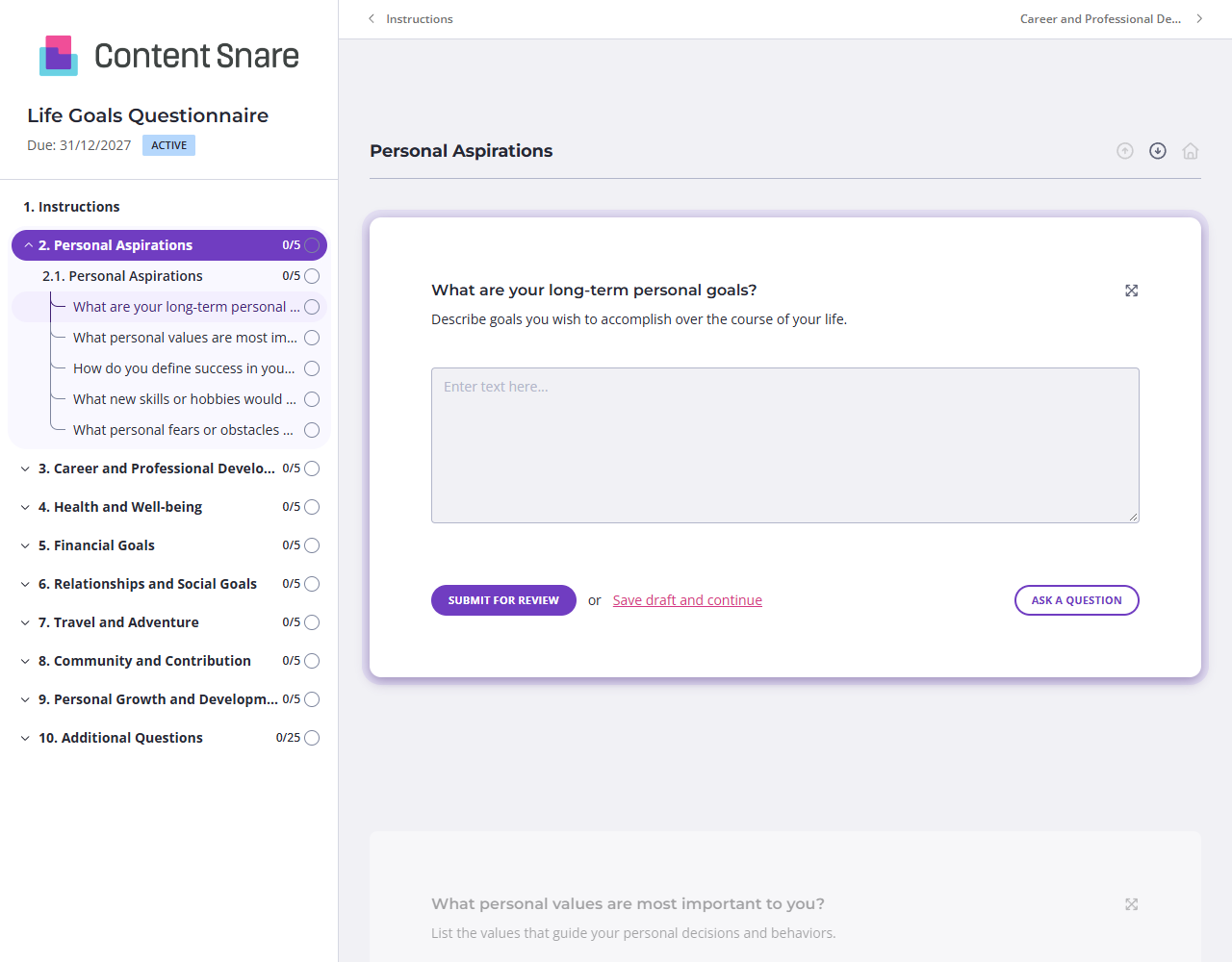
Life goals span multiple areas - career, health, finances, relationships, community. Don't overwhelm clients with a single endless scroll. Organize questions into separate pages that mirror these categories. Clients can focus on one area at a time, give thoughtful answers, and track their progress as they move through each section.
Some questions require deeper reflection than others. "How do you define success in your personal life?" isn't something people answer off the top of their head. Record a short video at the start explaining why you're asking these questions and how clients should approach them. Or add brief instructions above trickier sections to guide their thinking. You'll get more meaningful responses and fewer "I don't know" answers.
You likely gathered basic information when a client booked with you - name, contact details, maybe their general reason for seeking coaching. Pre-fill those fields or delete them entirely before sending the questionnaire. Jump straight into the questions that matter: their aspirations, obstacles, and what they want to achieve. Respect their time and they'll give you better answers.
Not every client cares equally about travel goals or community contribution. Use conditional logic to ask follow-up questions only when relevant. If someone rates travel as unimportant to their life goals, skip the bucket list questions. If they mention specific career challenges, show additional fields to explore those obstacles. You'll collect focused information without making the form feel like homework.
Google Forms and email chains weren't built for coaching intakes. Clients forget to respond, answers get buried in threads, and you waste hours chasing people down. Content Snare handles the follow-up automatically, keeps everything organized in one place, and makes you look polished from first contact. Thousands of coaches and consultants worldwide use it to streamline their client onboarding.
The platform is ISO 27001 certified, so client information stays secure. It integrates with tools you already use - your CRM, project management software, and more. And with hundreds of 5-star reviews across G2, Capterra, and Trustpilot, you know it actually works.
A life goals questionnaire is just the start. Coaches and consultants use Content Snare for:
Every form is customizable to your process, branded to match your business, and designed to make clients feel taken care of.


