



A comprehensive form that captures a client's complete financial picture including real estate holdings, investment accounts, business interests, vehicles, personal assets, and all outstanding liabilities.

Mortgage brokers, loan officers, and bank underwriters who need verified asset and liability information to assess lending capacity, calculate debt-to-income ratios, and complete compliant loan applications.

Send this after initial income verification but before final underwriting, once you've determined the loan amount requested and need complete financial disclosure to assess the client's total net worth and risk profile.
A client's $850,000 loan application sits on your desk. Their income checks out, credit score looks solid, but you're missing the full picture of their asset base. Without a complete asset declaration form, you're making lending decisions in the dark - and risking compliance issues, underwriting delays, and potential defaults down the line.
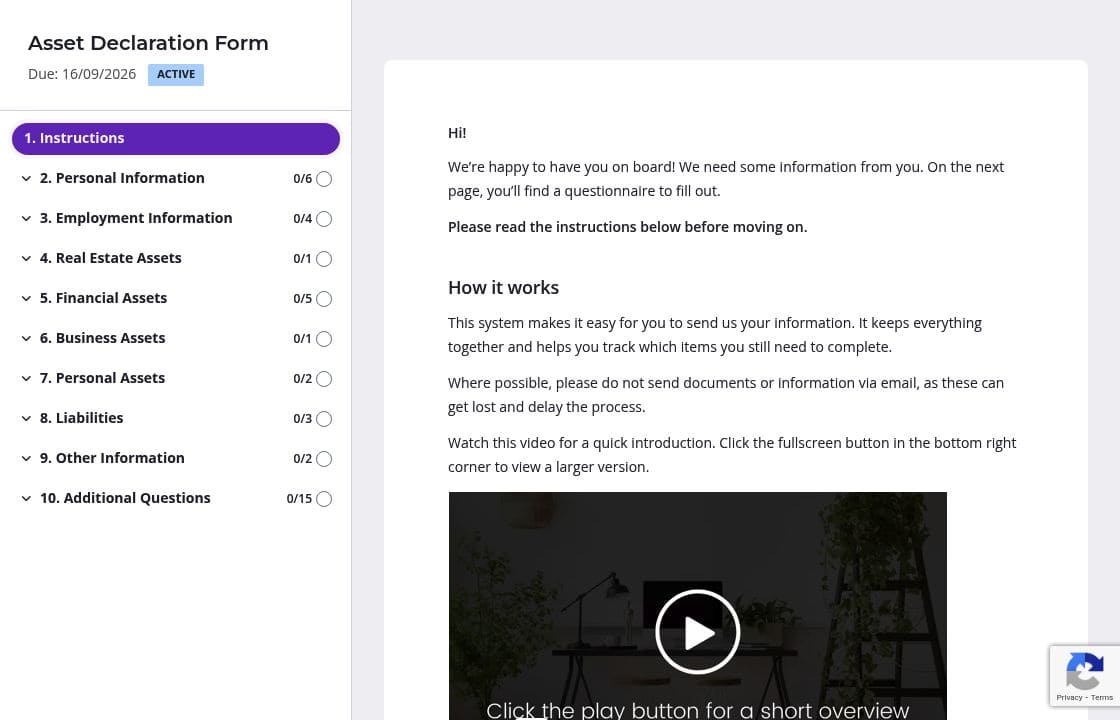
The asset declaration form captures everything you need in one structured document: real estate holdings, investment portfolios, business interests, vehicles, and outstanding liabilities. This post covers what an effective asset declaration form includes, how to use it to streamline your approval process, and gives you a free template to start using today. Let's dive in.
Personal Information
Capture core identifiers to match records, meet KYC needs, and link submissions cleanly to client files.
Employment Information
Establish income source and stability to inform risk, eligibility, and capacity assessments.
Real Estate Assets
Collect property holdings, addresses, valuations, encumbrances, and rental income to model net equity and cash flow.
Financial Assets
Map liquid and marketable assets across banking, securities, retirement, time deposits, and crypto for a complete balance sheet.
Business Assets
Identify business ownership, estimated value, and related obligations to capture non-salaried wealth and associated risks.
Personal Assets
Record vehicles and high‑value personal property for collateral assessment and insurance alignment.
Liabilities
List consumer and other debts to calculate net worth and debt service burden.
Other Information
Capture guarantees and edge cases that materially affect risk, compliance, or future cash flows.
Send valuation guidance upfront: Include examples of acceptable documentation for property and asset values - recent bank statements, property appraisals, investment account screenshots. Clients often guess at figures or provide outdated information, which just creates extra back-and-forth later.
Break complex assets into follow-up conversations: If a client indicates they own businesses, investment properties, or cryptocurrency holdings, schedule a brief call to walk through those sections together. These assets require nuanced explanation and you'll catch discrepancies or missing details much faster in dialogue than through form revisions.
Request supporting documents alongside the form: Ask clients to attach recent statements for any accounts, loans, or investments they declare. You'll verify figures immediately rather than chasing documentation after submission, cutting your processing time significantly.
Flag the liabilities section explicitly: Many clients focus on showcasing assets and downplay or forget to mention credit card debt, personal guarantees, or outstanding loans. A quick reminder that complete liability disclosure protects their application - and is legally required - prevents costly discoveries during underwriting.
Cross-reference employment income with asset accumulation: When a client declares substantial investment portfolios or property holdings that seem inconsistent with their stated annual income, it's worth a conversation. They may have inheritance, business income, or other sources they haven't fully explained, and clarifying this strengthens their application rather than raising red flags.
Not every client owns investment properties, runs a business, or holds cryptocurrency. Set up conditional logic so clients only see follow-up questions based on their answers. When someone selects "No" to owning real estate, skip the entire property valuation and mortgage balance section. This keeps the form focused and prevents clients from feeling overwhelmed by questions that don't apply to them.
Clients interpret "current market value" differently - some guess, others use purchase price from years ago. Add brief instructions above asset sections explaining what you need: market appraisal figures for properties, current account balances for investments, Kelly Blue Book estimates for vehicles. A single line of guidance prevents vague responses and reduces the rounds of clarification you'd otherwise need.
You've likely collected basic information during initial conversations - name, address, contact details, employer, income. Pre-fill those fields before sending the form. Clients appreciate not re-entering information they've already provided, and you'll get straight to the asset and liability details that actually matter for your assessment.
Asset declaration forms are detailed, and clients often start them but don't finish in one sitting. Automatic reminders nudge them to complete outstanding sections without you having to track who's submitted what. You're not chasing people manually, and clients get a helpful prompt rather than radio silence.
Email attachments get lost. Spreadsheets come back with half the fields blank. Phone tag over missing documentation wastes hours every week. Content Snare gives you a professional, structured way to collect complete asset declarations - with automatic follow-ups, progress tracking, and secure document uploads all in one place.
You're working with sensitive financial data. Content Snare is ISO 27001 certified and trusted by finance professionals worldwide. Clients upload bank statements, property appraisals, and investment records knowing their information is protected. You stay compliant without the security headaches of email or shared drives.
Clients actually complete the form. Automatic reminders mean you're not chasing people manually. Progress tracking shows you exactly who's submitted what. The interface is clean and intuitive - no confusing portals or clunky PDF forms that people abandon halfway through.
It integrates with the tools you already use. Connect Content Snare to your CRM, document management system, or workflow automation platform. Information flows directly into your existing processes instead of requiring manual data entry.
Content Snare has hundreds of 5-star reviews across G2, Capterra, and Trustpilot. Finance and mortgage brokers use it daily because it works.
This form is just one way to streamline your client onboarding. Use Content Snare to collect loan application details, employment verification documents, tax returns for income assessment, and refinancing questionnaires. Any information you currently chase via email or phone can become a structured, trackable process.


