
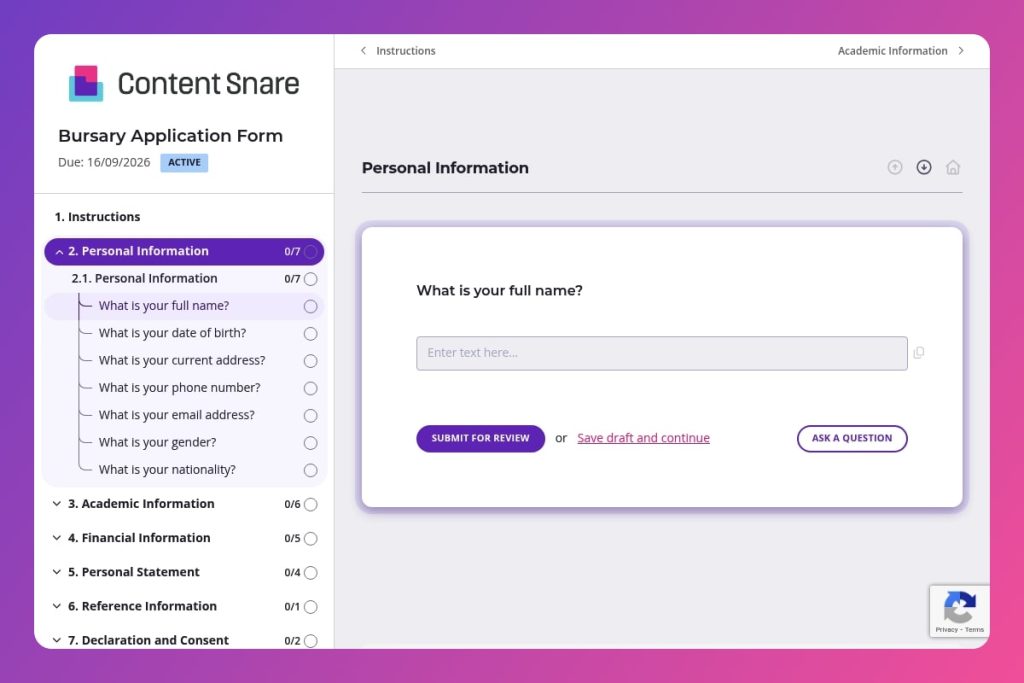


A comprehensive digital form that collects student details, academic records, financial documentation, personal statements, and references in one organized submission for bursary funding decisions.

Admissions teams, financial aid offices, and bursary committees at schools and colleges who need to evaluate student funding applications efficiently and fairly.

Deploy at the start of each funding cycle or term when students apply for financial assistance, well before award decision deadlines to allow time for document collection and reference gathering.
Incomplete applications cost you time. Missing documents delay decisions. Students miss out on funding they desperately need.
Your admissions team shouldn't spend hours chasing information or deciphering messy submissions. A well-designed bursary application form collects everything upfront - personal details, academic records, financial documentation, and supporting references - in one organized place. This post covers what makes an effective bursary application form, how to streamline your approval process, and includes a free template you can customize for your institution. Let's dive in.
Personal Information
Collect core identifiers for matching records, eligibility checks, and applicant contact.
Academic Information
Capture current enrollment, performance, and academic focus to assess merit and fit.
Financial Information
Gather means-testing inputs to evaluate need and avoid overlap with other funding.
Personal Statement
Elicit qualitative context on motivation, impact, and goals for holistic review.
Reference Information
Obtain an external verifier who can speak to academic readiness or character.
Declaration and Consent
Secure legal attestations and data processing permissions.
Attachments
Request evidence to substantiate academic standing and financial need.
Set clear financial documentation requirements upfront: Before launching your form, create a simple checklist or guide explaining exactly what financial documents you'll accept - recent tax returns, benefit letters, or pay stubs. Students often struggle with the financial section because they're unsure what counts as proof. A quick reference document saves everyone time and reduces back-and-forth emails.
Make the personal statement prompts work harder: The four personal statement questions gather crucial context about motivation and circumstances. Review these responses first when assessing applications - they often reveal financial hardships or exceptional circumstances that raw numbers don't capture. A student's explanation of their situation can be just as important as their GPA.
Request references early in your timeline: Don't wait until applications flood in to realize reference letters are missing. When you send the form, remind applicants that their teacher or mentor may need several weeks to write a strong recommendation. Consider sending a separate email template students can forward to their referees explaining what you need and when.
Create a scoring rubric based on the form sections: Use the natural structure - academic performance, financial need, personal statement, and extracurriculars - to build consistent evaluation criteria. This makes committee reviews faster and fairer, especially when you're comparing dozens of applications with varying circumstances.
Follow up strategically after submission: Send acknowledgment emails that confirm what you've received and flag any missing attachments immediately. Students juggling coursework and financial stress appreciate knowing their application is complete rather than wondering if something went wrong.
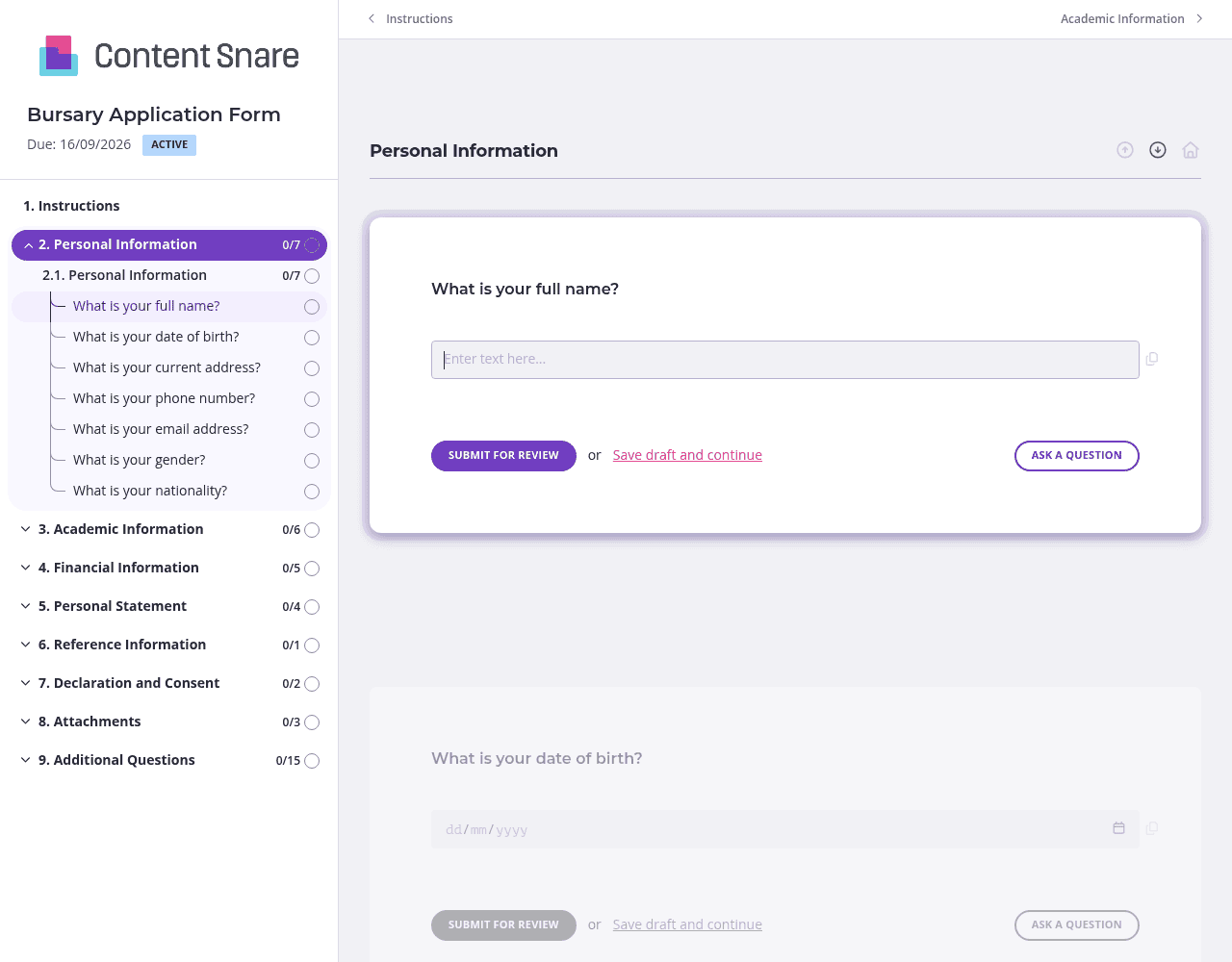
Students forget to submit documents. Teachers delay reference letters. You shouldn't have to chase every applicant manually. Set up automatic reminders that nudge students when sections remain incomplete or attachments are missing. The system follows up for you - friendly, consistent, and on schedule. You avoid the awkward emails, and students get the support they need to complete their applications on time.
You likely know basic details about applicants before they even start - name, student ID, current year of study, school name. Pre-fill these fields so students face a shorter, less daunting form. They'll appreciate not re-entering information you already possess, and you'll reduce errors from mistyped details. Delete questions entirely if they're irrelevant for internal applicants or returning students.
The financial information section trips up applicants every time. Use instruction areas to clarify exactly what "household income" means, which documents prove financial hardship, or how to report government assistance. A short explanation above tricky questions prevents incomplete submissions and reduces the "I wasn't sure what you wanted" responses. Screenshots showing sample documents or a quick video explaining the financial section can eliminate most confusion before it starts.
A bursary application form covers personal details, academics, finances, personal statements, and supporting documents - that's overwhelming on one endless page. Split these into separate sections so applicants tackle one category at a time. Students can save progress and return later, which matters when they need to gather financial documents or wait for a reference letter. The form feels less intimidating, and completion rates improve.
Email attachments get lost. Shared spreadsheets become version-control nightmares. Students submit incomplete applications, and your team wastes hours following up. Content Snare eliminates the chaos with a purpose-built system that tracks every submission, automates reminders, and keeps sensitive financial documents secure in one organized place.
Educational institutions handle sensitive student data daily, which is why Content Snare is ISO 27001 certified and trusted by thousands of businesses worldwide. You get bank-level security for financial documents, academic transcripts, and personal information - critical when processing bursary applications that contain household income details and government assistance records.
The platform integrates with tools you already use, so approved applications flow directly into your student information system or financial aid software. No manual data entry. No duplicate files scattered across email threads.
Content Snare has earned hundreds of 5-star reviews across G2, Capterra, and Trustpilot for one reason: it works. Admissions teams get complete applications faster. Students experience a professional, guided process instead of confusing email chains. Everyone saves time.
This form is just one way schools and colleges use Content Snare. The platform works for any process where you need information from students, parents, or staff:


