
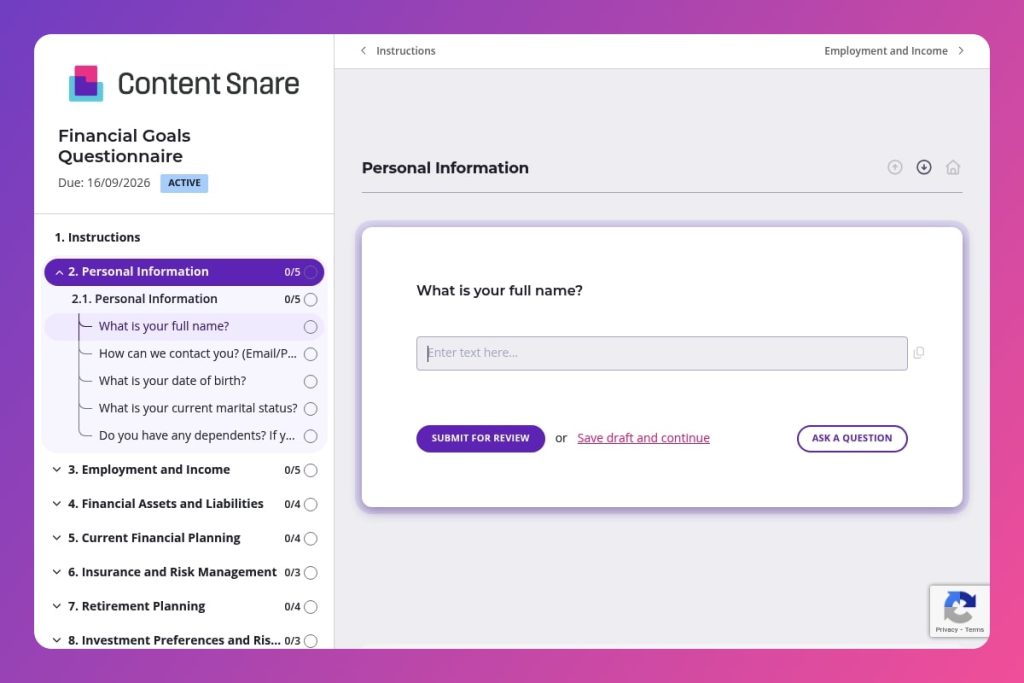


A comprehensive pre-meeting questionnaire that captures a client's complete financial picture - from income and assets to retirement goals, risk tolerance, and estate planning needs.

Financial planners and advisors who need to gather detailed client information about employment, investments, liabilities, insurance coverage, and long-term objectives before initial consultations.

Send 3-5 days before a first client meeting to collect account details, policy information, and financial aspirations so you can build a tailored plan instead of spending session time on data gathering.
Your first client meeting can make or break the relationship. Clients arrive with scattered thoughts about retirement, vague worries about debt, and dreams they haven't quantified. You need to capture everything - income sources, risk tolerance, estate plans, education funding - without turning the conversation into an interrogation.
A financial goals questionnaire solves this. Send it before your meeting and you'll walk in prepared, with a complete picture of their assets, liabilities, retirement timeline, and investment preferences. This post covers what to include in your questionnaire, how to use it effectively, and a free template you can customize. Let's get started.
Personal Information
Capture identity, contact, and household context to anchor planning and compliance.
Employment and Income
Establish current and projected cash inflows and employment context.
Financial Assets and Liabilities
Inventory the balance sheet to gauge liquidity, net worth, and debt obligations.
Current Financial Planning
Map existing advisory relationships and goal horizons to define scope and avoid duplication.
Insurance and Risk Management
Document coverage to assess protection gaps and set risk capacity.
Retirement Planning
Define timing, lifestyle, spending, and income sources for retirement models.
Investment Preferences and Risk Tolerance
Calibrate portfolio design to experience, risk appetite, and constraints.
Education and Family Planning
Identify upcoming education costs and current funding approach.
Estate Planning
Confirm documents and intent to align titling, beneficiaries, and legacy aims.
Other Financial Goals or Considerations
Surface philanthropic intent and foreseeable events that may shift priorities or cash flow.
Send it before the first meeting: Give clients at least 3-5 days to complete the questionnaire before you meet. They'll need time to gather account statements, loan details, and policy numbers. You'll show up with a roadmap instead of spending half the session collecting basic information.
Flag inconsistencies between goals and current behaviors: If a client says they want to retire at 55 but isn't contributing to retirement accounts, note it. Same goes for someone claiming conservative risk tolerance while holding aggressive stock positions. These gaps become your talking points and help clients see where their actions don't match their aspirations.
Use the "other considerations" section as your meeting opener: Start with their answer to major life events or charitable passions. It's warmer than diving into account balances and often reveals priorities that numbers alone won't show - like planning for aging parents or funding a passion project.
Create a summary sheet from their responses: Pull out key data points - total assets, total liabilities, retirement age, annual income needs - into a one-page overview. Share it at the start of your meeting so you're both looking at the same snapshot. It keeps conversations focused and helps clients see their full financial picture at a glance.
Follow up on vague answers before the meeting: If someone writes "some savings" or "not sure" for asset values, send a quick message asking for specifics. You can't build a solid plan around estimates. A brief follow-up email saves you from backtracking during your session.
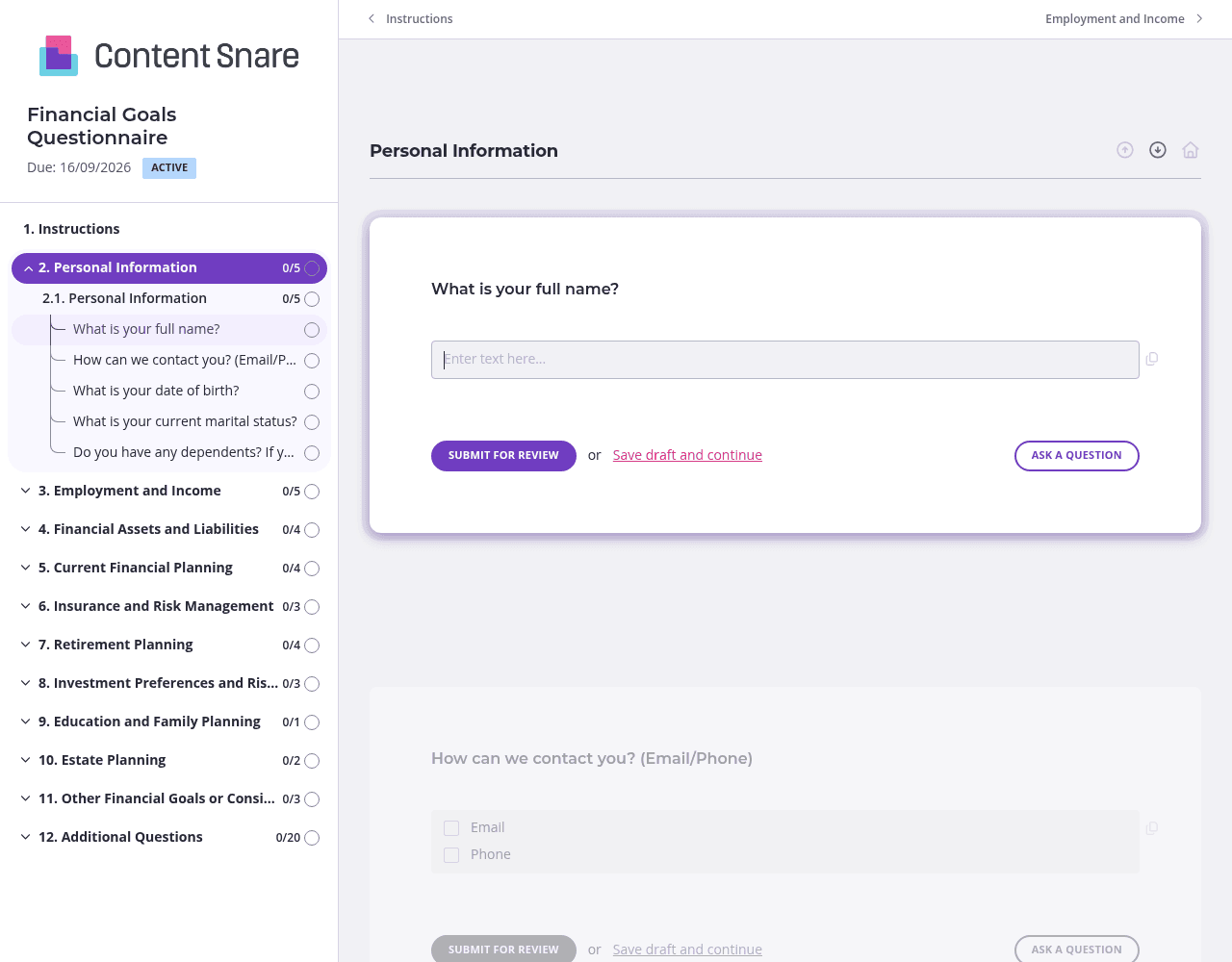
A financial goals questionnaire covers a lot of ground - from basic contact info to estate planning. Split it into logical pages: Personal Information, Assets & Liabilities, Retirement Planning, Investment Preferences, and Estate & Family Planning. Clients can tackle one section at a time without feeling overwhelmed. They'll also see progress as they move through, which keeps momentum going.
You likely have client names, contact details, and employment information from initial conversations or intake calls. Pre-fill those fields before sending the questionnaire. Clients appreciate not repeating themselves, and you'll get faster completion rates. Delete entire sections if they're not relevant - someone without dependents doesn't need education planning questions cluttering their form.
Questions about assets, liabilities, and insurance policies require specific details. Add brief instructions under those fields: "Include account numbers and current balances" or "Attach a copy of your most recent statement if available." A short explainer prevents vague responses like "some stocks" or "a few policies" that force follow-up rounds.
Clients get busy. They open your questionnaire, intend to complete it later, then forget. Automatic reminders handle the follow-up for you - a gentle nudge after 3 days, another after a week. You stay on schedule without becoming the person who nags, and clients get the prompt they actually need.
Email attachments get lost. PDFs come back incomplete. Spreadsheets arrive with formatting disasters. Content Snare gives you a professional, trackable system where clients complete everything in one place. You see progress in real-time, reminders go out automatically, and nothing falls through the cracks.
Security matters when you're collecting sensitive financial data. Content Snare is ISO 27001 certified and trusted by thousands of businesses worldwide, including financial planners who can't afford data breaches or compliance issues. Your clients share account numbers, income details, and social security information - they need to know it's protected.
The platform integrates with tools you already use, so responses flow directly into your CRM or planning software. No manual data entry. No copying and pasting between systems.
Content Snare has hundreds of 5-star reviews across G2, Capterra, and Trustpilot. Financial professionals specifically highlight how it's transformed their client onboarding.
This form is just one use case. Financial planners use Content Snare for:
The same system that streamlines your questionnaire can handle every information-gathering process in your practice.


