
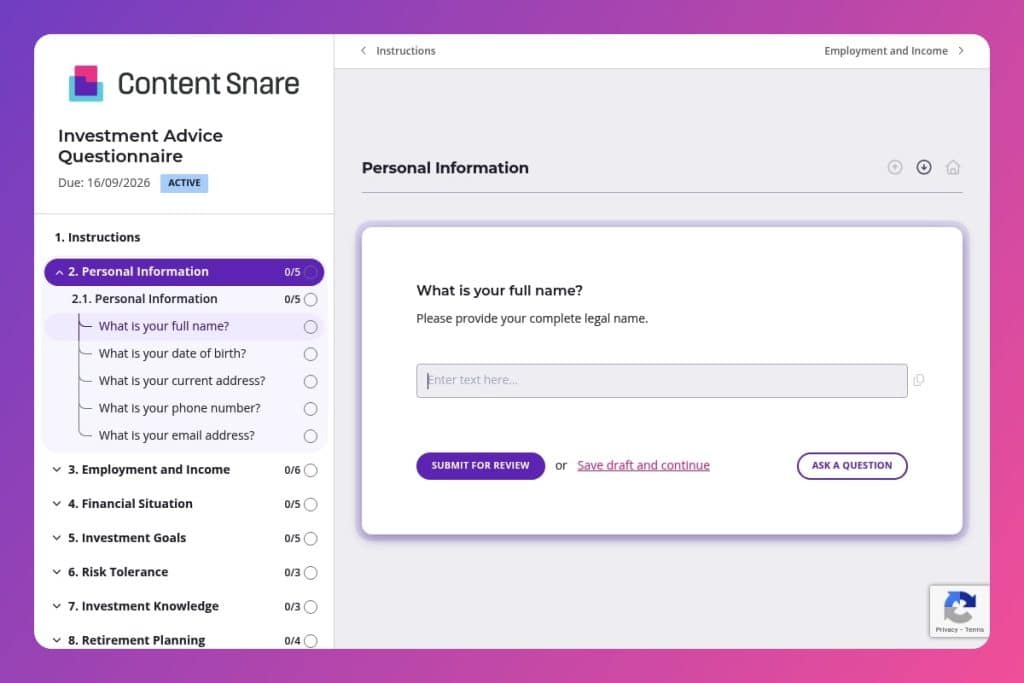


A comprehensive intake questionnaire that collects client information across personal details, employment, financial situation, investment goals, risk tolerance, retirement planning, and estate considerations before providing investment advice.

Financial advisors and wealth managers who need to gather detailed client information efficiently to build appropriate investment strategies and maintain regulatory compliance.

Send this questionnaire 48 hours before initial client consultations or annual reviews to collect essential data upfront, allowing advisors to arrive prepared with preliminary analysis rather than spending meeting time on data collection.
Nearly 70% of financial advisors spend over an hour per client gathering basic information during initial consultations. That's time you could spend analyzing portfolios and building strategies - not chasing down employment history or retirement goals.
Missing key details about risk tolerance or financial obligations leads to misaligned recommendations and compliance headaches. An investment advice questionnaire solves this by collecting everything upfront - from income sources and dependents to investment knowledge and ethical preferences. This post covers what makes an effective questionnaire, best practices for implementation, and a free template you can customize. Let's break it down.
Personal Information
Use these to verify identity, meet KYC obligations, and maintain reliable contact.
Employment and Income
Capture income stability and employment context to ground affordability and capacity assessments.
Financial Situation
Map cash flow, balance sheet, dependents, and near-term changes to determine suitability and liquidity.
Investment Goals
Define objectives, horizon, and funding levels to shape allocation, liquidity, and product selection.
Risk Tolerance
Calibrate portfolio volatility to the client's stated risk appetite and loss behavior.
Investment Knowledge
Assess sophistication to tailor explanations, disclosures, and product scope.
Retirement Planning
Anchor savings targets and glidepath to retirement age, income needs, and existing plan coverage.
Estate Planning
Align investment strategy with estate directives, beneficiaries, and anticipated tax exposure.
Additional Information
Record values-based constraints and sector preferences to implement screens and tilts.
Send it before the first meeting: Get clients to complete the investment advice questionnaire 48 hours before your initial consultation. You'll arrive prepared with preliminary analysis instead of spending half the session on data collection. Review their risk tolerance and investment goals ahead of time so you can tailor your conversation to their specific situation.
Flag incomplete responses early: Check submissions for vague answers in critical sections like financial situation and risk tolerance. A client who writes "comfortable" for risk tolerance or leaves monthly expenses blank isn't giving you enough to work with. Follow up immediately with clarifying questions before your meeting - it saves backtracking later.
Use retirement planning answers to spot gaps: Pay close attention to the retirement planning section alongside current contributions and income. Clients often have ambitious retirement income goals but minimal savings strategies in place. This gap becomes your value proposition and shapes your entire advisory approach.
Cross-reference employment stability with risk capacity: A client's stated risk tolerance doesn't always match their actual capacity for risk. Someone who's been at their job for six months with high monthly expenses can't afford the same risk as someone with ten years of tenure and minimal liabilities, regardless of what they check in the risk tolerance section.
Create a summary document from their responses: After submission, compile key details - goals, time horizon, ethical preferences, and constraints - into a one-page client profile. Share this summary at your first meeting to confirm accuracy. It shows you've done your homework and gives clients a chance to clarify or expand on their written answers before you build their investment strategy.
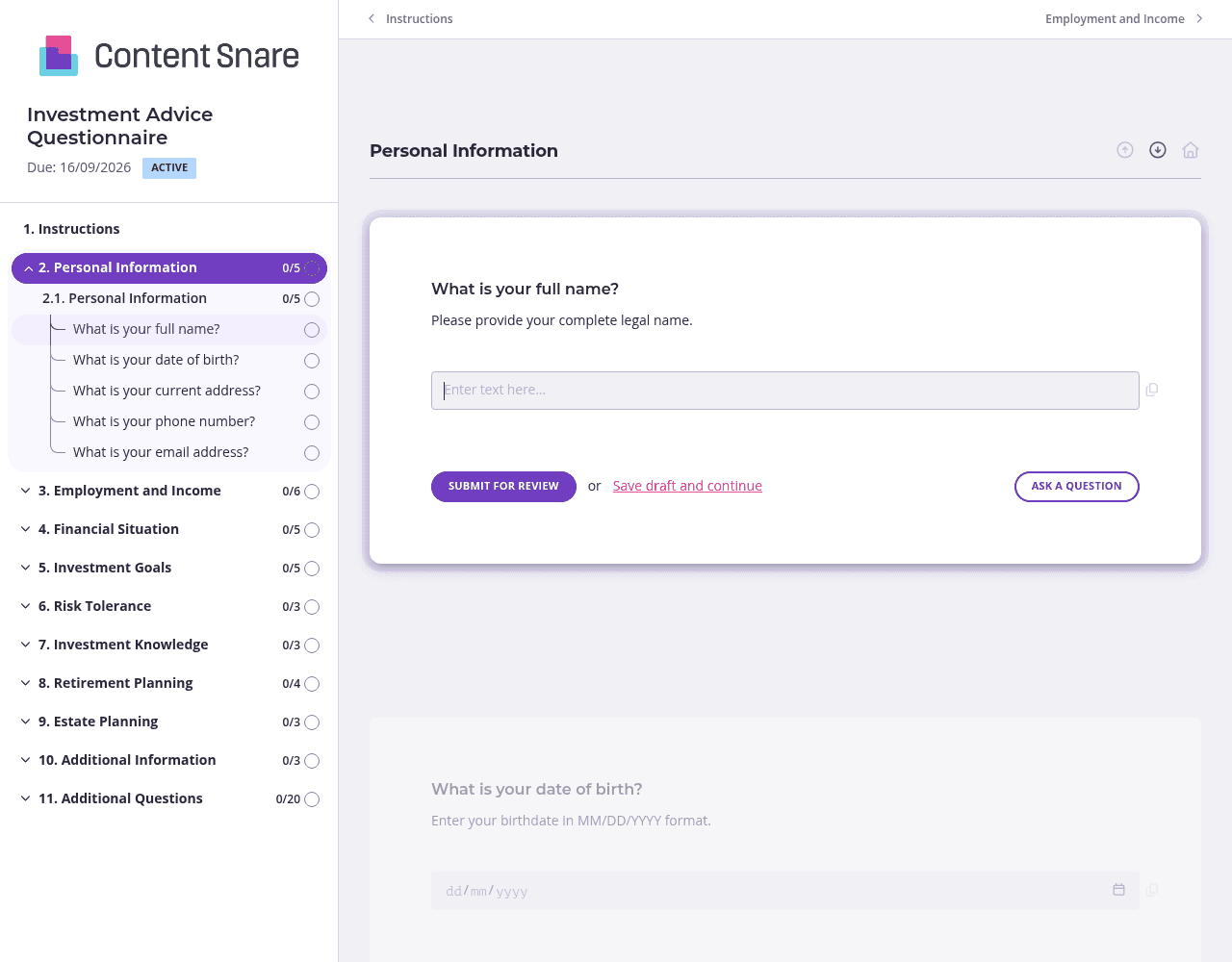
An investment advice questionnaire covers a lot of ground - financial situation, risk tolerance, retirement planning, estate considerations. That's overwhelming in one endless scroll. Split it into logical pages: one for personal details, another for employment and income, a third for investment goals and risk. Clients complete one section at a time, which reduces abandonment and improves response quality. They can save progress and return later without losing momentum.
You likely have basic client information on file - names, contact details, employment status, existing retirement accounts. Delete those questions or prefill the answers before sending. Your client sees a shorter form that respects their time, and you avoid the frustration of receiving incomplete or contradictory data. This works especially well for existing clients updating their information or annual reviews where you're refreshing specific sections like income or financial goals.
Risk tolerance and investment knowledge questions often get vague or contradictory answers. Add instruction text above those sections explaining what "moderate risk" actually means or providing examples of investment experience levels. A short note like "Consider how you'd react if your portfolio dropped 15% in a month" helps clients give more accurate responses. Better answers upfront mean fewer clarification calls and more precise recommendations from day one.
Clients get busy and forget to complete forms, especially lengthy ones about finances. Automatic reminders handle the follow-up without you playing the bad guy. Content Snare sends gentle nudges at intervals you choose, keeping your questionnaire top of mind. You'll see higher completion rates without spending time tracking who's submitted and who hasn't - the system does it for you.
PDFs and email chains create chaos. Clients send incomplete forms, you can't track who's responded, and sensitive financial data sits unprotected in inboxes. Content Snare eliminates the back-and-forth with a purpose-built system that guides clients through every question, automatically follows up on missing information, and keeps everything organized in one secure place. It's ISO 27001 certified and trusted by thousands of businesses worldwide who need to collect sensitive information reliably.
You get a professional client experience without the administrative headaches. Clients complete forms at their own pace with clear progress tracking. You see submissions in real time, organized by client, with automatic reminders handling follow-ups. Content Snare integrates with tools you already use and has earned hundreds of 5-star reviews across G2, Capterra, and Trustpilot for making information collection actually work.
This form is just one way financial planners use Content Snare. You can collect tax documentation, gather annual review updates, onboard new clients with KYC requirements, request supporting documents for loan applications, or collect information for insurance assessments - all with the same streamlined, secure system your clients will actually complete.


