
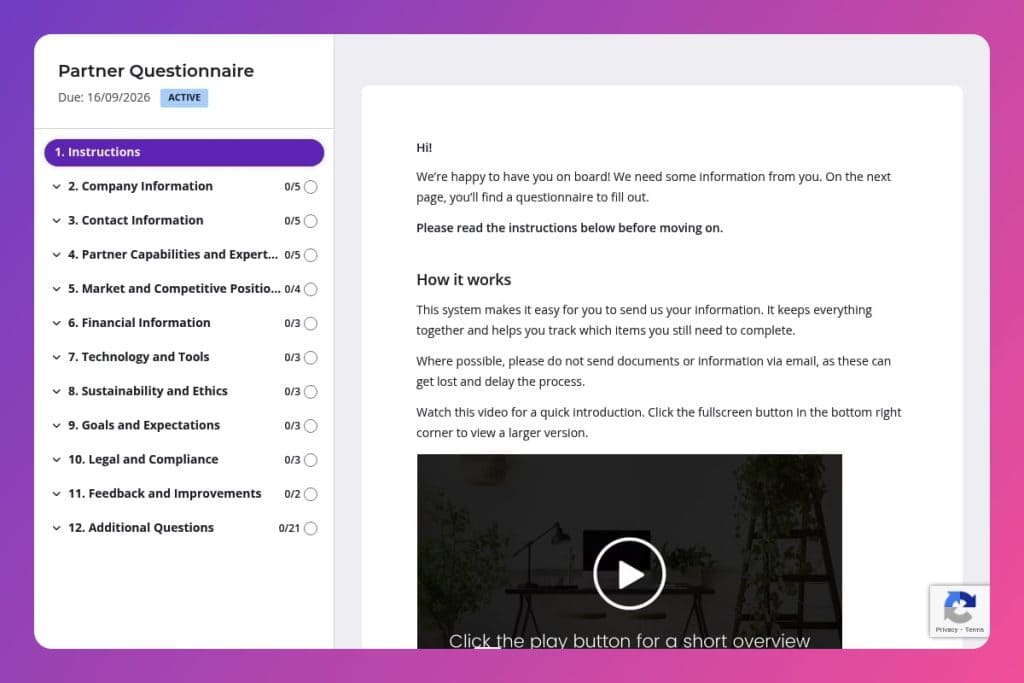


A structured questionnaire that collects essential information about potential partners - from company credentials and technical capabilities to financial health, compliance status, and partnership goals - in one organized submission.

Business leaders, partnership managers, and procurement teams who need to vet and compare multiple potential partners efficiently before committing time to detailed negotiations or formal agreements.

During initial partner discussions to quickly identify dealbreakers and alignment issues, before investing significant time in proposals, contract negotiations, or integration planning conversations.
You're vetting a potential partner, but the information trickles in through scattered emails, inconsistent meetings, and missing details. By the time you piece together their capabilities, compliance status, and expectations, you've already wasted weeks - and you still don't know if they're the right fit.
A partner questionnaire solves this. It collects everything you need upfront: company credentials, technical capabilities, financial health, and partnership goals in one organized place. This post covers what a partner questionnaire should include, how to use it effectively, and gives you a free template to get started. Let's break it down.
Company Information
Anchor core entity data for identity verification and CRM hygiene.
Contact Information
Confirm ownership of the relationship and escalation paths.
Partner Capabilities and Expertise
Capture differentiators, proof, and operating posture to assess fit.
Market and Competitive Positioning
Map target segments and positioning to avoid conflict and align GTM motions.
Financial Information
Screen for stability and scale to calibrate risk and investment.
Technology and Tools
Validate stack compatibility, integration effort, and security posture.
Sustainability and Ethics
Check alignment with your ESG standards and brand safeguards.
Goals and Expectations
Align outcomes, roles, and constraints from the start.
Legal and Compliance
Surface risk and requirements before you commit resources.
Feedback and Improvements
Set the operating cadence and continuous improvement loop.
Send it early in the conversation: Don't wait until you're deep into negotiations to deploy this form. Use it during initial discussions to quickly identify dealbreakers - like misaligned market focus, insufficient certifications, or compliance gaps - before you invest time in detailed proposals.
Frame it as mutual discovery, not interrogation: When introducing the partner questionnaire, position it as a two-way alignment exercise. Let prospects know you're gathering this information to ensure the partnership benefits both sides. This approach encourages more thoughtful, honest responses - especially in sensitive areas like financial standing or competitive positioning.
Pre-fill what you already know: If you've had preliminary conversations or found public information about their company, pre-populate basic details like legal name, headquarters location, or main offerings. This saves them time and shows you've done your homework, making them more likely to complete the rest thoroughly.
Create a comparison scorecard from responses: Once you're evaluating multiple partners, extract key data points - certifications held, market segments targeted, collaboration approach, CSR initiatives - into a simple comparison matrix. The standardized format of your partner questionnaire makes side-by-side evaluation straightforward and helps you spot the strongest strategic fit quickly.
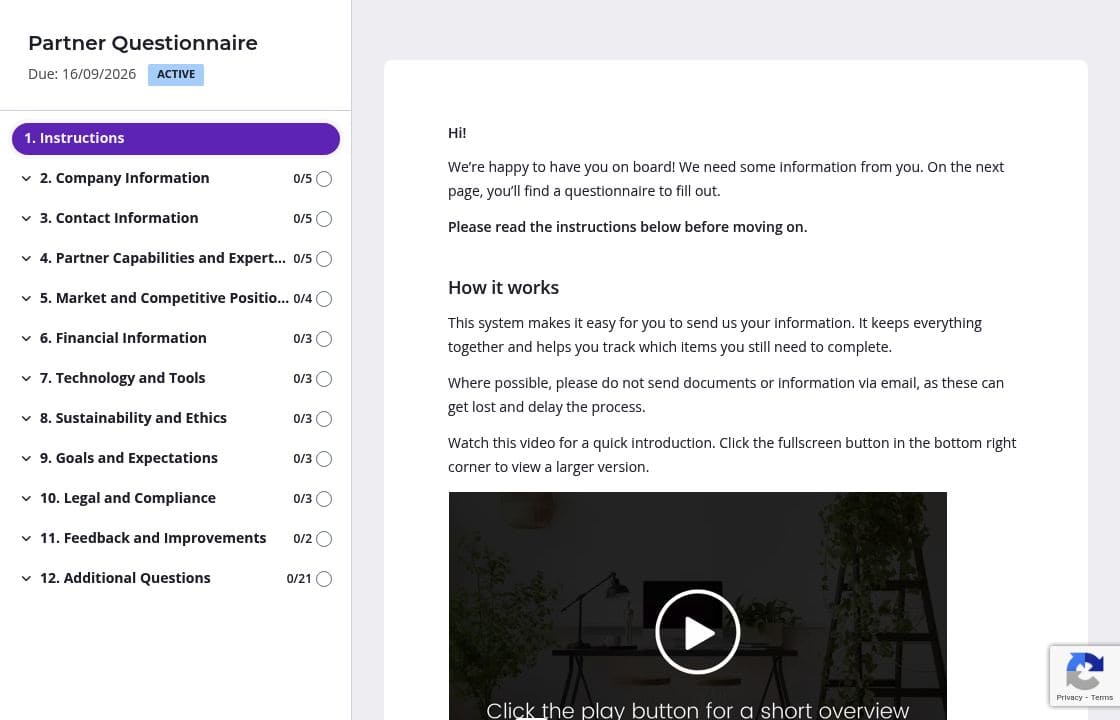
A partner questionnaire covers a lot of ground - from basic company details to financial standing, technical infrastructure, and compliance requirements. Organize related questions into separate pages: one for Company & Contact Information, another for Capabilities & Market Position, a third for Technology & Compliance, and so on. Partners can complete one section at a time without feeling overwhelmed by a 40-question wall of text.
Questions about "unique capabilities" or "competitive differentiation" can be vague. Use instruction areas to clarify what you're actually looking for. For the capabilities section, you might add: "Tell us about specialized skills, industry expertise, or resources that make your company valuable for this partnership." For financial questions, specify whether you need exact figures or ranges. Clear guidance means fewer follow-up clarifications and more useful initial responses.
Partner vetting often stalls because questionnaires sit incomplete while you hesitate to send another "just checking in" email. Set up automatic reminders to nudge partners at intervals you choose - say, three days after sending, then weekly. The system handles the persistence while you stay focused on evaluating completed submissions and moving qualified partners forward.
Not every partner needs to answer every question. Use conditional logic to tailor the experience: if a partner indicates they have multiple office locations, show the follow-up asking where. If they mention proprietary technology, prompt them for details about data security measures. Partners see only what applies to them, making the questionnaire feel more like a conversation than a generic intake form.
Email threads lose attachments. Shared documents get edited without version control. Spreadsheets arrive half-complete with unclear answers. Content Snare replaces that chaos with a professional system that tracks every response, sends automatic reminders, and keeps your partner vetting process moving without the manual follow-up.
Thousands of businesses trust Content Snare to collect critical information efficiently. It's ISO 27001 certified, which matters when you're handling sensitive financial data, compliance documentation, and proprietary technology details from potential partners. The platform integrates with tools you already use and comes with hundreds of 5-star reviews across G2, Capterra, and Trustpilot.
Partner questionnaires are just one application. You can also use Content Snare to:
The same system that makes partner vetting seamless works for any scenario where you need complete, organized information from external parties.


