
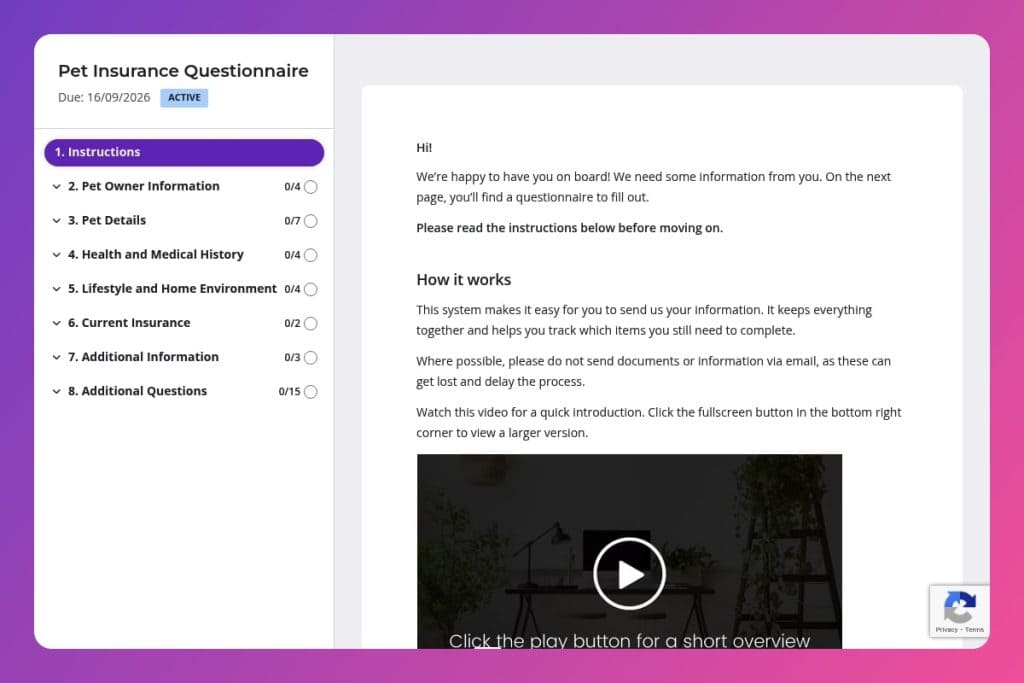


A comprehensive intake form that collects pet owner contact details, pet demographics, complete health and medical history, lifestyle factors, and current insurance status to generate accurate pet insurance quotes.

Insurance brokers who need to gather detailed information about clients' pets, their medical backgrounds, and coverage needs to provide tailored pet insurance recommendations and avoid quote delays from missing information.

Send this at the start of the pet insurance quoting process, immediately after initial client inquiry, to capture all necessary details before preparing customized coverage options and requesting veterinary records.
How many pet insurance quotes have you lost because clients couldn't clearly communicate their pet's health history or coverage needs? Incomplete information leads to delayed quotes, inaccurate pricing, and frustrated pet owners who take their business elsewhere.
A pet insurance questionnaire solves this problem by capturing every detail you need upfront - from breed-specific conditions and pre-existing ailments to lifestyle factors and current coverage. This post covers what makes an effective pet insurance questionnaire, practical tips for using it with clients, and a free template you can customize for your brokerage. Let's break it down.
Pet Owner Information
Collect reliable contact and address details for identity verification, policy documentation, and claims communication.
Pet Details
Establish species, breed, age, sex, and identification to drive eligibility, pricing, and coverage parameters.
Health and Medical History
Screen for pre-existing conditions, recent care, medications, surgeries, and breed-linked risks to set exclusions, waiting periods, and endorsements.
Lifestyle and Home Environment
Gauge exposure and household factors that influence risk profile, preventive needs, and eligibility.
Current Insurance
Map existing coverage and preferences to avoid duplication, manage transitions, and target recommendations.
Additional Information
Capture open-ended needs and lead source to refine plan design and follow-up.
Send veterinary records requests early: As soon as a client submits the form, use their vet information to request medical records in parallel with your quote preparation. Pre-existing conditions and surgical histories often require documentation, and getting ahead of this saves days in turnaround time.
Flag breed-specific risks during initial review: When you see breeds prone to hereditary conditions (like hip dysplasia in German Shepherds or heart issues in Cavalier King Charles Spaniels), proactively note these in your follow-up. Clients appreciate when you demonstrate expertise about their specific pet, and it helps set realistic coverage expectations upfront.
Use the "currently insured" section as a conversion tool: If a client indicates existing coverage, don't just note it - ask them what they wish was different about their current plan. This opens a consultative conversation and helps you position better alternatives rather than just quoting comparable coverage.
Clarify "pre-existing" with a quick call: The medical history section often reveals conditions clients don't realize count as pre-existing. A five-minute call to discuss that ear infection from six months ago or ongoing medication can prevent disputes down the line and builds trust early in the relationship.
Create a coverage summary based on their lifestyle answers: Indoor versus outdoor pets, multiple-pet households, and specialized activities all affect risk and appropriate coverage levels. Reference these details when presenting quotes to show you've tailored recommendations to their actual situation, not just their pet's age and breed.
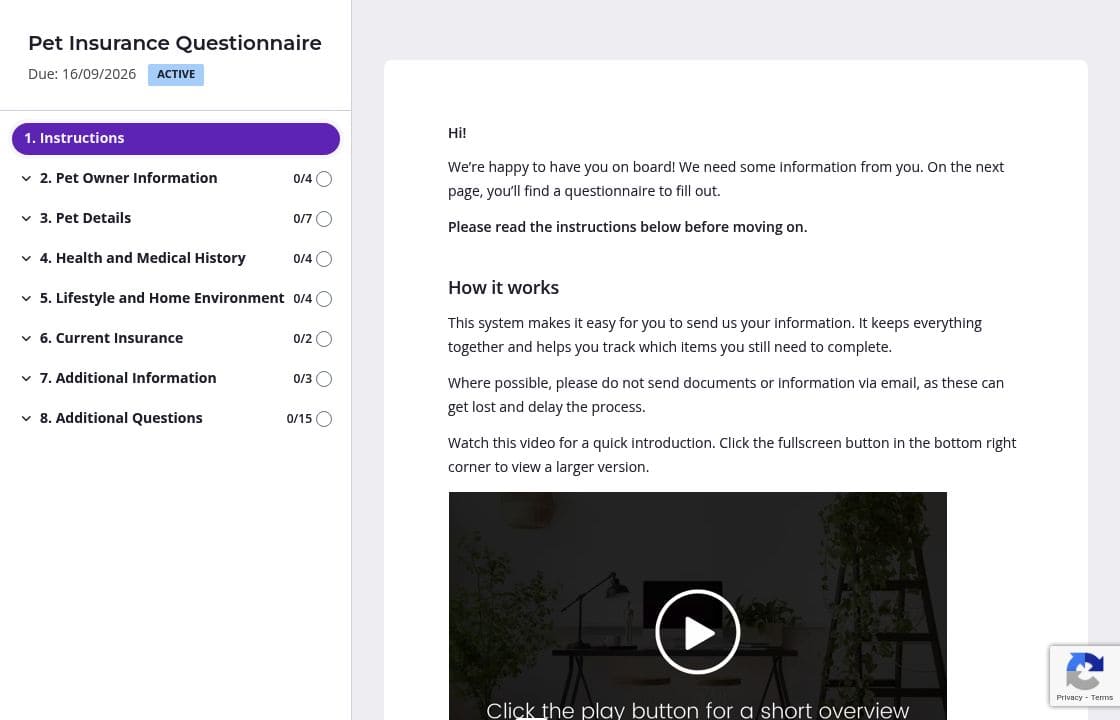
Pet insurance forms can feel overwhelming when clients see every possible question upfront. Conditional logic lets you show follow-up questions only when they're relevant. If a client answers "yes" to pre-existing conditions, you can ask for specifics. If they say "no," those fields never appear. The same applies to current insurance - only clients with existing coverage see questions about their current provider and policy details. This keeps the form focused and prevents clients from abandoning halfway through.
You likely already have your client's name, email, phone, and address in your CRM or from previous interactions. Delete those fields or pre-fill them before sending the questionnaire. This gets clients straight to the pet-specific questions that actually matter - breed, age, medical history, and lifestyle factors. It shows respect for their time and dramatically improves completion rates.
"Pre-existing conditions" confuses pet owners more than any other part of the form. Some think it only means chronic illnesses; others don't realize that a treated ear infection from last year still counts. Add a brief instruction or example at the top of the health section: "Include any condition your pet has been treated for in the past 12 months, even if it's fully resolved." A thirty-second explainer video works even better. Clear guidance here prevents back-and-forth clarifications and speeds up underwriting.
Pet owners want insurance, but they're busy. They start the form during lunch, get interrupted, and forget to finish. Automatic reminders send gentle follow-ups without you having to track who's completed what. You're not chasing clients - Content Snare handles it. This is especially valuable for the sections that require digging up information, like microchip numbers or veterinary contact details.
Email threads and PDF forms don't cut it when you're collecting sensitive pet health records and client information. Content Snare gives you a purpose-built system that tracks what's submitted, what's missing, and automatically follows up - so nothing falls through the cracks. Clients get a professional experience, and you get complete information without the back-and-forth chaos.
Content Snare is ISO 27001 certified and trusted by insurance professionals who need to handle client data securely. It integrates with your existing CRM and tools, so information flows directly into your workflow. With hundreds of 5-star reviews across G2, Capterra, and Trustpilot, it's proven to save brokers hours every week.
This form is just one way to use Content Snare. Insurance brokers also use it to collect business insurance applications, claims documentation, policy renewal information, commercial risk assessments, and client onboarding details - anywhere you're currently chasing information via email or phone calls.


