
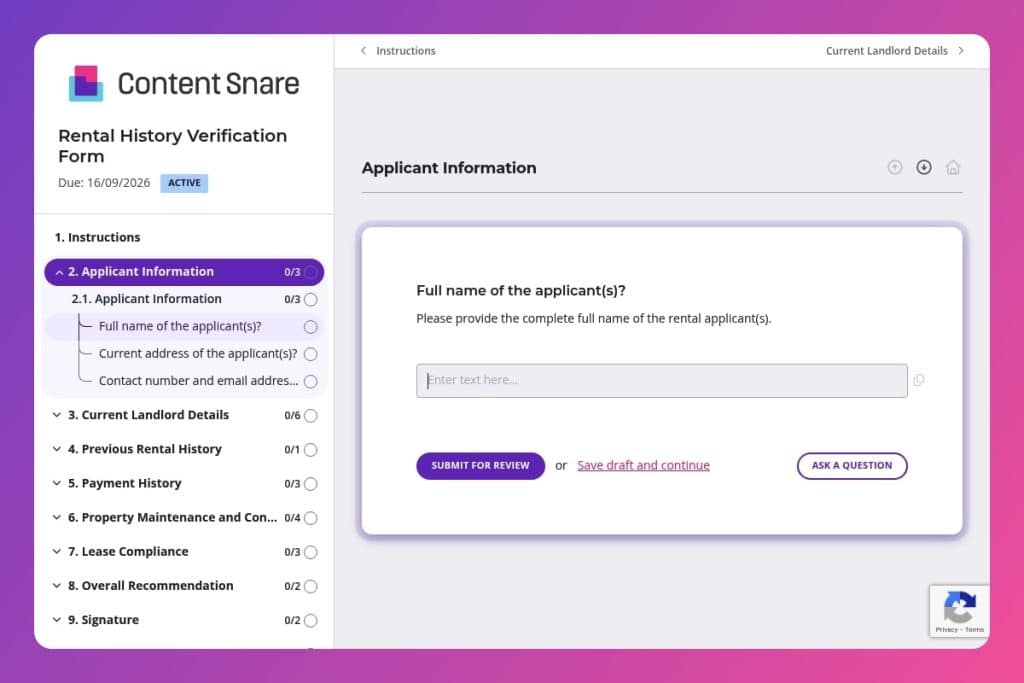


A structured questionnaire sent to current and previous landlords to verify an applicant's payment history, property maintenance, lease compliance, and overall tenancy record.

Real estate agents, property managers, and landlords who need documented evidence of a prospective tenant's rental behavior before approving a lease application.

During tenant screening after receiving a rental application, sent directly to the applicant's current and previous landlords to gather objective references before making a placement decision.
You're about to hand over the keys to a $300,000 property based on what a prospective tenant tells you about their rental past. One bad placement costs you thousands in lost rent, legal fees, and property damage. You need facts, not stories - and you need them fast.
A rental history verification form solves this. It gets you direct feedback from previous landlords about payment history, property care, lease compliance, and whether they'd rent to this applicant again. This post covers what goes into an effective rental history verification form, how to use it during tenant screening, and includes a free template you can customize. Let's break it down.
Applicant Information
Capture baseline identifiers and contact channels to match responses to the correct file and enable follow-up.
Current Landlord Details
Confirm the current tenancy context and provide direct points of contact for verification.
Previous Rental History
Build a longitudinal view of the applicant’s tenancies to spot stability and patterns.
Payment History
Confirm reliability and quantify any delinquencies.
Property Maintenance and Conduct
Assess care of the asset and any behavior issues that affected other residents.
Lease Compliance
Verify adherence to contractual obligations and end-of-lease procedures.
Overall Recommendation
Elicit a clear risk signal and capture any nuanced context.
Signature
Document attestation and timestamp.
Request verification for at least two previous landlords: One reference might give you an incomplete picture. Asking about the past 5 years of rental history helps you spot patterns - consistent late payments, recurring damage complaints, or a history of lease violations that one glowing review might hide.
Send the form directly to landlords, not through the applicant: Applicants sometimes coach references or provide contact details for friends posing as landlords. Use the contact information provided, but verify it independently through property records or online listings when possible. A quick reverse phone lookup can save you headaches.
Pay attention to security deposit details: If a landlord didn't return the full deposit, the reason tells you everything. Normal wear and tear? No problem. Unpaid rent, property damage beyond repair costs, or early lease termination? Red flags worth exploring in a follow-up call.
Compare monthly rent amounts to what you're offering: An applicant paying $1,200 monthly who's applying for your $2,400 property may be stretching beyond their means, even if their payment history looks perfect. It's a data point worth weighing against their income verification.
Follow up by phone on any concerning answers: The form gives you documented responses, but a quick conversation can reveal context. Maybe those neighbor complaints were about a one-time party, or the late payment happened during a documented medical emergency. Use the form as your starting point, not your only source.
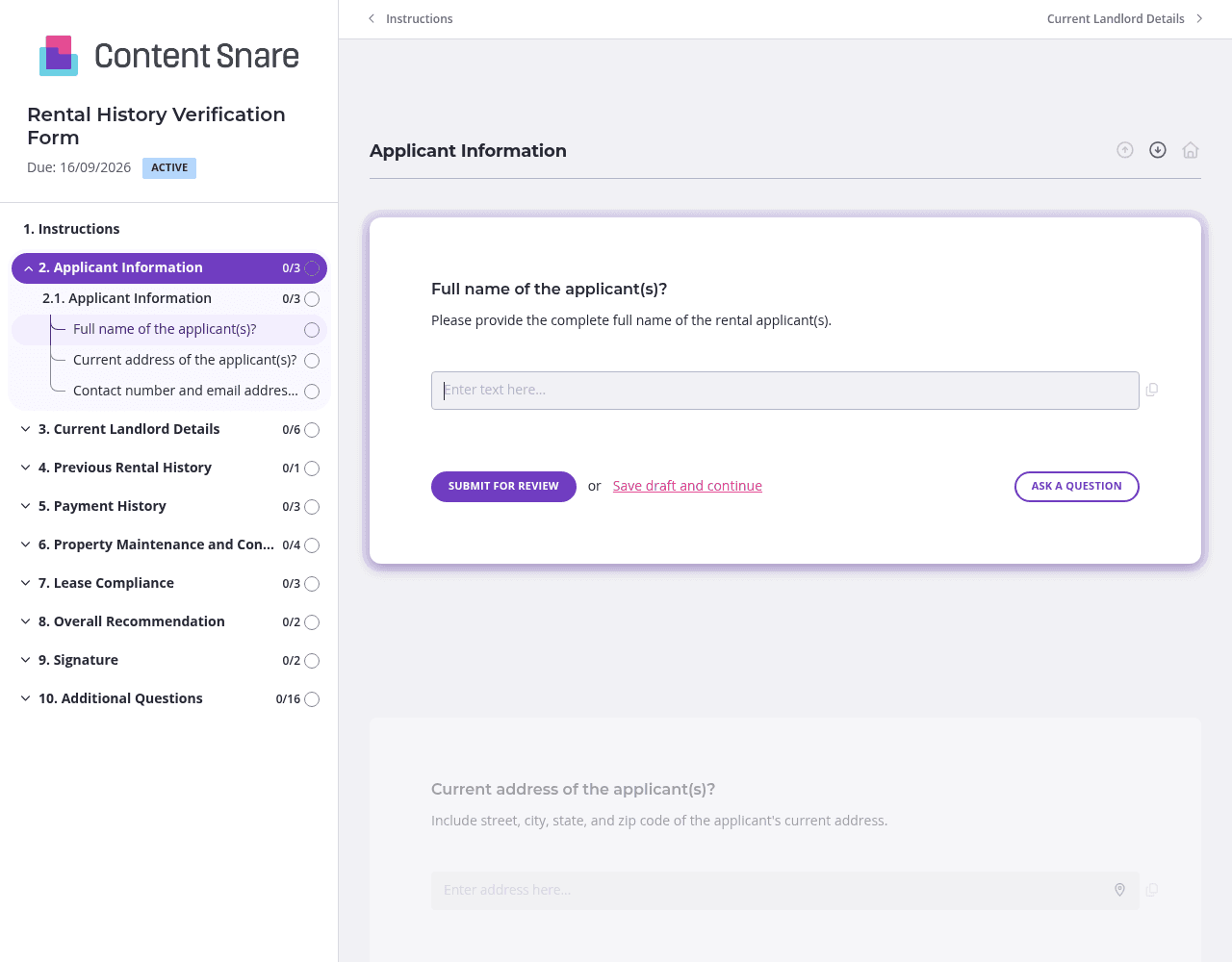
You already have the applicant's name, current address, and contact information from their initial application. Pre-fill those fields before sending the form to their current or previous landlords. It saves time, reduces errors, and makes it crystal clear whose rental history you're verifying. The landlord can focus on answering the questions that actually matter - payment history, property condition, and whether they'd rent to this person again.
Not every applicant has multiple previous landlords worth contacting. Set up conditional logic so the "Previous Rental History" section only expands if the landlord confirms the applicant rented elsewhere in the past 5 years. This keeps the form tight and relevant. Landlords are more likely to complete a form that doesn't waste their time on questions that don't apply.
Landlords aren't mind readers. Add a brief instruction at the top of the "Payment History" section clarifying what counts as a late payment (e.g., "paid after the 5th of the month"). Do the same for "Property Maintenance and Conduct" - specify that you're asking about damage beyond normal wear and tear, not minor scuffs. Clear guidance means better data and fewer follow-up calls to clarify vague answers.
Landlords manage multiple properties and tenants. They're not ignoring your verification request on purpose - they're just busy. Automatic reminders handle the follow-up for you, so you don't have to send awkward "just checking in" emails. You get the information you need faster, without becoming the person who nags.
Email chains and PDF attachments turn rental verification into a mess of lost files, unclear responses, and endless follow-ups. Content Snare gives you a professional, trackable system that landlords can complete in minutes - no downloads, no printing, no confusion. You get clean, organized data every time, and automatic reminders handle the chasing for you.
Content Snare is trusted by thousands of businesses worldwide and has hundreds of 5-star reviews across platforms like G2, Capterra, and Trustpilot. It's ISO 27001 certified, so sensitive tenant and landlord information stays secure. Plus, it integrates with the tools you already use, making it easy to slot into your existing workflow.
This form is just one way to streamline your real estate business. You can use Content Snare to collect:
Every form is customizable, trackable, and designed to save you hours of back-and-forth.


