


A pre-consultation intake form that collects comprehensive information about a client's parenting history, current custody arrangements, living situation, financial status, and relationship with their children before the first meeting.

Family law attorneys and legal practices handling child custody cases who need complete client information, supporting documentation, and case details organized before initial consultations.

Send immediately after a client schedules their first appointment so they can gather school records, financial documents, and evidence of parenting involvement before the consultation begins.
A parent walks into your office with scattered notes, missing documents, and incomplete details about the other parent's living situation. You're starting from scratch - again. Family law attorneys lose hours piecing together basic custody information that should arrive organized from day one.
A child custody questionnaire changes that. This digital intake form captures everything you need upfront: parenting history, living arrangements, financial details, and relationship dynamics. Your clients provide complete information before the first meeting. You spend less time on data collection and more time on strategy. This post covers what the form includes, how to use it effectively with clients, and a free template you can customize. Let's dive in.
Personal Information
Collect baseline identifiers and contact details to match records and coordinate communications.
Parenting Background
Establish household composition and any special considerations affecting caregiving and scheduling.
Current Custody Arrangement
Document the status quo and any governing orders to frame the scope of change requested.
Desired Custody Arrangement
Capture the relief sought to guide negotiations and drafting.
Other Parent Information
Profile the other parent and surface any safety or capacity issues relevant to best interests.
Child’s Day-to-Day Life
Map routines and responsibilities to evaluate continuity and logistical feasibility.
Living Arrangements
Assess housing stability and suitability for overnight care.
Financial Information
Confirm financial capacity and current support posture for child support considerations.
Relationship with Child
Gauge the strength of the bond and actual parenting time patterns.
Legal Considerations
Identify parallel proceedings and any child welfare concerns that may impact strategy.
Additional Information
Provide space for case-specific facts that do not fit earlier categories.
Send it before the initial consultation: Get the questionnaire to clients as soon as they schedule their first meeting. They'll have time to gather school records, financial documents, and details about the other parent's employment - information they rarely have at their fingertips. You'll walk into that first conversation fully briefed.
Flag the sections that require evidence: Tell clients upfront that claims about substance abuse, domestic violence, or special needs require documentation. A simple note when you send the form - "Please attach any relevant police reports, medical records, or court documents" - saves weeks of back-and-forth later.
Use responses to identify gaps in their case: Look for vague answers in the "Relationship with Child" and "Living Arrangements" sections. If a client writes "good relationship" without specifics, you know exactly what to probe during your consultation. Missing details about who takes the child to activities? That's a weak spot in their custody argument you can address early.
Create a pre-submission checklist: Some clients will skip questions they find uncomfortable or legally concerning. Before they hit submit, remind them that blank answers in sections like "Legal Considerations" or "Other Parent Information" only delay the process. Incomplete forms mean incomplete case prep.
Turn responses into your case narrative: The questionnaire gives you the building blocks of their custody argument. A client who handles all school drop-offs, manages medical appointments, and provides a stable home environment has already outlined their strengths. Use their own words from the "Child's Day-to-Day Life" section to draft initial filings or negotiation talking points.
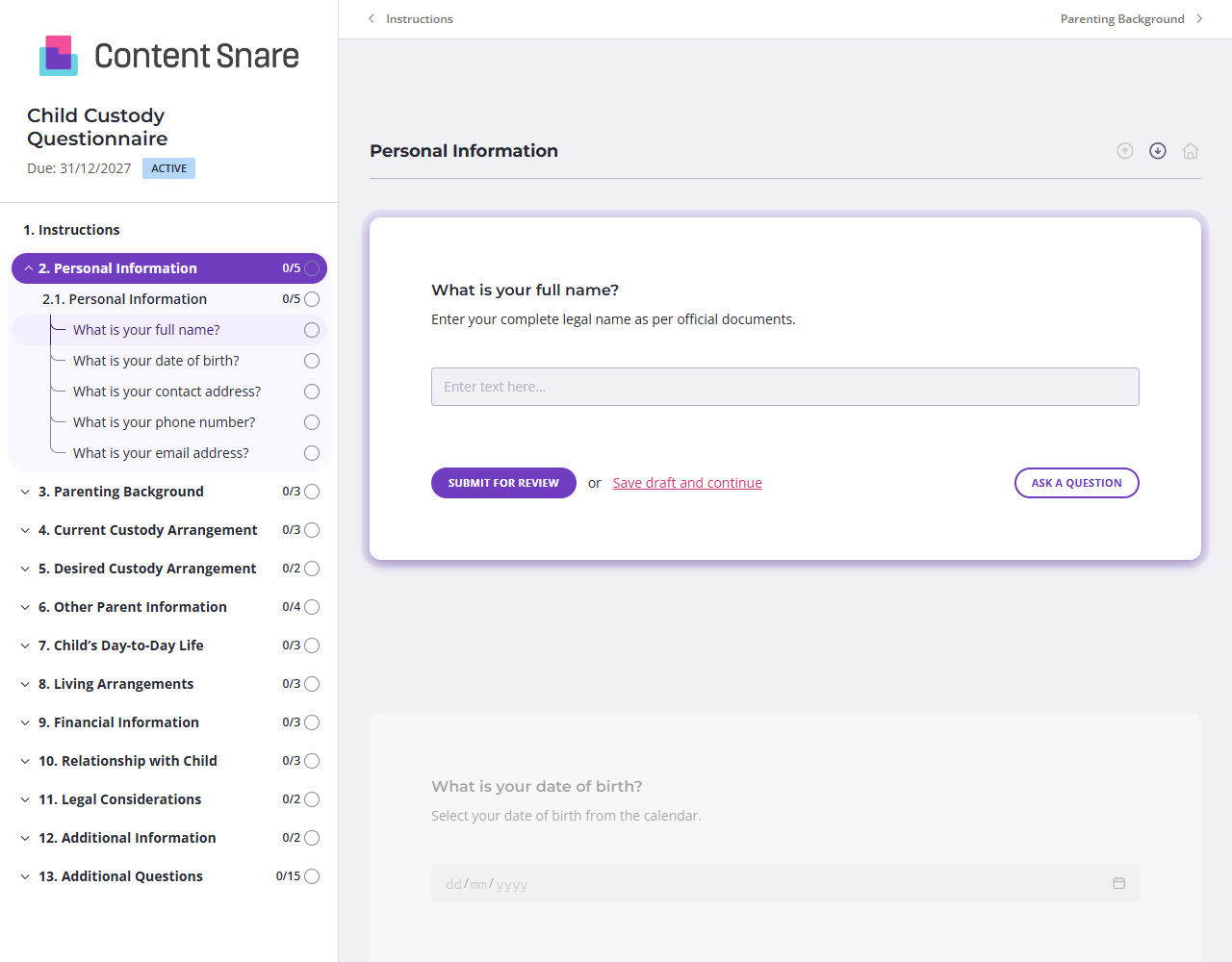
Not every custody case involves substance abuse allegations or special needs children. Content Snare's conditional logic lets you tailor the questionnaire based on initial responses. A client who answers "no" to special needs won't see follow-up questions about medical conditions. Someone seeking joint custody won't wade through questions designed for sole custody requests. Clients complete the form faster, and you avoid collecting irrelevant information.
Questions about domestic violence, substance abuse, and legal history often confuse clients. They don't know what qualifies as "legal matters" or how much detail you need. Use Content Snare's instruction fields to clarify exactly what you're asking for. Add a note above "Does the other parent have any history of substance abuse or domestic violence?" explaining that documented incidents matter most - and remind them to attach police reports or protective orders if available.
You likely collected names, contact details, and the number of children during the initial intake call. Pre-fill those fields in the Personal Information section before sending the questionnaire. Clients see you're organized and efficient. More importantly, they skip the busy work and focus on the substantive questions about custody arrangements, living situations, and their relationship with the children - the information that actually builds their case.
Custody cases move quickly, and you can't afford clients who forget to finish the questionnaire. Content Snare sends automatic follow-ups to clients who haven't completed their forms. You're not chasing them down or sending awkward "just checking in" emails. The system handles it, and clients get gentle nudges until they submit everything you need.
Email attachments get lost. Word documents come back with half the fields blank. Phone intake takes hours and still misses critical details. Content Snare gives you a purpose-built system for collecting complete, organized client information - with automatic follow-ups, file uploads, and progress tracking built in.
You maintain complete control. Customize every question, add legal disclaimers, and adjust the form for each client's situation before sending. Clients see your branding, not a generic survey tool.
Security matters in family law. Content Snare is ISO 27001 certified and trusted by legal professionals handling sensitive custody cases, divorce proceedings, and estate planning. Your clients' financial records, custody allegations, and personal details stay protected.
The platform works with your existing tools. Integrate responses directly into your practice management software, CRM, or document storage system. Thousands of businesses worldwide use Content Snare to streamline client intake - it has hundreds of 5-star reviews across G2, Capterra, and Trustpilot.
A child custody questionnaire is just one application. Legal professionals use Content Snare for divorce intake forms, estate planning questionnaires, personal injury case documentation, corporate client onboarding, and real estate transaction checklists. Any time you need detailed information from clients, Content Snare handles it better than email or static PDFs.


