content snare

Templates

Corporate governance questionnaire template (39 questions)

Industry
|
Country
Global
|
Reviewed by
James Rose
|
Last Updated
November 20, 2026

At a glance

WHAT this is

A comprehensive questionnaire that captures a company's board structure, compliance policies, risk management protocols, executive succession planning, and ESG commitments to identify governance gaps and liability exposure.


WHO this is for

Corporate attorneys, general counsel, compliance officers, and legal advisors who conduct governance reviews, due diligence assessments, or advisory services for corporate clients.


WHEN to use this

During annual governance audits, pre-transaction due diligence, compliance assessments, board evaluations, or when onboarding new corporate clients to establish baseline governance practices.


Template preview

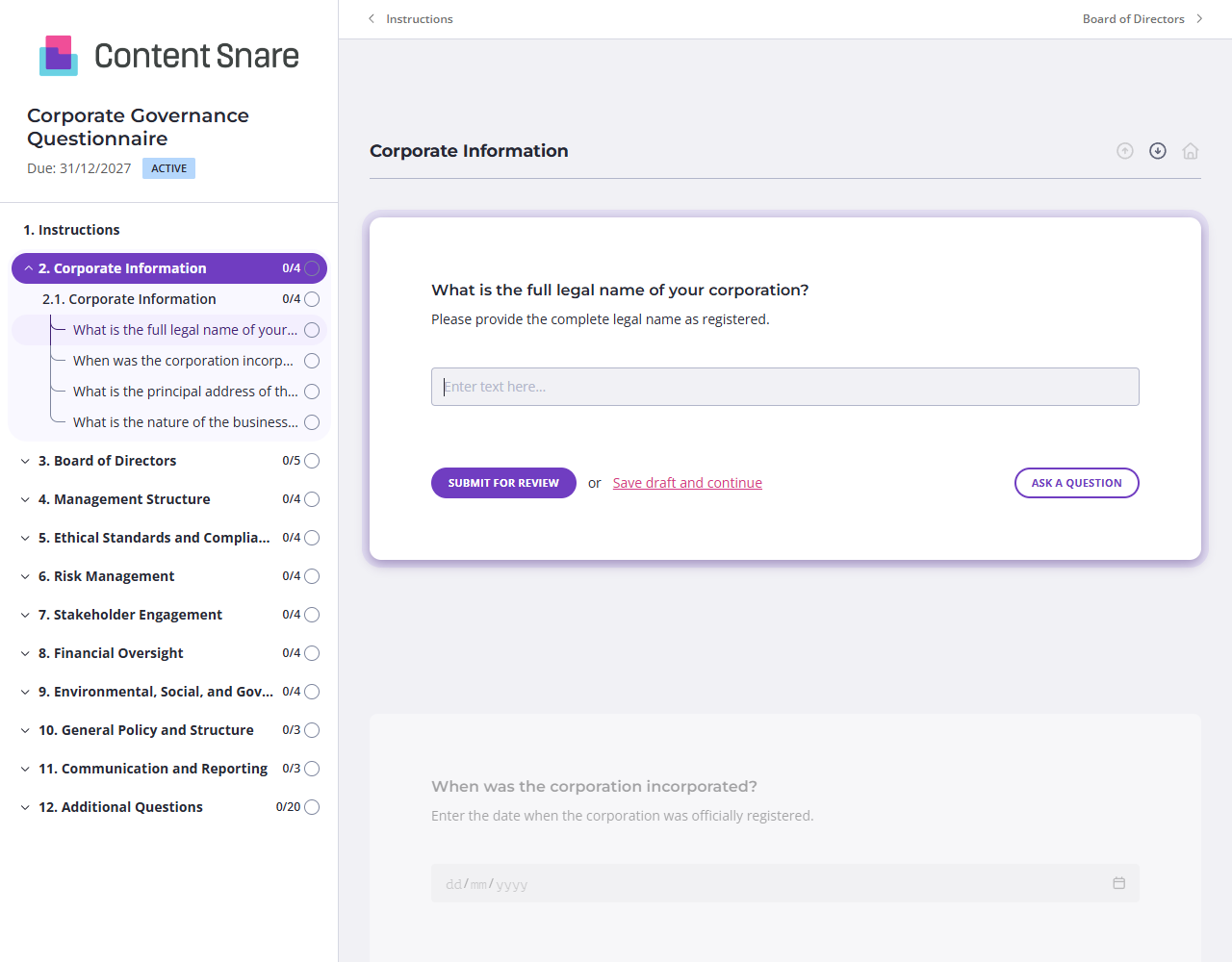
Here's what this template looks like in Content Snare.
Start your free trial to send this template in minutes.

Board composition gaps, unclear succession plans, missing ethics policies - these aren't just audit findings. They're lawsuits waiting to happen.

A corporate governance questionnaire cuts through the chaos. It systematically captures your board structure, compliance measures, risk protocols, and ESG commitments in one standardized format. Less time chasing answers across departments. Fewer blind spots that expose your clients to liability. This post covers what makes an effective corporate governance questionnaire, practical tips for implementation, and a free template you can customize. Here's what you need to know.

Tired of chasing people to fill out your forms? Try Content Snare

Content Snare is like a forms tool on steroids. Autosaving forms mean no progress is lost. Automatic reminders mean you can relax knowing your forms will get finished without you having to chase people down. 
Start My Free Trial

Questions to include on your corporate governance questionnaire

Corporate Information
Use these items to anchor entity identification and operating context for downstream governance analysis.

  • What is the full legal name of your corporation?
  • When was the corporation incorporated?
  • What is the principal address of the corporation?
  • What is the nature of the business and its primary operations?

Board of Directors
Probe board size, composition, cadence, tenure policy, and selection criteria to assess oversight maturity.

  • How many members are on the board of directors?
  • What is the diversity composition of the board (e.g., gender, ethnicity)?
  • How often does the board meet?
  • Do directors have term limits? If so, what are they?
  • What are the key qualifications you seek in board members?
    Diversity, term limits, and qualification criteria indicate independence, renewal, and skills alignment.

Management Structure
Clarify senior leadership, continuity planning, performance governance, and risk ownership.

  • Who are the current key executives and what are their roles?
  • Is there a succession plan in place for key executive positions?
  • What are the mechanisms for executive performance evaluation and compensation?
  • How is risk management integrated into the executive responsibilities?
    These elements drive continuity, incentive alignment, and clear accountability for risk.

Ethical Standards and Compliance
Confirm ethics frameworks, communication practices, speak-up mechanisms, and compliance controls.

  • Does the corporation have a code of conduct or ethics policy?
  • How is the code of conduct communicated to employees and stakeholders?
  • Is there a whistleblower policy and is it actively communicated to employees?
  • What measures are in place to ensure compliance with legal and regulatory requirements?
    Strength here signals cultural health and regulatory resilience.

Risk Management
Surface risk universe, assessment cadence, mitigation posture, and cyber approach.

  • What are the primary risks identified by the corporation?
  • How often are risk assessments conducted?
  • What risk management strategies or policies are in place?
  • How does the corporation address cybersecurity risks?
    Detail in this area informs control design, prioritization, and assurance planning.

Stakeholder Engagement
Map stakeholder set, outreach channels, feedback pathways, and integration into governance.

  • Who are the key stakeholders for the corporation?
  • How does the corporation communicate with its stakeholders?
  • Are there mechanisms for stakeholders to provide feedback to the board?
  • How does the corporation incorporate stakeholder feedback into decision-making?
    These answers reveal responsiveness and the legitimacy of board deliberations.

Financial Oversight
Evaluate financial review rhythm, assurance functions, transparency controls, and external audit coverage.

  • How often are financial statements reviewed by the board?
  • Does the corporation have an internal audit function?
  • What are the processes to ensure financial transparency and integrity?
  • Are there independent auditors, and how often are audits conducted?
    This underpins financial integrity and reduces audit and fraud risk.

Environmental, Social, and Governance (ESG) Factors
Gauge ESG strategy integration, targets, reporting, and impact evaluation.

  • How does the corporation address ESG factors in its strategy?
  • Are there specific ESG goals or targets set by the corporation?
  • What reporting is done related to ESG initiatives?
  • How does the corporation evaluate the impact of its ESG initiatives on its operations?
    Clarity here affects capital access, disclosure readiness, and risk–opportunity management.

General Policy and Structure
Confirm core governance policies, enforcement mechanisms, and recent structural changes.

  • What is the corporation’s policy on conflicts of interest?
  • How does the corporation ensure compliance with its governance policies?
  • Are there any recent changes to the governance structure?
    These determine independence safeguards, policy effectiveness, and change risk.

Communication and Reporting
Capture shareholder communications, meeting cadence, and voting mechanics.

  • How are board decisions communicated to shareholders?
  • What is the frequency and method of shareholder meetings?
  • Are there established procedures for shareholder voting and proposals?
    Robust processes support transparency, rights protection, and dispute avoidance.

Other question ideas

When you are creating your corporate governance questionnaire, here are some additional questions you may want to consider. These won't apply in every case, but should give you some ideas as you build out your form.
  1. How does the corporation incorporate technology advancements into its corporate governance framework?
  2. What policies are in place to support employee professional development and retention?
  3. Has the corporation considered the impact of climate change on its operations and strategic planning?
  4. How does the corporation involve employees in decision-making?
  5. How does the corporation address mental health and well-being of its employees?
  6. How does the corporation support diversity and inclusion beyond the board level, such as in its workforce and supply chain?
  7. What measures are in place to ensure data privacy and protection?
  8. How does the corporation measure its overall corporate culture and what steps are taken to improve it?
  9. Does the corporation have any social impact initiatives or partnerships in place?
  10. How does the corporation address digital accessibility for all stakeholders, including employees and customers?
  11. How does the corporation handle issues related to gender pay gap?
  12. Are there policies in place to handle potential pandemics or global health crises?
  13. Does the corporation have a position or policy on political donations or lobbying?
  14. How does the corporation plan for long-term sustainability of its operations?
  15. What are the corporation's policies around artificial intelligence and automation?
  16. How does the corporation engage with its local community?
  17. Does the corporation report non-financial information such as social impact, human rights, etc?
  18. How is the corporation preparing for potential future regulatory changes in its industry?
  19. How does the corporation manage its supply chain to ensure ethical practices?
  20. How does the corporation handle shareholder activism?

Tips to get the best results

  • Pre-populate corporate basics before sending: Fill in fields like legal name, incorporation date, and principal address yourself before distributing the form to clients. This shows you've done your homework and lets them focus on substantive governance questions - board composition, risk management protocols, and ESG commitments - rather than administrative details they assume you already have.

  • Request supporting documentation alongside responses: When asking about codes of conduct, whistleblower policies, or succession plans, prompt clients to attach the actual documents. You'll verify that policies exist in writing, not just in theory, and you'll spot gaps between what they claim and what's formally documented. It turns a questionnaire into an audit trail.

  • Schedule a follow-up call for complex sections: Board diversity metrics, executive compensation mechanisms, and stakeholder engagement strategies rarely fit neatly into form fields. Tell clients upfront you'll discuss sections like Management Structure and ESG Factors in detail after submission. They'll provide richer context, and you'll catch nuances that matter for compliance.

  • Use responses to build a governance scorecard: Track answers across clients to identify common weaknesses - missing term limits, infrequent risk assessments, unclear conflict-of-interest policies. You'll spot industry trends and develop targeted advisory services that address recurring gaps.

  • Cross-reference financial oversight with audit schedules: When clients describe their board's financial review frequency and audit cycles, compare those timelines against their fiscal calendar and regulatory deadlines. Misalignments often reveal governance vulnerabilities before they become compliance problems.
How to use Content Snare for your corporate governance questionnaire

Corporate governance questionnaire template in Content Snare

Break complex governance topics into digestible sections

Corporate governance spans board structure, compliance protocols, financial oversight, and ESG initiatives - that's overwhelming in a single view. Organize your questionnaire into logical pages: one for Board of Directors, another for Ethical Standards and Compliance, a third for Risk Management. Clients can tackle one area at a time without losing momentum. They'll provide more thoughtful responses when they're not scrolling through 40+ questions simultaneously.

Add context with instructions and examples

Questions about board diversity composition or stakeholder engagement mechanisms can feel ambiguous. Use instruction areas to clarify exactly what you need: "List gender and ethnic diversity percentages" or "Describe formal channels like advisory committees, quarterly surveys, or shareholder forums." Clients get it right the first time. You avoid the back-and-forth that delays every governance review.

Let automatic reminders handle the follow-up

General counsel and corporate secretaries are juggling regulatory filings, board meetings, and contract reviews. They'll forget about your questionnaire. Set up reminder sequences that nudge them at sensible intervals - three days, then a week - without you manually tracking who's responded. You stay top of mind without feeling like you're pestering busy legal teams.

Show only relevant questions with conditional logic

Not every company has an internal audit function or formal ESG targets. Configure the form to show financial oversight details only when clients indicate they have internal auditors, or display ESG reporting questions only if they've set specific goals. Clients answer fewer irrelevant questions. You collect cleaner data that reflects their actual governance structure.


Why use Content Snare

Email threads turn governance reviews into archaeological digs. Word documents come back with formatting disasters and half-answered questions. Spreadsheets require constant version control. Content Snare replaces that chaos with a structured system that tracks progress, sends automatic reminders, and delivers complete responses - all while maintaining the ISO 27001 certified security your legal clients demand.

Thousands of businesses worldwide trust Content Snare to collect sensitive information without the friction. It integrates with tools you already use like Zapier and your practice management software. You'll get clean, organized data every time, not messy email attachments that require manual follow-up.

Corporate governance questionnaires are just the beginning. Legal teams use Content Snare for:

  • Due diligence requests for M&A transactions
  • Client intake forms that capture matter details and conflict checks
  • Annual compliance updates across your corporate client base
  • Contract questionnaires for terms and business requirements
  • Litigation fact-gathering from clients and witnesses

The platform adapts to any legal workflow where you're collecting information from clients. Hundreds of 5-star reviews across G2, Capterra, and Trustpilot confirm what legal professionals already know: chasing information wastes billable hours. Content Snare gets you back to practicing law.


Get the information you need without chasing people

Content Snare is the stress-free way to get information from anyone. Break free of your inbox and reclaim your time. Let Content Snare chase your clients for you.
Start My Free Trial

Related templates

lockcrossmenuchevron-uparrow-right