content snare

Templates

Spousal support questionnaire template (65 questions)

Industry
|
Country
Global
|
Reviewed by
James Rose
|
Last Updated
November 20, 2026

At a glance

WHAT this is

A comprehensive intake form that collects financial information, marital history, asset details, dependent information, health status, and spousal support preferences from clients in separation or divorce proceedings.


WHO this is for

Family law attorneys, divorce lawyers, and legal practices handling spousal support and alimony cases who need complete client financial and personal information before consultations.


WHEN to use this

Send immediately after initial client contact or case acceptance, before the first substantive consultation, so you can review complete financial pictures and focus billable time on strategy rather than data collection.


Template preview

Here's what this template looks like in Content Snare.
Start your free trial to send this template in minutes.

Your client sits across from you, clearly overwhelmed. They're facing a spousal support case but haven't organized basic financial information, let alone considered health coverage gaps or lifestyle changes post-separation. You're left piecing together fragments across multiple conversations, billing hours that could be spent on strategy instead of data collection.

A spousal support questionnaire solves this problem. It captures everything you need upfront - income details, asset ownership, dependent information, health considerations, and support preferences - in one organized intake form. Your clients provide complete information before the first meeting. You spend less time on intake, avoid critical gaps in documentation, and move cases forward faster. This post covers what makes an effective spousal support questionnaire, best practices for implementation, and a free template you can customize. Let's dive in.

Tired of chasing people to fill out your forms? Try Content Snare

Content Snare is like a forms tool on steroids. Autosaving forms mean no progress is lost. Automatic reminders mean you can relax knowing your forms will get finished without you having to chase people down. 
Start My Free Trial

Questions to include on your spousal support questionnaire

Personal Information
Collect identifiers and contact methods to match responses to the file and coordinate follow-up.

  • What is your full name?
  • What is your date of birth?
  • What is your current address?
  • What is your phone number?
  • What is your email address?

Spouse Information
Capture the other party’s identifiers for service, disclosures, and cross-referencing.

  • What is your spouse’s full name?
  • What is your spouse’s date of birth?
  • What is your spouse’s current address?
  • What is your spouse’s phone number?
  • What is your spouse’s email address?

Marital Information
Establish the marriage and separation timeline and any governing agreements that frame support analysis.

  • What was the date of your marriage?
  • Are you currently separated?
  • What was the date of separation?
  • Do you have any prenuptial or postnuptial agreements?
    Agreement existence and dates drive applicability of terms that can control or limit support; flag for document requests.

Financial Information
Gather income, expense, and debt data for both parties to model need and ability to pay.

  • What is your current occupation?
  • What is your monthly income from all sources?
  • Do you have any other sources of income?
  • Please specify your other sources of income.
  • What are your average monthly expenses?
  • Do you have any debts?
  • Please provide details of your debts.
  • What is your spouse’s current occupation?
  • What is your spouse’s monthly income from all sources?
  • Does your spouse have any other sources of income?
  • Please specify your spouse's other sources of income.
  • What are your spouse’s average monthly expenses?
  • Does your spouse have any debts?
  • Please provide details of your spouse's debts.
    Open-ended income and debt details often drive deviations from guidelines and shape discovery priorities.

Assets and Properties
Inventory property and accounts to assess resources, liquidity, and potential imputed income.

  • Do you own any properties jointly with your spouse?
  • Please provide details of joint properties owned.
  • Do you own any properties individually?
  • Please provide details of individually owned properties.
  • Does your spouse own any properties individually?
  • Please provide details of properties owned by your spouse.
  • What savings accounts, retirement accounts, or other financial accounts do you have?
  • What savings accounts, retirement accounts, or other financial accounts does your spouse have?
  • Are there any valuable assets such as vehicles, jewelry, or collectibles?
  • Please provide details and ownership information for valuable assets.
    Ownership and characterization impact division, offsets, and the parties’ capacity to pay or self-support.

Children and Dependents
Confirm dependents and related obligations that affect budgets and statutory factors.

  • Do you have any children or dependents?
  • Please list the names and ages of your children or dependents.
  • Are there any current child support arrangements?
  • Do your children have any special needs or requirements?
  • Please detail the special needs or requirements of your children.
    Existing child support and special needs materially affect support amounts, duration, and budgeting.

Health and Insurance
Identify health limitations and coverage that influence earning capacity and expense assumptions.

  • Do you have any health issues that affect your ability to work?
  • Please provide details of health issues affecting your work ability.
  • Does your spouse have any health issues that affect their ability to work?
  • Please provide details of your spouse’s health issues affecting work ability.
  • Do you have health insurance?
  • What is the provider and coverage of your health insurance?
  • Does your spouse have health insurance?
  • What is the provider and coverage of your spouse’s health insurance?
    Work capacity and insurance scope can justify temporary support, imputation adjustments, or duration changes.

Lifestyle and Living Expenses
Capture current living arrangements, costs, and anticipated changes to anchor budgets.

  • What is your current living arrangement?
  • What is the estimated monthly cost of living?
  • Are there any significant lifestyle or standard of living changes expected as a result of the separation?
    Projected changes inform temporary vs. long-term support and potential step-down or review structures.

Legal and Counseling
Surface prior proceedings, ADR, and safety issues that drive strategy and scheduling.

  • Are there any prior legal proceedings between you and your spouse?
  • Please provide details of prior legal proceedings.
  • Are you or your spouse currently receiving counseling or undergoing mediation?
  • Please provide details of counseling or mediation.
  • Have there been any incidents of domestic violence or abuse?
  • Please provide details of instances of domestic violence or abuse.
    Domestic violence history and prior orders can affect eligibility, duration, protective measures, and court findings.

Spousal Support Preferences
Clarify current support, desired outcomes, and key conditions to shape negotiation ranges.

  • Do you currently receive any spousal support or alimony?
  • Please provide details of spousal support or alimony received.
  • What are your expectations or preferences for spousal support arrangements post-separation?
  • Are there specific concerns or conditions you'd like to address in a spousal support agreement?
    Stated expectations and conditions streamline proposal drafting and surface non-monetary terms early.

Additional Information
Provide space for context or edge cases not covered above.

  • Is there any other information that might be relevant to assessing spousal support needs?

Other question ideas

When you are creating your spousal support questionnaire, here are some additional questions you may want to consider. These won't apply in every case, but should give you some ideas as you build out your form.
  1. Have there been any significant changes in your or your spouse's lifestyle since separation?
  2. Are there any anticipated changes in your or your spouse's income in the near future?
  3. Is your spouse supporting another person or child not common to you both?
  4. Did you or your spouse make any career or educational sacrifices for the benefit of the other or the marriage?
  5. Are there any joint business interests or investments between you and your spouse?
  6. Did you or your spouse inherit any assets during the course of the marriage?
  7. Have you or your spouse incurred any significant expenses due to health, legal, or other unexpected circumstances?
  8. Are there any tax implications or debts that could potentially affect spousal support?
  9. Do you or your spouse have any educational or training needs to improve employment prospects?
  10. Are there any cultural or religious considerations that should be taken into account when determining spousal support?
  11. Do you or your spouse have any pets? If so, who will be responsible for their care and associated costs?
  12. Is there any history of substance abuse or gambling that could affect finances?
  13. Do you or your spouse have plans to remarry or cohabit with a new partner in the near future?
  14. Are you or your spouse eligible for any pensions or retirement benefits?
  15. Is there a history of financial mismanagement or hidden assets in your relationship?
  16. Do you have any concerns about your spouse's ability to pay spousal support?

Tips to get the best results

  • Send a pre-form checklist to reduce back-and-forth: Before clients start filling out your spousal support questionnaire, email them a simple list of documents to gather - recent pay stubs, tax returns, bank statements, property deeds, and any existing prenuptial agreements. This preparation makes the financial sections (income, expenses, assets, debts) much faster to complete and dramatically improves accuracy. Clients won't need to pause mid-form to hunt down account numbers or estimate figures they could easily verify.

  • Schedule a brief walkthrough call for complex situations: If your client has multiple income sources, owns several properties, or has children with special needs, offer a 15-minute call before they tackle the form. Walk them through what level of detail you need in open-ended fields like "provide details of joint properties owned" or "detail the special needs or requirements of your children." This small time investment upfront prevents vague responses that require follow-up and helps clients feel supported during an already stressful process.

  • Review submissions immediately and flag gaps in your case notes: Don't wait until your first meeting to review responses. As soon as a client submits the questionnaire, scan for incomplete answers or red flags - missing spouse financial information, vague expense estimates, or mentions of domestic violence that need sensitive handling. Create a short follow-up list of clarifying questions and add these directly to your case file. You'll enter your first consultation prepared, focused, and able to address the most critical issues without wasting billable time on basic fact-finding.
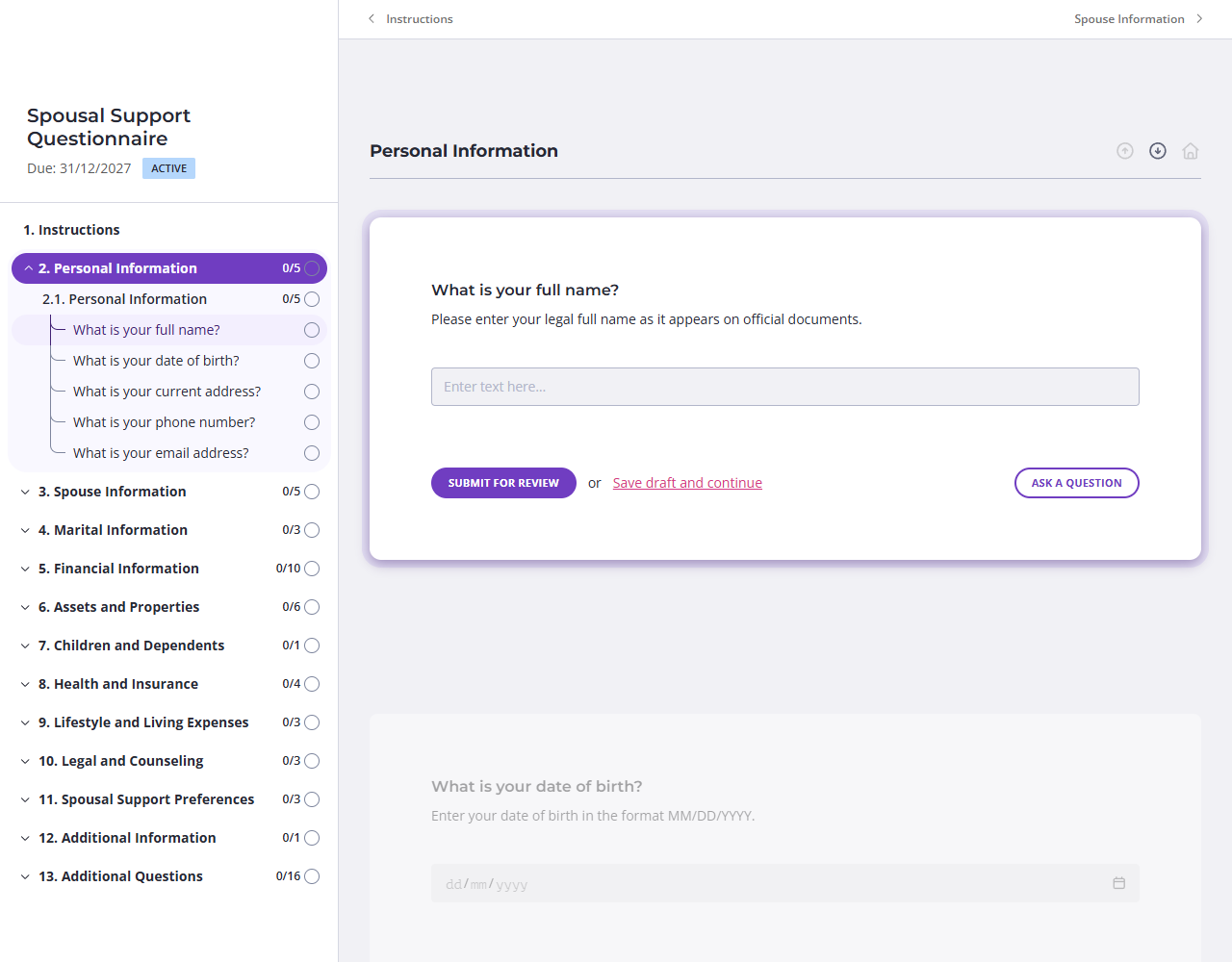
How to use Content Snare for your spousal support questionnaire

Spousal support questionnaire template in Content Snare

Break complex questions into logical pages

Spousal support cases involve sensitive financial and personal details. Organize your questionnaire into clear pages - Personal Information, Financial Details, Assets & Properties, Children & Dependents, and Support Preferences. Clients can complete one section at a time without feeling overwhelmed by a 50-question scroll. They can save progress and return later when they need to gather documentation for the financial sections.

Show or hide questions based on previous answers

Conditional logic keeps your form relevant to each client's situation. If someone answers "no" to "Do you have any children or dependents?", hide the follow-up questions about names, ages, and special needs. When clients indicate they have debts or health issues, show the detail fields requesting specifics. You'll collect exactly what you need without forcing clients through irrelevant questions.

Add instructions for financial sections to get accurate data

The income, expenses, and asset questions require precision. Add brief instructions above these sections explaining what to include: "List gross monthly income before taxes and deductions" or "Include mortgage payments, utilities, insurance, and regular household expenses in your monthly cost estimate." A quick note about gathering recent bank statements or pay stubs before starting saves everyone from vague estimates that require clarification later.

Set up automatic reminders to keep cases moving

Clients dealing with separation are juggling emotional stress and logistical chaos. Automatic reminders ensure your questionnaire doesn't get lost in the shuffle. Content Snare can follow up for you at intervals you choose, keeping the tone professional and pressure-free. You stay on top of case progress without manually tracking who's submitted what or sending awkward "just checking in" emails.


Why use Content Snare

Email chains and PDF attachments create chaos in spousal support cases. Clients send incomplete information across multiple messages. You waste time consolidating responses and following up on missing details. Content Snare centralizes everything in one secure, organized place where clients can complete your questionnaire at their own pace and you can track progress in real time.

The platform is ISO 27001 certified and trusted by law firms handling sensitive client data. Clients see your branding throughout the experience, reinforcing professionalism during an already stressful process.

Content Snare handles the follow-up for you with automatic reminders, so cases keep moving without awkward nudging emails. Hundreds of 5-star reviews across G2, Capterra, and Trustpilot highlight how firms save hours per client on intake alone.

The platform integrates with tools you already use - your CRM, practice management software, and cloud storage - so information flows directly into your workflow.

Beyond spousal support questionnaires

This form is just one application. Legal professionals use Content Snare for:

  • Client intake forms for new matter onboarding across practice areas
  • Discovery document requests with clear instructions for what clients need to provide
  • Estate planning questionnaires collecting beneficiary information and asset details
  • Personal injury case intake gathering incident details, medical records, and witness information
  • Business formation packets collecting entity information, shareholder details, and operating agreements

Get the information you need without chasing people

Content Snare is the stress-free way to get information from anyone. Break free of your inbox and reclaim your time. Let Content Snare chase your clients for you.
Start My Free Trial

Related templates

lockcrossmenuchevron-uparrow-right