


A comprehensive intake form that documents a company's proprietary information assets, protection protocols, access controls, and incident response procedures to assess trade secret vulnerability and legal preparedness.

Attorneys and legal teams conducting trade secret audits for corporate clients, handling misappropriation cases, or advising businesses on intellectual property protection strategies.

During initial client intake for IP matters, when investigating suspected trade secret theft, before litigation, or as part of annual compliance reviews and risk assessments.
A client calls in a panic - their former employee just joined a competitor, and they suspect proprietary information walked out the door with them. You need to assess what was taken, who had access, and whether adequate protections were even in place. The problem? Critical details about trade secret identification, security measures, and incident response protocols are scattered across departments or simply undocumented.
A trade secrets questionnaire streamlines this entire process. It helps you gather comprehensive information about what trade secrets exist, how they're protected, who has access, and what safeguards are active - all in one structured form. This post covers what the questionnaire includes, practical tips for implementation with clients, and a free template you can customize. Let's break it down.
Identification of Trade Secrets
Use this group to inventory protected assets and capture their origin and scope.
Protection Measures
Document the contractual, physical, and technical controls that evidence reasonable measures.
Employee and Contractor Access
Map who can see what and how least-privilege and training are enforced.
Documentation and Management
Confirm governance, ownership, and change-control for trade secret records.
Disclosure and Use
Surface external disclosures and commercial arrangements that affect secrecy and valuation.
Legal Considerations
Record litigation history, enforcement planning, and legal coverage.
Expiration and Evolution
Define lifecycle criteria and potential patent migration paths.
Risk Assessment
Capture top threats, assessment method, and review cadence.
Incident Response
Outline breach playbooks and accountable roles.
Compliance and Best Practices
Establish regulatory alignment and adherence to recognized standards.
Send a preliminary scope document first: Before distributing the trade secrets questionnaire, share a brief explainer on what qualifies as a trade secret versus other IP. Many clients conflate patents, copyrights, and proprietary information. Clarifying definitions upfront means you'll get more accurate responses in the "Identification of Trade Secrets" section and won't waste time sorting through irrelevant submissions.
Request supporting documentation alongside the form: Ask clients to attach existing NDAs, employee handbooks, security policies, or any trade secret registries they maintain. This gives you tangible proof to cross-reference against their answers about protection measures and access controls. You'll spot gaps faster - like claims of "robust security" that aren't backed by actual policies.
Schedule a follow-up call for the risk assessment section: Questions about threat analysis and incident response often surface issues clients haven't fully considered. Rather than letting them struggle with blank fields, set up a 30-minute discussion after initial submission. You can probe deeper into potential vulnerabilities, recent departures of key personnel, or industry-specific risks they may have overlooked.
Use responses to build a prioritized action plan: Once you receive the completed form, categorize findings into immediate risks (no NDAs in place, unrestricted employee access), medium-term improvements (formalizing documentation practices), and long-term strategy (patent transition considerations). Present this roadmap in your follow-up meeting so clients see clear next steps, not just a laundry list of problems.
Track year-over-year changes: Trade secret portfolios evolve as businesses grow, employees turn over, and technology shifts. Save each client's responses and review them annually or after major company events like mergers or leadership changes. This creates a living audit trail and helps you catch deteriorating protections before they become litigation nightmares.
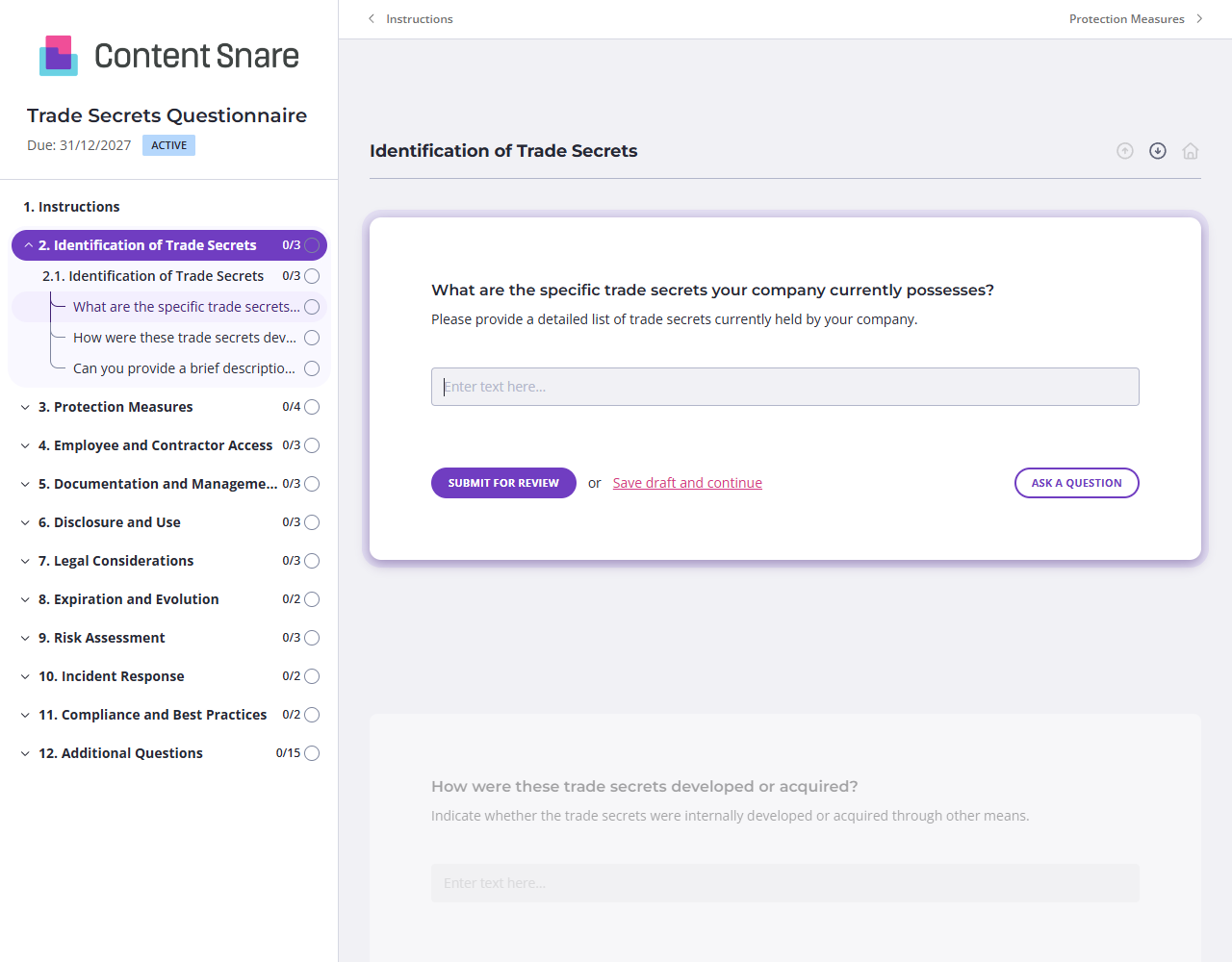
Trade secrets questionnaires cover a lot of ground - from identifying assets to incident response protocols. Split the form into logical pages like "Trade Secret Identification," "Protection Measures," "Access Controls," and "Legal & Compliance." Clients can tackle one area at a time without feeling overwhelmed by a 30-question scroll. They can save progress and return later, which matters when gathering information from multiple departments or digging up security policies buried in shared drives.
Questions about "physical security measures" or "trade secret registries" can be vague to clients who've never formalized these processes. Use instruction areas to clarify what you're looking for. For the protection measures section, explain that physical security might include locked server rooms, restricted access badges, or safes for physical prototypes. For the documentation question, note that a registry could be as simple as a spreadsheet listing each trade secret, its custodian, and date of last review. Clear guidance upfront means fewer "I'm not sure what you mean" emails and more complete initial submissions.
You likely already know basic details about your client's business - company name, industry, key contacts, existing legal team members. Prefill those fields before sending the questionnaire. Delete questions that don't apply to their specific situation. A solo consultant doesn't need extensive questions about employee training programs, and a pure software company won't have questions about physical prototype security. Tailoring the form shows you've thought about their needs and cuts down the time they spend filling it out.
Trade secret questionnaires often require input from IT (for electronic security measures), HR (for NDAs and training), operations (for physical access controls), and legal. Clients frequently get stuck waiting on one department while others have already responded. Automatic reminders keep the form moving without you having to track down each stakeholder manually. Schedule follow-ups at 3 days, 7 days, and 14 days so nothing falls through the cracks during busy periods.
Email threads turn trade secret assessments into chaos. Attachments get lost, version control becomes a nightmare, and you're left chasing clients for missing information weeks after the initial request. Content Snare eliminates the back-and-forth with a structured questionnaire that tracks exactly what's been completed and what's still outstanding. Clients get a professional experience, and you get complete responses without the follow-up hassle.
Security matters when handling sensitive IP information. Content Snare is ISO 27001 certified and trusted by legal professionals worldwide - critical when you're collecting details about proprietary formulas, client lists, and security protocols. You can customize every aspect of the form to match your firm's branding, and it integrates seamlessly with tools you already use.
Trade secrets questionnaires are just one application. Legal teams use Content Snare for:
Content Snare has hundreds of 5-star reviews across G2, Capterra, and Trustpilot. It's built for professionals who need complete information without the constant follow-up grind.


