


A comprehensive intake questionnaire that captures transaction details, dispute history, evidence documentation, and client goals for consumer law cases before the first consultation.

Consumer law attorneys and legal practices handling disputes involving defective products, false advertising, unauthorized charges, contract breaches, and other consumer protection matters.

During initial client intake, before the first consultation, to systematically gather all essential case information and documentation while assessing case viability based on damages, budget, and urgency.
Most consumer law cases collapse before they begin - not from weak claims, but from incomplete information. Clients struggle to recall transaction dates, misplace critical documents, and forget key details about disputes. You end up playing detective instead of advocate, wasting billable hours on basic fact-finding.
A consumer law questionnaire solves this problem upfront. It systematically captures everything you need - from transaction details and dispute history to evidence documentation and client goals - before the first consultation. This post covers what to include in your questionnaire, how to use it effectively during intake, and a free template you can customize. Let's break it down.
Client Information
Start with the basics you need to open a file and know how to reach the client.
The individual or business question tells you who the client is for engagement and conflict checks.
Legal Issue Identification
These questions give you a quick read on the issue and how far it has already progressed.
Prior advice and existing filings can affect deadlines and strategy, so check these answers early.
Consumer Transaction Details
This group captures the purchase at the centre of the dispute.
The transaction date and payment details help you assess limitation periods and the remedies available.
Dispute Description
Here the client explains the problem and what has happened since.
Earlier resolution attempts and offers from the other side show where negotiations stand before you step in.
Damages or Loss
These questions size up the harm the client has suffered.
Legal Preferences and Goals
This group sets expectations on outcome, timing and cost.
Budget and urgency answers let you scope the work and raise any gap between goals and resources at the start.
Previous Legal Actions and Outcomes
These questions surface history that could affect the current matter.
Evidence and Documentation
This group shows what proof the client already holds.
Knowing what evidence exists, and whether any formal investigation has started, helps you judge the strength of the claim early.
Legal Representation and Authorization
Confirm who else is involved and what the client lets you do on their behalf.
Additional Comments
Give clients room to add anything the earlier questions missed.
Send a pre-form email explaining what documents to gather: Before clients fill out your consumer law questionnaire, give them a checklist of what they'll need - contracts, receipts, correspondence with the seller, proof of payment, and any warranty information. This prevents half-completed submissions and saves you from chasing down basic documentation later.
Use the completed form as your consultation roadmap: Print or open the client's responses during your initial meeting and work through each section systematically. This keeps consultations focused and ensures you don't miss critical details about damages, previous resolution attempts, or timeline issues that could affect statute of limitations.
Flag budget and urgency responses immediately: The questions about budget and timeline urgency tell you whether a case is viable before you invest significant time. A client seeking $500 in damages but unwilling to spend more than $200 on legal fees needs a different approach - or a referral to small claims court.
Cross-reference evidence claims with actual documentation: Clients often say they "have emails" or "kept records" in the evidence section, but those documents never materialize. Create a follow-up task to verify that every piece of evidence mentioned actually exists and is usable. Request specific items by name based on their responses.
Look for red flags in the previous legal actions section: If a client has multiple prior disputes or existing judgments, dig deeper before taking the case. These responses can reveal patterns of litigiousness, credibility issues, or complications that might affect your representation strategy.
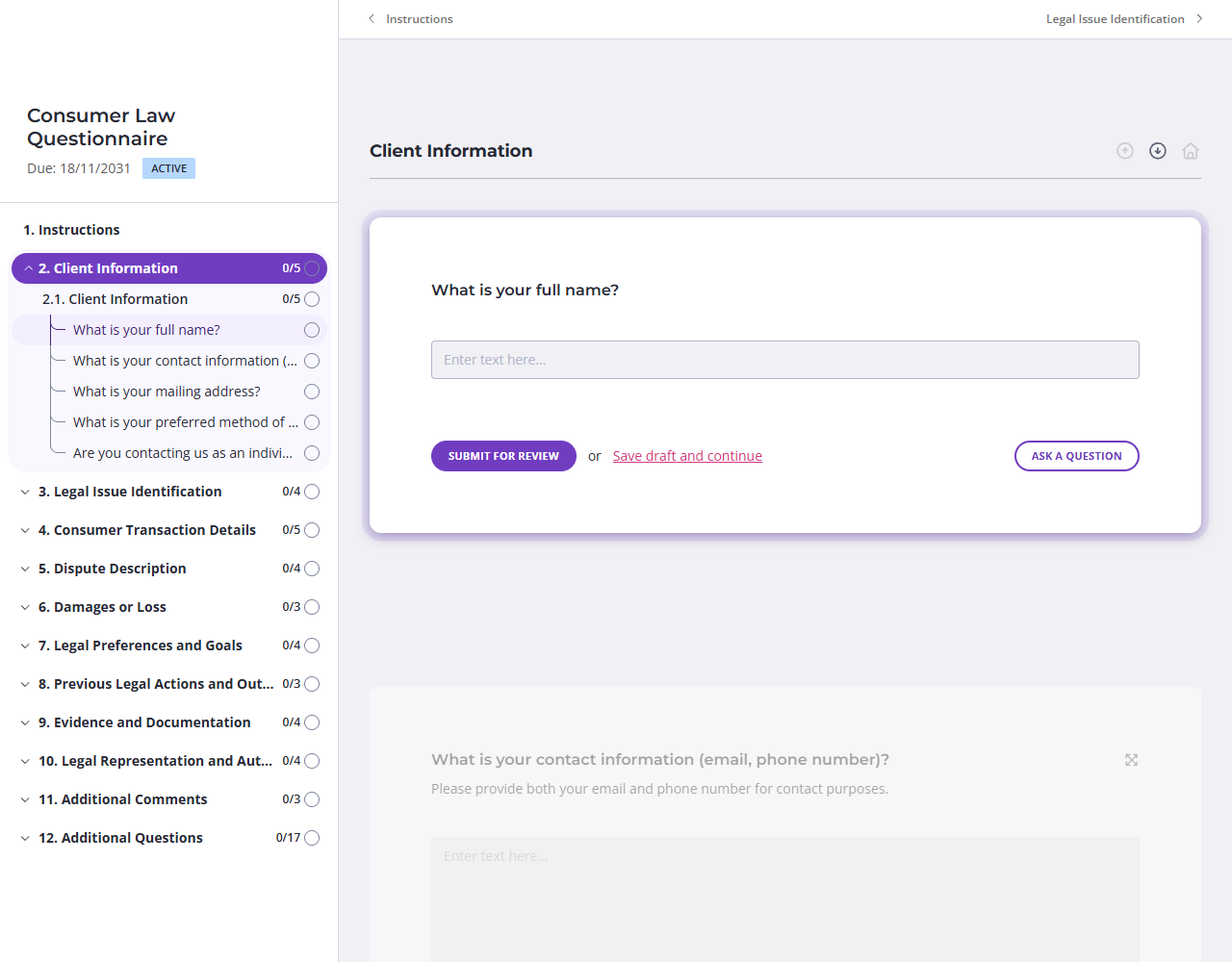
Consumer law cases involve multiple moving parts - transaction details, dispute history, evidence documentation, and legal preferences. Content Snare lets you split your questionnaire into separate pages for each major section. Clients can complete "Consumer Transaction Details" on one page, save their progress, then return later to tackle "Evidence and Documentation" when they've gathered their receipts and correspondence. This prevents overwhelming clients with a 50-question wall of text and dramatically improves completion rates.
Not every question applies to every client. Someone contacting you as an individual doesn't need business-related follow-ups. A client who hasn't sought previous legal advice shouldn't see questions about prior attorneys or existing judgments. Content Snare's conditional logic shows or hides questions based on earlier answers, creating a streamlined experience that respects your client's time and reduces confusion.
The "Evidence and Documentation" section makes or breaks consumer law cases, but clients often misunderstand what you need. Use Content Snare's instruction areas to clarify expectations. Next to "What evidence do you have to support your claim?" add a brief note: "Include photos of defective products, screenshots of false advertising, or records of unauthorized charges." For document requests, specify acceptable formats: "Upload PDFs or clear photos - we need to read the fine print on contracts and receipts." Clear guidance upfront means fewer back-and-forth emails asking for usable files.
Clients start your questionnaire with good intentions, then life intervenes. They get stuck on the damages section or can't find that purchase agreement right away. Content Snare sends automatic reminders so incomplete forms don't fall through the cracks. You're not the one nagging - the system handles it professionally, freeing you to focus on active cases instead of playing intake coordinator.
Email threads turn intake into chaos. Clients send partial information across multiple messages, attachments get lost, and you waste hours tracking down missing details. Content Snare centralizes everything in one organized submission, automatically follows up on incomplete sections, and ensures you get usable information the first time. You'll never again dig through your inbox searching for a client's transaction date or that PDF they swore they sent.
Security matters in legal work. Content Snare is ISO 27001 certified and trusted by law firms handling sensitive client information. Your consumer law questionnaire - complete with financial details, dispute documentation, and personal data - stays protected with enterprise-grade security that meets professional standards.
Files can sync to Google Drive, Dropbox, OneDrive or SharePoint, and Zapier, Make and the API connect Content Snare to your other tools. Hundreds of 5-star reviews across G2, Capterra, and Trustpilot confirm what thousands of businesses worldwide already know: Content Snare delivers professional client intake without the friction.
This consumer law questionnaire is just one application. Legal professionals use Content Snare for:
The platform adapts to any legal workflow where you need complete, organized information from clients.


