


A structured intake form that captures client citizenship, tax residency status, foreign income sources, international assets, multi-country compliance history, and documentation needed for cross-border tax matters.

Tax attorneys, international law firms, and legal advisors who handle cross-border taxation, expatriate compliance, foreign asset reporting, and multi-jurisdictional tax planning for individual and business clients.

Send at initial client onboarding for international tax matters, before consultation calls to gather complete financial details, or annually to update foreign income and asset information for ongoing compliance work.
Your client just sent over a messy spreadsheet with their foreign income details - half the cells are blank, property values are in three different currencies, and you're not even sure which countries they've filed returns in. Sound familiar?
International tax matters are complex enough without incomplete client data slowing you down. An international tax questionnaire streamlines intake by capturing everything upfront: residency status, foreign assets, multi-country income sources, and compliance history in one organized form. This post covers what the form should include, how to use it effectively with clients, and a free template you can customize for your practice.
Let's dive in.
Personal Information
Start with the identity details you need to open the client file and match their records to the right person.
Contact Information
These questions set how you reach the client when a filing or a foreign authority needs a quick answer.
Employment and Income
This group shows where the client's income comes from and which of it may be taxable in more than one country.
The multi-country income question tells you which jurisdictions to look at first. The tax-exempt income question catches items that still need reporting even when no tax is due.
Tax Residency
Residency drives which country can tax what, so this group sets the scope of the whole engagement.
The last two questions surface dual residency and part-year moves that clients often leave out when they only list their home country.
Foreign Assets and Accounts
These questions identify the offshore holdings that trigger reporting obligations.
Trusts, foundations and foreign gifts carry separate disclosure rules and penalties. Clients rarely mention them unless asked directly.
Deductions and Credits
This group collects the foreign-side items that can reduce the client's overall liability.
Compliance and Documentation
These questions show the client's filing history and any risk you inherit before you start work.
Prior penalties and pending legal issues change how you approach the engagement, so you want to know about them before you quote or file.
Additional Information
Use this group to pick up anything the earlier sections missed and to let the client raise their own concerns.
Foreign pensions and business activities are common gaps in an intake form, and they often carry their own reporting requirements.
Send a pre-questionnaire checklist: Before you share the form, email clients a simple list of documents they'll need on hand - foreign bank statements, property deeds, employment contracts from multiple jurisdictions, and any prior-year tax returns filed abroad. This prevents the "I'll have to get back to you" cycle and speeds up completion dramatically.
Break complex sections into client conversations: The Foreign Assets and Accounts section often trips people up - clients forget about that rental property in Spain or the inheritance sitting in a trust overseas. Walk through these questions verbally first during an initial call, then send the form as a way to formalize and document what you've discussed. You'll catch details they'd otherwise miss on a solo form fill.
Flag inconsistencies immediately after submission: Review responses for red flags before your next meeting - like someone claiming single-country tax residency but listing income from three different nations, or missing documentation for foreign accounts. Create a quick follow-up list of clarifying questions so your first substantive conversation is productive, not just another round of information gathering.
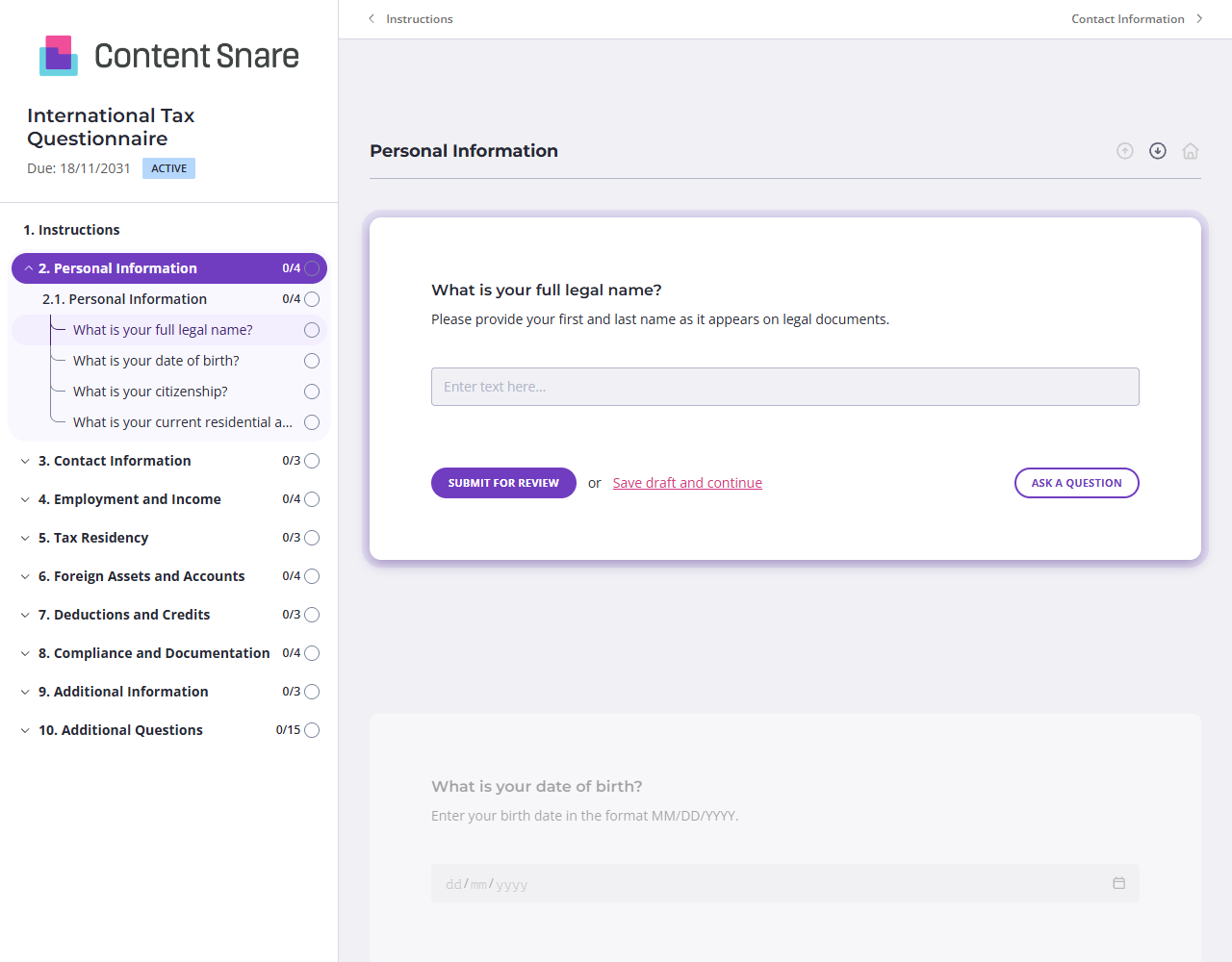
Not every client has foreign trusts, rental income, or multi-country employment. Conditional logic lets you hide irrelevant sections based on earlier answers. If someone selects "retired" for employment status, skip the employer questions. If they answer "no" to holding foreign accounts, the entire Foreign Assets section disappears. Clients see a shorter, cleaner form tailored to their situation - and you avoid sorting through dozens of "N/A" responses.
The Foreign Assets and Accounts questions require specifics: account numbers, property addresses, exact valuation dates. Add instruction text directly above these fields explaining what you need and why. For foreign property, clarify whether you want purchase price or current market value. For income sources, specify the date range and currency format. Clear instructions up front mean fewer back-and-forth emails correcting submission errors.
You likely know your client's legal name, citizenship, residential address, and email before sending this form. Prefill those fields so clients jump straight into the substantive tax questions - residency status, foreign income, asset holdings. It shows you're prepared, saves them time, and lets them focus mental energy on the complex financial details that actually require their input.
International tax questionnaires are notoriously slow to complete - clients need to dig up foreign bank statements, translate documents, or contact overseas accountants. Automatic reminders keep the form moving without you playing enforcer. Schedule gentle nudges every few days, and clients stay on track without feeling nagged.
Email attachments get lost. Shared Google Docs turn into version control nightmares. Phone calls require endless note-taking and follow-up. Content Snare gives you a dedicated space where clients submit everything you need - structured, complete, and tracked - without the back-and-forth chaos that bogs down international tax work.
Content Snare is ISO 27001 certified, which matters when you're collecting sensitive financial data across multiple jurisdictions. Clients can trust that their foreign account details, asset valuations, and tax documentation are handled securely. It's used by thousands of businesses worldwide and has hundreds of 5-star reviews across G2, Capterra, and Trustpilot.
The platform syncs files to cloud storage like Google Drive, Dropbox, OneDrive and SharePoint, and connects to other apps through Zapier, Make or the API.
This form is just one use case. Legal professionals use Content Snare for:
Any scenario where you need detailed information from clients - and need it organized, complete, and on time - becomes simpler with Content Snare.


