
Learning and development is one of those things that every accounting firm agrees is important, but somehow keeps slipping down the priority list. There’s always something more urgent, usually things like deadlines or internal bottlenecks that need immediate attention. In a recent podcast episode of Between Two Ledgers, James Rose sat down with Rob Pillans to unpack why that happens and where firms tend to get it wrong.
The conversation goes beyond technical training and looks at the broader skills people need as they move into more senior roles. What emerges is a pattern: most firms aren’t lacking training altogether, they’re just focusing on the wrong areas.
ABOUT
Rob Pillans
Rob Pillans is the founder of Planet Consulting, where he works with accounting firms on leadership and team development. He has over 30 years of experience in and around firms, including roles as CEO, general manager, and business services manager.
The gap between technical and non-technical training

Technical training tends to take care of itself. Rob explains this kind of training is required and measurable, which is why firms know how to deliver it. The problem starts when people move beyond purely technical roles. As responsibilities shift, so does the skillset required, but the training often doesn’t follow:
“I think most firms do the technical training pretty well… but there’s other forms of training which are so important, particularly as people get more senior.”
Once someone becomes a manager, they’re expected to lead people, review work, communicate with clients, and coordinate across teams. These aren’t skills most accountants are formally trained in, according to Rob. Instead, many learn by observing others, which usually means repeating habits rather than building real capability. Over time, that creates a layer of technically strong managers who are underprepared for everything else the role requires.
Defining “how we do things around here”
Another issue that shows up quickly is the lack of clarity around internal ways of working. Even when processes exist, they’re often loosely defined or interpreted differently across the team. Rob says this becomes especially visible in delegation:
“Sometimes it’s as simple as when something is due… I might think ‘end of the week’ means 5:30pm Friday, but what I really meant was lunchtime Friday.”
Small gaps like this create friction that compounds over time. The challenge isn’t just documenting processes, but making sure people understand what good looks like in practice. That includes context, judgment, and knowing where to draw the line.
A common issue inside firms is overworking small details. For instance, junior team members can spend far too long chasing minor items that don’t materially impact the outcome. Rob points out that even well-intentioned work quickly becomes inefficient when expectations around effort and priorities aren’t clearly set.
Making time for training in busy firms
Time is one of the major barriers to better learning and development. Accounting firms know this matters, but it’s constantly pushed aside by more immediate work. There’s always another job to finish or deadline to hit.
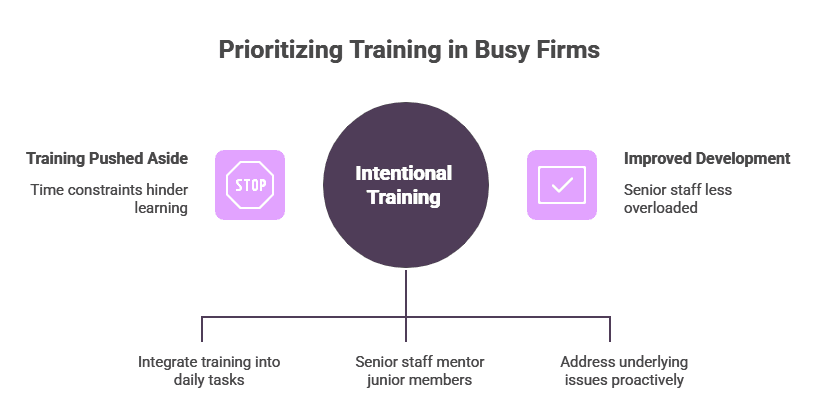
The problem is that without making space for training, the underlying issues don’t go away. That way, senior people stay overloaded while junior team members don’t develop as quickly as they could. Besides that, inefficiencies become part of the system. Rob notes fixing this doesn’t require massive change, but it does require intent - training has to be treated as part of the job, not something extra that happens if there’s time left over.
The role of technology and AI in learning
Technology introduces a different kind of challenge in accounting because it’s not even clear how people learn to use new tools. In many cases, the biggest barrier is hesitation. This is how Rob puts it:
“One of the ways we learn is just playing with stuff… we read, then we play, and go - oh, I could do that now.”
In his opinion, that kind of learning doesn’t happen unless people feel they have permission to experiment. If every hour is expected to be billable or productive in the traditional sense, there’s no room to explore.
That’s exactly why leaders play a key role here. They are the ones who need to signal that experimentation is a valid use of time. Without that, even the best tools end up underused.
Related: How small automation wins create big change in accounting
A more balanced approach to learning
What this conversation makes obvious is that learning and development in accounting firms needs to be broader and more deliberate. Technical skills will always matter, but accounting practices also need to think about how people manage work, communicate, delegate, and adapt to change. Rob says this becomes even more relevant for senior staff taking on leadership responsibilities:
“You can’t manage other people if you can’t manage yourself.”
That line captures the core issue: development requires knowledge, but it also demands capability. And the firms that recognize that early are the ones that build stronger teams over time.