
Plenty of firms say they care about culture, but only a handful can explain how they build it and how to keep it strong as the team grows. In a recent episode of Between Two Ledgers, host James Rose sits down with Taryn Holman from Seamless SMSF to discuss exactly how they do it. Seamless is an outsourcing partner for accountants and financial planners, and their vibe is hard to miss: people talk about the business differently and seem genuinely proud of the team they’re part of.
What’s interesting is that none of it is accidental. Taryn makes the case that great culture is designed on purpose through careful hiring and shared standards. We’ve highlighted the most useful lessons from the conversation, along with practical ways other firms can apply them without needing a Silicon Valley playbook.
ABOUT
Taryn Holman
Taryn Holman is a longtime team member at Seamless SMSF, where she focuses on relationships, community, and experiences that strengthen trust with clients and peers.
Business culture is a system
One of the biggest takeaways from this chat is that culture isn’t something you write on a wall and hope for the best. At Seamless SMSF, it’s treated like a system with inputs and outputs. Here’s how Taryn explains it:
“It’s an amazing business, and that’s not an accident because Mike McHenry has really designed the culture of Seamless. It hasn’t happened by default.”
The idea is simple: if you want a team that feels high-trust, high-energy, and genuinely connected, you can’t leave it to chance. You have to design the conditions where that’s likely to happen and repeat them until they become normal.
Hiring for “fit” first (and being unapologetic about it)
According to Taryn, most firms hire for skills and then hope the person gels with the team, while Seamless flips that order. Before anyone gets deep into the interview process, candidates go through what the team calls the “two-hour coffee or beer test.”
It’s not literally a two-hour meeting. It’s a short conversation with several team members, designed to answer one question: would we happily spend a couple of hours with this person?
If the answer is yes across the board, then skills and role-fit get their turn:
“You’re spending eight hours a day with people, sometimes ten or eleven… You’d rather stab yourself in the eye with a fork than hang out with someone for that amount of time and not actually get along with them.”
It’s a strong filter, but it’s also honest. After all, if someone looks perfect on paper but makes everyone tense in real life, that’s a big problem.
Trust grows faster when people actually talk to each other
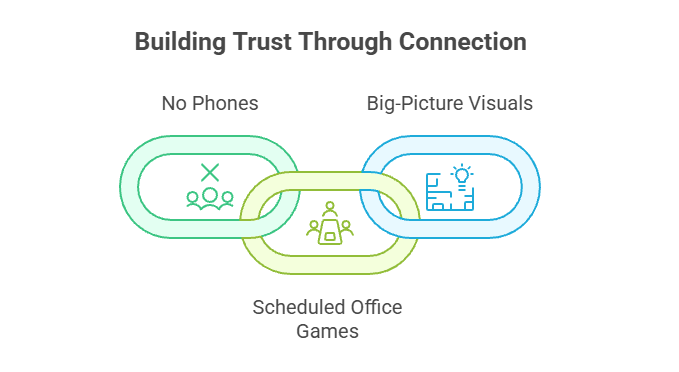
A lot of modern work is designed to reduce friction: fewer meetings, fewer interruptions, fewer reasons to stop and chat. On the other hand, Seamless SMSF intentionally adds some friction back in, but they do it in a good way. Taryn shared a few examples:
- No mobile phones in the office: Conversations happen more naturally and meetings aren’t half-attended while someone scrolls.
- Scheduled office games: The idea isn’t just to have “a pool table in the corner.” The purpose of this approach is to structure games and rotate matchups so people mix beyond their usual circles.
- Big-picture visuals: The team creates a shared “where we’re going” picture each year, and it’s displayed in the office so it stays top of mind.
Taryn points out that it’s hard to build trust if people only interact inside their job description. In her own words, trust comes from shared experiences and enough casual conversation to make work feel human. Culture is mostly made from the everyday stuff, not the annual retreat.
Pro tip: cut distraction before you add more “culture activities”
The team at Seamless SMSF understands that most people don’t need another initiative. What they really need is fewer things pulling everyone’s attention away from each other. That’s why it’s best to create a bit more space for real conversation instead of organizing workshops.
Events people remember aren’t about traditional networking
The second half of the podcast shifted into the world of events, with Taryn explaining why some gatherings create real connection while others feel like awkward small talk with name tags. Taryn runs “Net Walking,” an early morning walking event where people show up in activewear, walk in pairs, and rotate conversations every few minutes. According to her, the result is a different kind of networking that feels less polished and more effective.
Sometimes Seamless goes big with special outings, but the middle ground is what most firms will find useful: these are thoughtful details that make people feel seen without burning a hole in the budget. Taryn shared a nice example - she learned someone didn’t drink coffee, tea, or alcohol, but loved Coca-Cola. Before a virtual meeting, she arranged for two cans of Coke to be delivered to their office, which was a simple and cheap but highly memorable move.
“It’s about paying attention and actually caring about people, there are no gimmicks to this.”
The bottom line: Relationships compound when you play the long game
That small Coca-Cola moment sums up the bigger theme running through the entire conversation: a genuine interest in people. With that said, Taryn’s advice is to play the long game:
- Spend time with people
- Ask questions
- Listen more than you talk
- Make notes and follow through
- Give without keeping score
As she put it, people will break up with a service provider, but they’re much less likely to break up with a friend. This is why successful firms focus less on transactions and more on building relationships that stand the test of time.