
Australia’s upcoming Tranche 2 reforms will greatly expand anti-money laundering and counter-terrorism financing (AML/CTF) obligations to professions that have historically sat outside the regulatory framework. Kicking off 1st of July 2026, most firms will need to verify identity documents, identify beneficial owners, assess risk levels, and maintain detailed records of their due diligence. That’s a lot of extra admin many professionals have never had to formalise before.
However, much of the heavy lifting can be automated. Content Snare now supports the full identity verification and AML screening workflow required for Tranche 2 compliance, alongside the client information collection firms are already doing every day. The same platform that gathers documents and onboarding information now handles identity verification, AML checks, and risk assessment records simultaneously.
Before we get into the specifics, it’s worth noting what Tranche 2 requirements actually involve.
The boring (but important) regulatory details
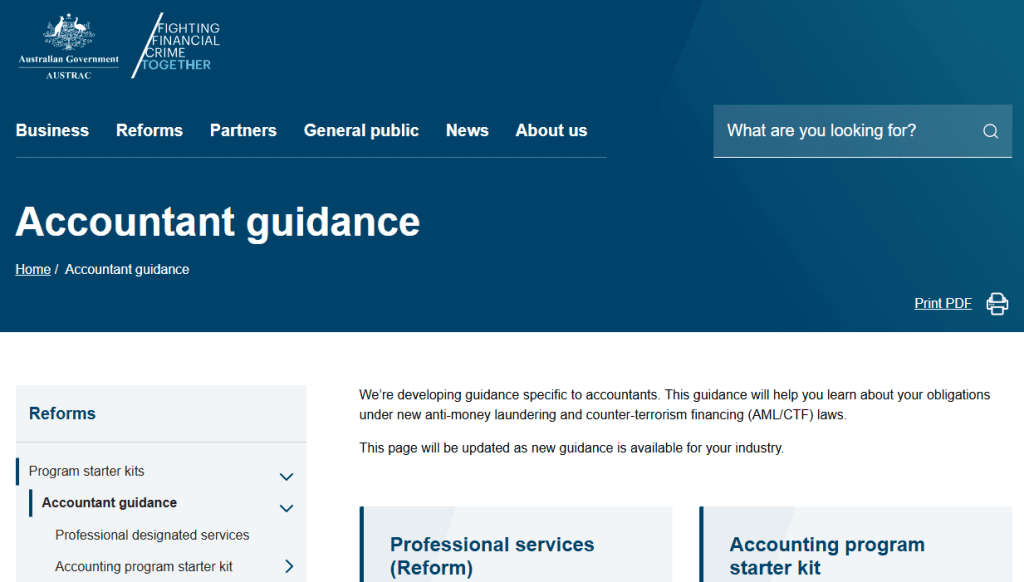
The upcoming Tranche 2 reforms expand Australia’s anti-money laundering regime to cover professions like accountants, lawyers, and real estate agents. Under the oversight of the Australian Transaction Reports and Analysis Centre (AUSTRAC), regulated businesses must implement a range of compliance procedures. In a nutshell, accounting practices will need to:
- Develop an AML/CTF program with documented policies and procedures
- Appoint an AML/CTF compliance officer
- Verify the identity of clients and beneficial owners
- Screen individuals against sanctions and politically exposed person (PEP) lists
- Assess the risk level of each client relationship
- Conduct ongoing customer due diligence
- Maintain records of all checks performed for at least 7 years
- Report suspicious matters to AUSTRAC
None of these requirements are particularly unusual on their own - banks and financial institutions have been doing them for years. The difference is that most accounting firms in Australia still don’t have the systems in place to handle this kind of compliance workflow.
Content Snare can help with the operational side of this: collecting client information, verifying identities, running AML screening, recording risk assessments, and keeping everything in one exportable record. The policy and program side is up to your firm (and ideally, a compliance professional).
Why AML compliance can quickly become messy
Most regulatory guidance documents assume a fairly formal compliance environment. They are written in a way that makes sense to lawyers and regulators, but not always to ordinary accounting clients. For example, this is a question from one of the official guidance questionnaires provided to firms - documents that accountants are expected to interpret and translate into client-facing questions:
“What powers bind or govern you?”
That might make sense in legal language, but it’s not the kind of question business owners will understand. And then there’s the workflow problem. Without a structured system, AML compliance can look something like this:
- Long questionnaires sent by email
- Identity documents arriving as attachments
- Manual checks against sanctions and PEP databases
- Separate notes about risk assessments
- Documents stored across multiple folders
Even with the best intentions, the process will quickly become fragmented. This is exactly the type of workflow Content Snare is designed to simplify.
Identity verification and AML screening in one workflow
Thousands of accounting firms already use Content Snare to collect structured information from clients. For Tranche 2 compliance, identity verification and AML screening simply become another step inside that same workflow. From your client’s perspective, the process is intentionally simple:
- Fill out the basic info
- Upload an identity document
- Take a selfie to confirm identity
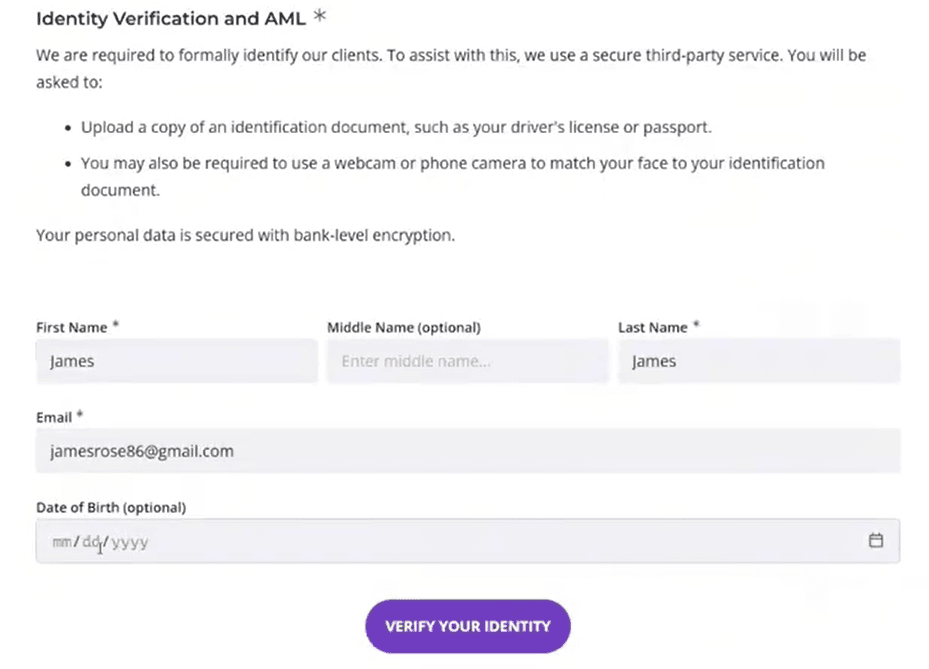
Behind the scenes, however, the system performs a much wider set of checks. These checks include:
- Identity document authenticity verification
- Identity matching between the document and the person submitting it
- Sanctions list screening
- Politically exposed person (PEP) checks
- Financial crime database searches
- Adverse media analysis
While the client only completes a few steps, the system runs a large number of verification checks in the background. The result is a detailed verification report that firms can review and store as part of their compliance records. Here’s a quick look at how the verification process works in practice:
Pricing and credits
Content Snare features a simple credit-based system for identity verification and AML screening.
A verification can either cost 1 or 2 credits.
- 1 credit if only standard features are used
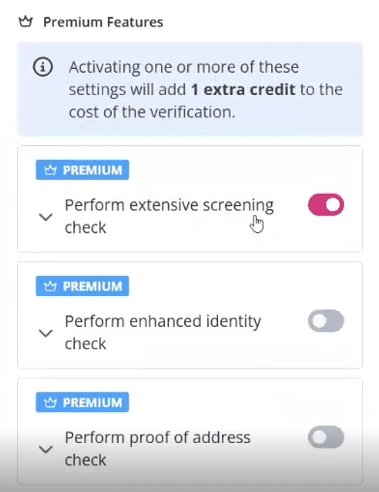
- 2 credits if any premium features are used
Each credit costs $4.99.
Even if you enable all premium features (extensive screening, enhanced identity verification, and proof of address) the total cost remains 2 credits per verification, not per feature.
Identity verification: Standard vs advanced
Content Snare allows you to choose between different levels of identity verification depending on your risk policies.
Standard identity check (1 credit)
The standard identity check verifies that the person submitting the information matches their identity document using a selfie-based verification. It runs multiple actions, including:
- Facial similarity (matching the selfie to the ID photo)
- Liveness detection to confirm the person is physically present
- Anti-spoofing protection against common attacks (such as printed photos or masks)
This process runs in just a few seconds and provides a reliable level of identity verification for most client onboarding scenarios.
Advanced identity check (2 credits)
Enhanced identity checks add another layer of fraud protection. They are typically used when a higher level of confidence is required or when regulations mandate stronger verification. This system uses a video-based verification flow, where the client is guided through actions such as:
- Turning their head
- Solving voice challenges or responding to prompts
- Completing motion-based challenges
These additional steps provide stronger assurance that a real person is present and significantly reduce the risk of advanced spoofing attempts, including video replay or deepfake-style attacks.
AML screening: Standard vs extensive
In addition to identity verification, Content Snare performs AML screening on individuals captured in the request. This also comes in two levels.
Standard AML screening
Standard AML screening checks individuals against core compliance databases, including:
- Global sanctions lists
- Politically exposed person (PEP) databases
- Key watchlists and regulatory sources
This level of screening is sufficient for most client relationships and aligns with standard AML compliance requirements during onboarding.
Extensive AML screening
Your firm can also enable more extensive screening for higher-risk clients. This expands the scope of checks to include:
- A broader range of global watchlists and exclusion lists
- Deeper PEP coverage across multiple levels
- Adverse media screening across categories such as financial crime, regulatory issues, and organised crime
With coverage across thousands of international data sources, extensive screening provides deeper insight into potential risk signals and supports enhanced due diligence requirements.
Questionnaire templates built around AUSTRAC guidance
Regulatory guidance usually comes in the form of long documents or generic templates that are not particularly client-friendly. Content Snare is converting these questionnaires into six ready-to-use templates designed specifically for accounting workflows.
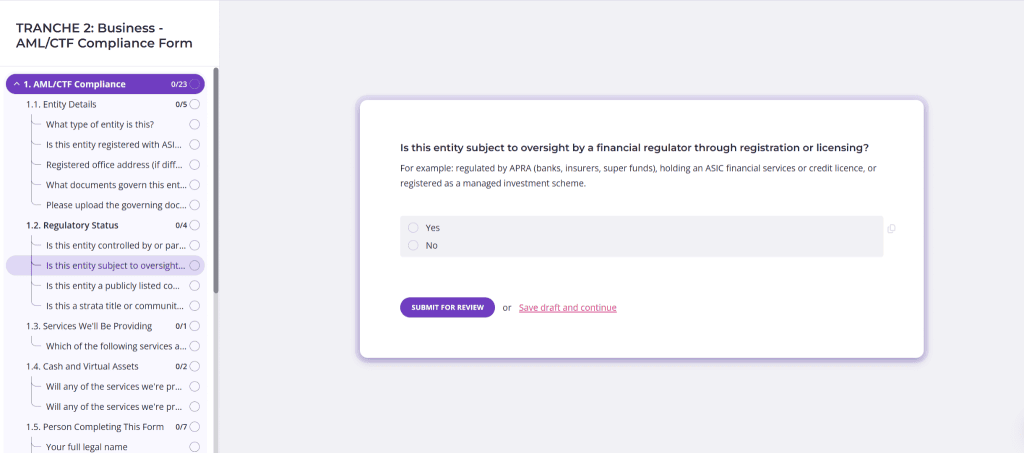
Templates cover common entity types, including:
- Individuals and sole traders
- Companies
- Partnerships and associations
- Trusts
- Government bodies
Each template asks the questions required to identify the client, understand the ownership structure, and determine whether AML obligations apply. The difference is that the questions are presented in clear language clients can actually understand, with explanations and instructions guiding them through the process.
In addition, two of these templates will be integrated directly into Content Snare’s existing client onboarding templates (individual and business), allowing you to collect information and Tranche 2 compliance data in a single request.
Conditional logic also keeps the experience simple. For example, beneficial owner questions only appear if the client indicates that someone owns more than 25 percent of a company. If that isn’t the case, those sections remain hidden. The result is a questionnaire that still captures the required information but feels far less intimidating for clients to complete.
Pro tip: Record risk assessments internally
Identity verification and AML screening are only part of the compliance process - you can also assess and document the level of risk associated with each client relationship. Content Snare supports this through internal questions that are visible to staff but hidden from clients:
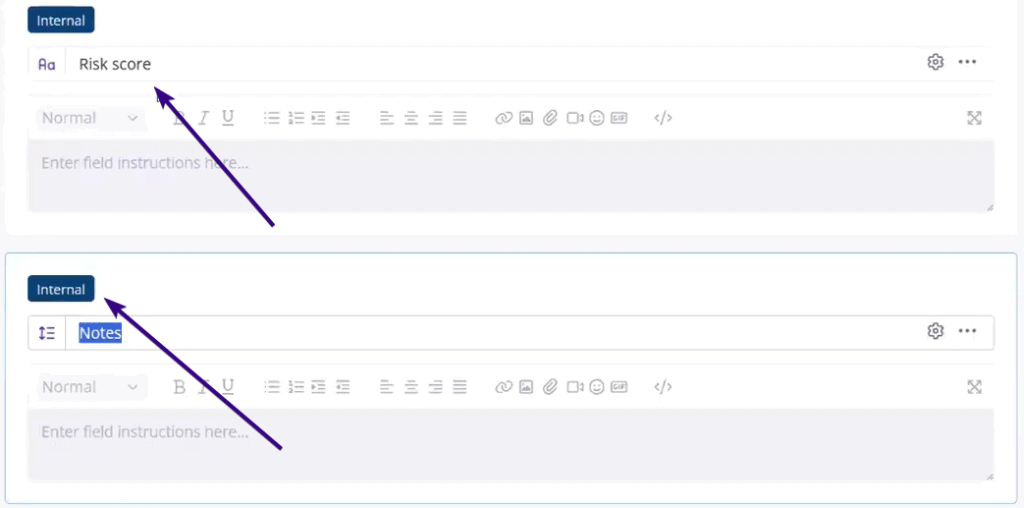
Once the client has completed the questionnaire and the screening checks have run, staff can record information such as:
- The client’s overall risk rating
- Notes explaining how the rating was determined
- Any risk indicators that were identified
- Approval or sign-off from a compliance officer
Because these questions exist inside the same request, they remain linked to the original client information and screening results. This makes the risk assessment process much easier to document and review later.
Exporting a complete compliance record
One of the most important aspects of AML compliance is maintaining accurate records of the checks performed. Content Snare enables you to download a full verification report that includes:
- Identity verification results
- AML screening outcomes
- Documents uploaded by the client
- Internal risk assessment notes
Everything is packaged together into a single file. This creates an audit trail showing what information was collected, what checks were performed, and how your firm assessed the client’s risk level.
Prepare for Tranche 2 without adding more admin
Tranche 2 will undoubtedly introduce new compliance responsibilities for accounting firms, but it doesn’t have to mean more manual work. Content Snare allows your accounting practice to manage the entire process in a structured and automated way. That way, you can collect information, verify identities, run AML checks, and generate compliance records as part of the same workflow they already use to gather client documents.
Curious how it works?
Sign up for a 14-day free trial to explore how Content Snare can streamline your Tranche 2 compliance workflows.