
Too many financial institutions get stuck in long back-and-forths when onboarding new clients. Research from Fenergo shows that banks take an average of 95 days to complete a KYC review for a commercial client, while full due diligence takes even longer.
It’s practically impossible to avoid some level of follow-up and clarification, as there’s always going to be a missing document or an unanswered question, but a good client due diligence checklist will make your process faster and far more predictable. In this post, we’ll show you a template checklist to help improve your client due diligence procedure.

Ready-made client due diligence checklist
The due diligence checklist isn’t something your clients will ever see. It’s your internal guide that keeps your team members aligned, so each onboarding follows the same rules and covers the same risks, no matter who’s handling the account.
Identity and ownership verification
This section establishes who the client really is and who ultimately controls the business. It forms the foundation of your compliance process and ensures you are not onboarding unknown or high-risk parties.
1. Collect and verify the client’s legal business name and registration details
2. Confirm the registered business address
3. Identify all directors, signatories, and beneficial owners
4. Collect and verify government-issued ID for required individuals
5. Collect and verify proof of address
6. Run sanctions screening on all required parties
Risk assessment
In this section, you determine how much attention and monitoring a client will require over time. The outcome guides how strict your controls should be and whether additional safeguards are necessary.
7. Assign an initial client risk rating
8. Assess geographic risk
9. Assess industry risk
10. Assess ownership and control complexity
11. Assess transaction risk indicators
12. Determine whether enhanced due diligence is required
13. Document the rationale for the assigned risk level
Relationship purpose and expected activity
The following tasks help you define what “normal” looks like for the client relationship. By setting clear expectations up front, you can more easily spot unusual or potentially risky behavior later.
14. Record the stated purpose of the business relationship
15. Define expected products or services
16. Estimate expected transaction volume
17. Estimate expected transaction frequency
18. Collect source of funds information
19. Collect source of wealth information
20. Confirm the profile aligns with internal risk policies
Business and financial verification
This step confirms that the client’s business is legitimate, active, and financially sound. It also gives your team confidence that the relationship is built on accurate and current information.
21. Collect and verify incorporation or registration documents
22. Collect and verify required business licenses
23. Collect and review organizational structure
24. Collect and review financial statements
25. Verify bank account details
26. Collect and verify tax identifiers
27. Confirm proof of active business operations
Internal approvals
These tasks represent your final internal checkpoint before the relationship is formally approved.
28. Complete compliance review
29. Complete risk review
30. Obtain manager or compliance officer approval
31. Record approval date and approver
32. Store all documents according to retention policy
Ongoing monitoring
Due diligence doesn’t stop once a client is onboarded. This section makes sure the relationship stays up to date as the client, regulations, or risk profile changes.
33. Assign client review frequency
34. Define monitoring triggers (ownership changes, large transactions, etc.)
35. Assign monitoring responsibility
36. Schedule next review date
37. Set reminders for periodic re-verification
Turn your client due diligence checklist into a living system with Content Snare
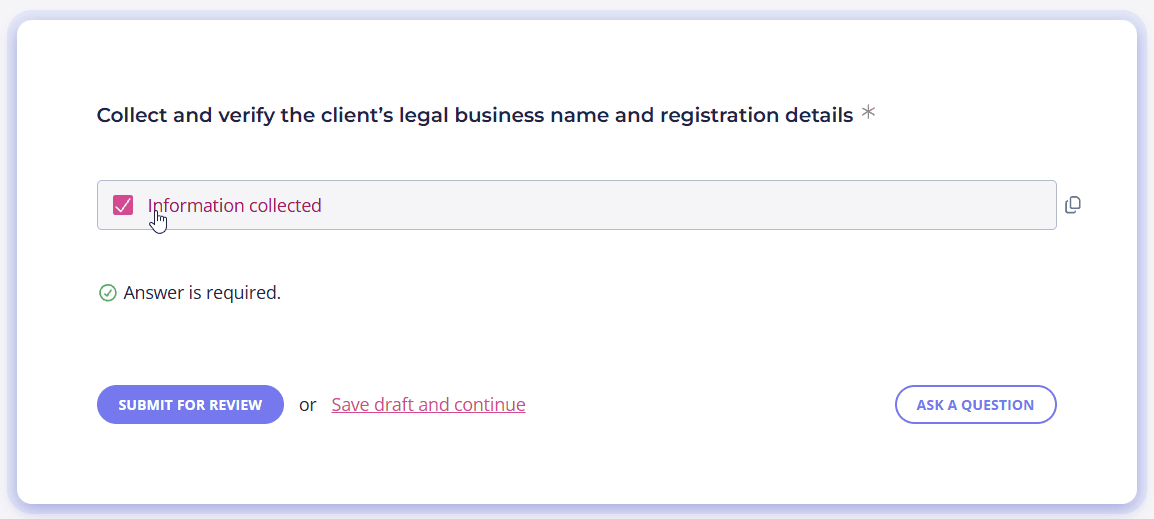
This is where the rubber meets the road. With Content Snare, you can take the exact internal checklist above and turn it into a trackable workflow in minutes with no duct tape or guesswork. You can start from scratch, edit a ready-made template, or spin up a brand-new checklist that fits your specific process. Content Snare helps your team members confirm what’s been collected or reviewed using the task list field (like the one shown below) without bouncing between tools:
If you’re pressed for time, Content Snare’s AI can get you up and running in minutes. For instance, you can describe what you need to create and generate a structured checklist automatically, or simply upload a PDF and have it transformed into a working request you can quickly refine. It’s also worth noting that Content Snare is ISO 27001-certified, following the most trusted security standards to protect sensitive information.
Serious firms opt for Content Snare to avoid:
- Missing one document that triggers rework, delays, or liability
- Scope creep
- Inconsistent processes across staff
- Junior staff asking the wrong questions
- Looking unprofessional
Ready to stop pushing paper uphill? Start your 14-day free trial to turn your client due diligence checklist into a system that basically runs itself.
FAQ
What’s the difference between a client due diligence checklist and an onboarding form?
A client due diligence checklist is an internal process document that defines what you need to collect or approve. On the other hand, an onboarding form is simply the client-facing way you gather some of that information.
How does Content Snare help with client due diligence?
Content Snare turns your internal checklist into trackable workflows and smart forms, so nothing is left to chance. This platform standardizes how you request and follow up information, which means your entire team is able to move faster and deliver a better onboarding experience.
How often should client due diligence be reviewed?
That depends on your risk framework, but most firms assign a review schedule based on client risk level. Low-risk clients may be reviewed annually, while higher-risk clients often require more frequent reviews or event-based checks when something changes.