
Marketing usually isn’t at the top of the list for most bookkeepers or accountants. It can feel time-consuming, a bit mysterious, and more often than not, it lands somewhere between a blog draft and a Canva project you abandon halfway through.
Meanwhile, over in the marketing world, the pros are already crushing it with AI. According to recent surveys, 93% of marketers use AI to generate content faster and 81% use it to uncover insights. That’s not a fringe trend - that’s practically everyone. So, if AI is already powering up almost every high-performing marketing team on the planet, why wouldn’t accountants and bookkeepers be jumping on the same train? And what’s the best way to do it?
That’s exactly what we discussed with Trent McLaren at this year’s Content Snare AI & Automation Summit. In this post, we’re sharing the key takeaways you can start using right away.
Trent McLaren is a marketing strategist and SaaS entrepreneur with over 15 years of experience in the accounting and bookkeeping industry. Named Australia’s Accounting Thought Leader of the Year in 2017, he’s the co-founder of Vinyl, an AI-powered meeting assistant built specifically for accountants and bookkeepers.
Why AI-powered marketing matters for bookkeepers and accountants
Let’s get one thing straight: AI marketing for accountants isn’t just about getting more clients. Sure, that’s part of it, but the real magic of marketing lies in building awareness and trust before someone even needs you.
Here’s why - only 3% of your potential clients are actively looking for help right now. That means if you’re only showing up when you need to “get more clients,” you’re already behind. The other 97%? They’re scrolling, browsing, listening, and storing away names for when things hit the fan or growth forces their hand. You want to be the name they remember.
And whether you like it or not, every prospect is running a silent checklist in their head:
- Do I know this person?
- Do I like this person?
- Can I trust this person?
If the answer to all three is “yes,” you’re halfway to the sale, even if they’re not ready to buy today.
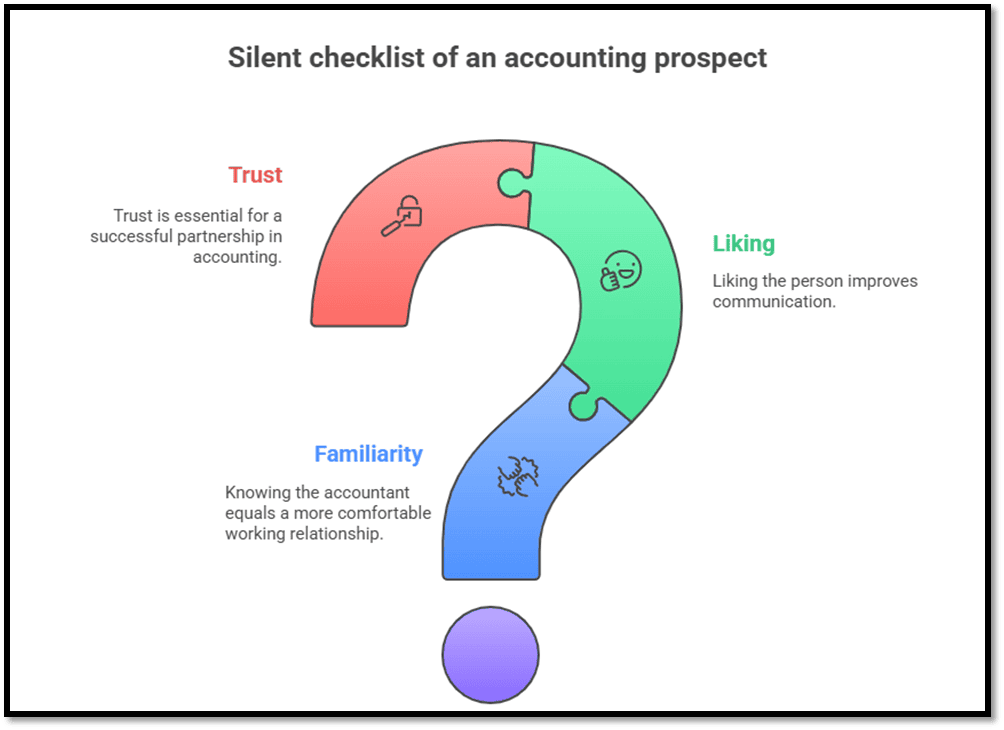
AI makes this whole process simpler and more consistent. It helps you stay visible with helpful content, show up in the right places, and look like the trustworthy pro you actually are (even when you’re head down reconciling bank feeds).
And here’s the bonus round: good marketing doesn’t just attract clients. It also helps you recruit great people, land speaking gigs, and open doors to partnerships you didn’t even know you wanted.
Marketing strategy: The foundation before AI
Before you dive headfirst into ChatGPT prompts and auto-generated blog posts, you’ve got to do the not-so-sexy stuff first: build a marketing strategy.
That’s because AI won’t fix a foggy marketing plan. On the contrary, it’ll just help you create more fog, faster. The good thing is that you don’t need to reinvent the wheel. A simple 5-step framework is all it takes to start marketing like someone who actually means it:
1. Set clear goals
It all starts with setting tangible goals. Do you want 10 new clients this year? An extra $100k in revenue? Or maybe just fewer hours stuck behind a screen? Whatever it may be, get specific, because vague goals lead to vague results.
2. Define your target audience
If your answer to “Who do you serve?” is “anyone with an ABN and a wallet”, you’ve got some work to do. Niche down. Think about the industry, business size, common struggles, and who you actually enjoy working with. That’s your ideal client profile.
3. Craft key messages
This is your “why us” moment. What makes you stand out? Maybe you're a payroll expert or a hospitality specialist. Whatever it is, own it. Here’s how Trent McLaren explains it:
A few ideas: you're really good at payroll tech implementations, you’re a QuickBooks specialist, and you're really good at something. You need to be able to tell your audience what you're good at and why they should consider working with you.
4. Find your channels
Now think about where those dream clients hang out. Is it LinkedIn or Facebook groups? Perhaps it’s industry events? Maybe they’re lurking in podcasts, local business newsletters or magazines. In each case, the point is to go where they are - not where you wish they were.
5. Decide on tactics
The last step is to pick a few tactics that suit your skills and capacity. Don’t try to do everything: focus on specific solutions such as blogs, short videos, newsletters, social posts. Each of these works for a particular audience, as long as you stay consistent.
AI in action: From idea to execution
Once you’ve nailed down your strategy based on these five steps, take a screenshot and plug it into ChatGPT or Claude. Tell it to come up with content ideas based on your strategy. That one prompt will turn into dozens of tailored content ideas and campaigns without the guesswork.
For instance, we created an example focusing on accountants working with creative agencies, and this is what Claude came up with:
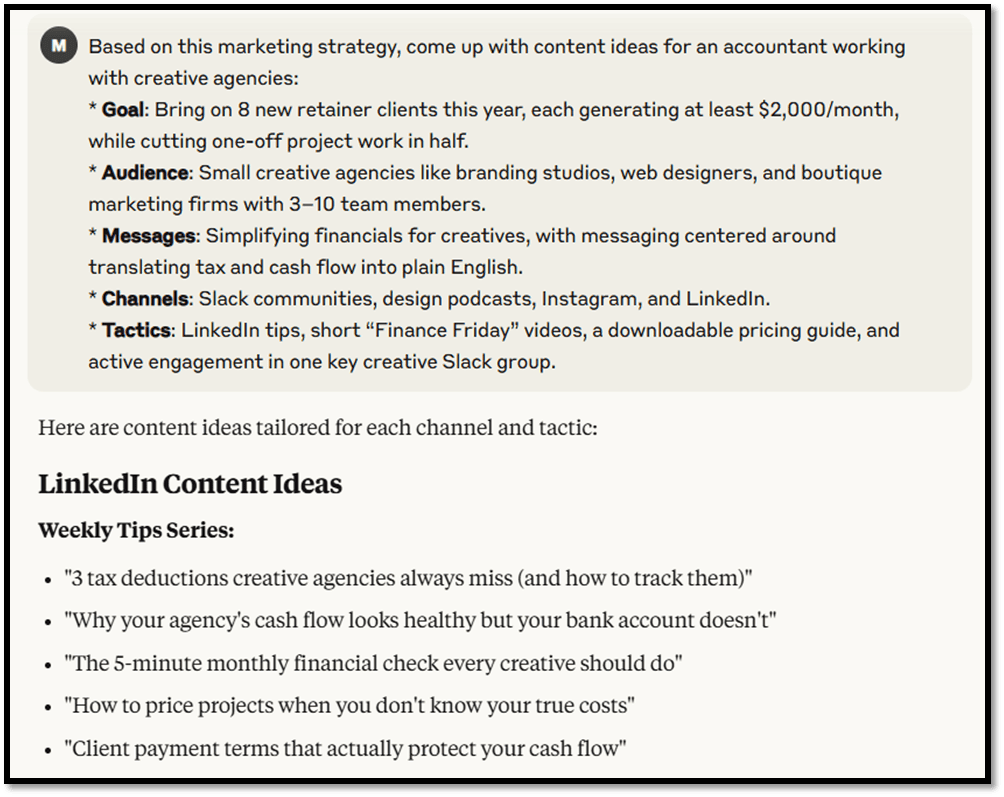
The list goes on since AI created more than 50 content creation ideas in mere seconds. And it’s just the starting point - you are free to tweak the prompt or ask the platform to recalibrate suggestions based on additional inputs.
Once you’re happy with the proposed plan, you can also use AI to create content. For instance, it’s easy to write an entire article by asking ChatGPT to generate an SEO-optimized 800-word blog using a specific outline.
Your output is only as good as your input
We strongly encourage you to instruct AI to write from your voice, include bullet points with detailed instructions, add quotes from industry experts, relevant stats, and even add actionable takeaways.
You can use the same principles and ask AI tools to create social media posts, develop lead magnets, and even design simple visual content for your marketing channels.
How to use AI for content creation: Best practices
AI is incredible, but it’s not a mind reader. It’s more like a very obedient intern with zero context who’s willing to work 24/7 as long as you tell it exactly what to do. That said, here are three golden rules to make AI actually work for you, not just spit out mediocre fluff:
1. Garbage in, garbage out
If your prompt is something like “Write a blog about accounting”, don’t be surprised when it sounds like a Wikipedia entry from 2012. Instead, be specific by saying something like this
“Write a 500-word blog for solo tradies about how to manage quarterly BAS without losing your weekends. Keep it informal, include a practical tip, and sound like someone who gets their world.”
Spell it all out, including your tone, audience, and intent.
2. Micromanage the output
Never take the first draft and call it a day. Use AI like a collaborator:
- Ask it to rewrite the intro
- Add an analogy
- Give you three headline options
- Change the tone from “formal” to “friendly but informed”
- Insert credible industry stats
Treat your AI tool like a creative assistant with endless patience and zero ego.
3. Practice makes perfect
Like anything in business (or life), getting good with AI takes repetition. Your first few prompts might feel awkward or land flat, but that’s part of the process. You’ll only figure out what works by creating, tweaking, and doing it again.
The good news? AI makes that trial-and-error loop ridiculously fast. As Trent himself put it:
“The more you create, the faster you will be. So you’ll learn what works, what doesn't. You can then hopefully see the results you're trying to get, and then you just wanna keep doing more of what works.”
How is AI used in marketing: Tools to keep an eye on
By now, everyone and their uncle knows about ChatGPT. However, it’s far from the only tool changing the way bookkeepers and accountants can create and scale content. From writing blog posts to editing videos and turning Zoom calls into lead magnets, here are some of the standout tools worth checking out:
- ChatGPT: Your go-to for ideation and writing
- Claude: Great for structured thinking, long-form content, and even visual layouts
- Riverside: It helps you record podcasts and video content like a pro
- Descript: Edit audio and video transcripts within minutes
- Canva: Create sleek designs fast (bonus points for its ChatGPT integration)
- Vinyl: Built for accountants and bookkeepers by Trent McLaren himself, Vinyl transcribes your client meetings and turns them into ready-to-go content
This is far from an exhaustive list, but these tools are a solid place to start if you’re ready to dip your toes into AI-powered marketing without getting overwhelmed.
Final takeaways
AI doesn’t replace strategy, but it does help you execute it smarter and much faster. For bookkeepers and accountants, this is a massive opportunity to create trust-building content that cuts through the noise. With the right tools and a clear plan, you can turn a few hours of work into months of marketing assets.
So go ahead: experiment, test, tweak, and repeat. Just like Trent explains it here:
“AI lets us try, fail, try again until we get a successful result that we're happy with. And that's the way that I would encourage you to think about it. Just keep tweaking and fine tuning.”