
Artificial intelligence (AI) has moved from buzzword to business reality faster than almost any technology before it. The question for accounting firms is no longer if AI will impact workflows, but how quickly and to what extent.
At the 2025 Content Snare AI & Automation Summit, industry leaders explored what AI really means for accountants right now, cutting through hype to share practical use cases and emerging risks that lie ahead. This post distills their key insights into a clear picture of where the profession stands today, what firms can do immediately to harness AI, and what to expect as automation accelerates over the next few years.
The insights in this post come from a panel that featured 2025 Accounting Thought Leader of the Year Sarah Lawrance, Accounting Technology Consultant Alan FitzGerald, and International Keynote Speaker on AI and Automation Inbal Rodnay.
The current state of AI adoption in accounting
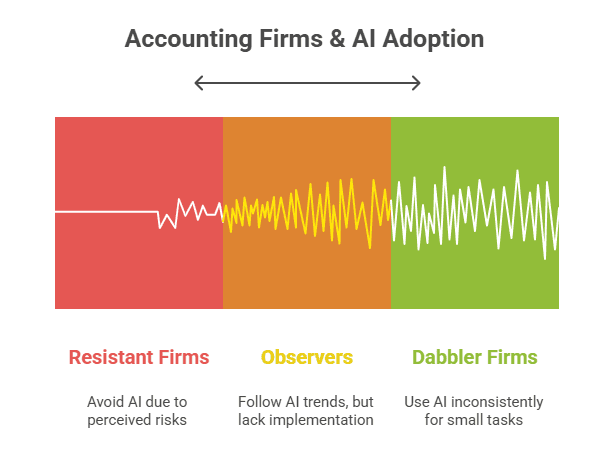
AI adoption in the accounting profession isn’t happening all at once. On the contrary, firms are spread across a spectrum, moving at very different speeds depending on their culture and appetite for risk. Industry leaders point out that most accounting firms fall into three broad groups:
- Resistant: These firms actively block or discourage the use of AI tools, believing that AI is risky, inaccurate, or unnecessary. While resistance feels safe in the short term, it can leave firms struggling to catch up later as the technology becomes mainstream.
- Observers: These practices are curious, but not yet committed. They read articles, attend events, and follow conversations on LinkedIn, but rarely move beyond theory.
- Dabblers: This is where most firms sit today. Dabblers let a few team members experiment with ChatGPT, Copilot, or similar tools, often for small tasks like drafting emails or troubleshooting Excel. While this builds familiarity, usage is inconsistent and not yet embedded into firm-wide workflows.
What’s striking is how quickly firms are moving through these stages compared to past shifts like the transition to cloud accounting. According to industry thought leaders, AI is spreading from fringe curiosity to everyday experimentation in record time.
How come AI is accelerating so quickly?
The pace of AI adoption in accounting has surprised even industry experts and seasoned technology observers, mainly because previous shifts like the transition to cloud software took years to move from skepticism to widespread use. According to the 2024 State of Tax Professionals Report by Thomson Reuters, almost 50% of respondents said they were eyeing new technology solutions, while 35% said they would be investing in some form of AI.
One of the biggest drivers is economics.
Breakthroughs such as DeepSeek’s R1 model have effectively “open-sourced” knowledge about how to build advanced systems, which lowered the barriers to entry for new players. This has shifted the economics away from developing the core models themselves and toward building applications on top of them. In the words of Sarah Lawrance:
“All of a sudden it changed the unit economics for investors… We’ve now de-commoditized these models and now we can actually make money at the application level. That’s why we’ve seen this massive ramp up”
At the same time, firms are feeling the pull of practicality since AI tools are no longer just vague futuristic concepts - they’re showing up inside the software accountants already use. For example, meeting assistants, productivity tools, and research agents can be added into workflows with little effort. Combined with constant visibility on LinkedIn and in the media, this creates momentum that accelerates adoption.
Practical tips for AI and automation in accounting

Figuring out where to start with AI and automation is a common challenge among accounting practices. Speakers at the 2025 Content Snare AI & Automation Summit agreed that the best way to build confidence is to begin with simple and low-risk use cases that create immediate value without disrupting client service.
Here are some practical starting points:
- Experiment with ChatGPT or Claude: Use these tools for everyday tasks such as drafting emails or summarizing documents. This helps staff build comfort with conversational AI in a low-stakes way.
- Swap Google for Perplexity: Instead of scanning through dozens of search results, Perplexity provides direct answers with source links. It’s an easy upgrade for research tasks, saving time while still giving you the ability to validate the information.
- Adopt an AI meeting assistant: Tools like Fireflies or Fathom can automatically join online meetings, record them, and create transcripts. Those transcripts can then be fed into AI to generate summaries and action lists.
- Use AI for prep and framing work: AI can do the heavy lifting when it comes to structuring a due diligence spreadsheet or pulling together regulatory references.
- Pilot within internal workflows first: Rather than exposing clients to AI-generated outputs immediately, begin with internal use cases. Examples include drafting internal notes, generating blog outlines, or summarizing training sessions.
Starting small in these areas creates a foundation for more advanced automation down the line. The goal isn’t to replace human expertise, but to give accountants back the hours usually lost to repetitive, low-value work. A great example comes from Content Snare and its smart requests feature:
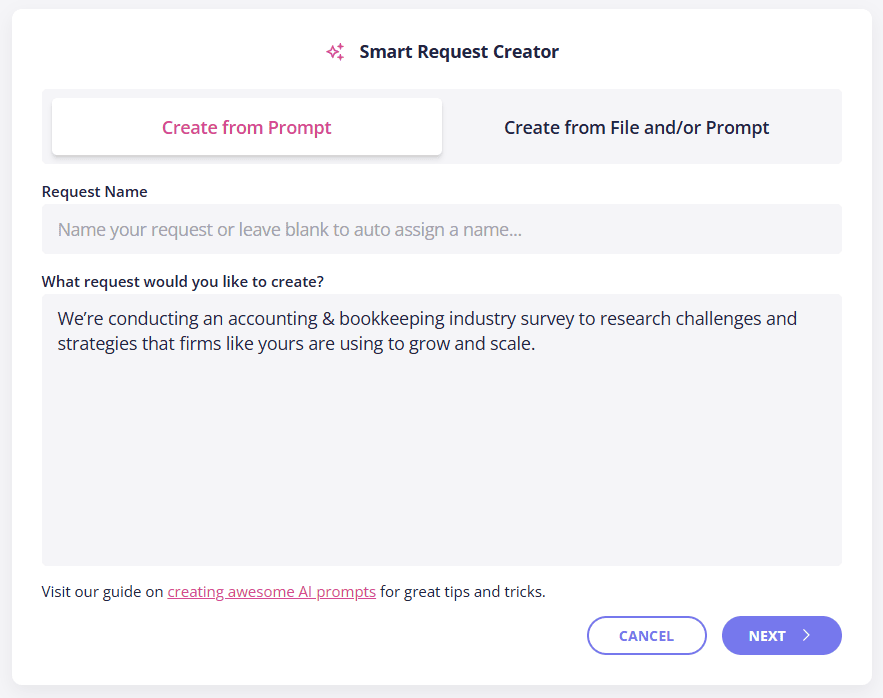
All it takes is to describe your type of form or upload a PDF as a base for creating the request, and AI will generate a list of questions, broken into sections. Instead of endless email chains and follow-ups, accountants can send a single structured request that guides clients through exactly what’s needed, while Content Snare automatically reminds them to respond.
This is ideal for client onboarding as it removes the frustration of chasing clients and keeps workflows moving smoothly.
Automation in the accounting industry: Pitfalls and guardrails
As powerful as AI has become, it’s not even close to a “set and forget” solution. Industry leaders point out that firms that get the best results are those that adopt with care by balancing experimentation with common-sense guardrails.
First, it’s important not to automate processes end-to-end just yet. Generative AI tools can be incredibly helpful, but they aren’t consistently accurate enough to run workflows without human oversight. A misplaced assumption or small error can create client confusion or even compliance risks if left unchecked. As Inbal Rodnay puts it:
“No process should be automated end-to-end today with generative AI. It’s not accurate enough yet… In my business we use it a lot, but there’s not a single process that’s fully automated with it, not even note taking.”
That’s why the human-in-the-loop principle is essential. Think of AI as producing the first 80%, whether that’s a draft document, a spreadsheet model, or meeting notes. The remaining 20% always requires professional review and judgment. This blend of machine speed and human expertise is where real value emerges.
Transparency and consent also matter. For example, if you’re recording client meetings with an AI assistant, always ask permission first. This maintains trust and also protects against awkward situations where transcripts or recordings might be shared unexpectedly.
However, industry observers warn to beware of overwhelm. The AI landscape is moving so quickly that it’s easy to get caught up chasing every new model or app, so firms should focus on a small set of reliable tools and learn how to use them well before digging deeper.
Final thoughts: Adopt with intention
AI is already reshaping the way accountants work, but the firms that benefit most aren’t the ones chasing every new tool or trend. Real value comes from being intentional and choosing solutions that align with existing workflows.
The goal isn’t to hand work over to machines, but to free accountants from repetitive and low-value tasks so they can focus on the insight and relationships that clients truly value. In other words: don’t try to automate everything, but rather automate the right things with clarity and intention.