
You spent hours building the questionnaire. You tested it, refined it, cut the questions that were not relevant. Then a client finishes it and emails back: "I may as well have done this myself. What am I paying you for?"
It hurts because the form was supposed to make things easier, not create a new complaint to manage. And the double bind is real - ask too little and you miss things that cost the client money or expose you to risk; ask too much and you get this response.
The good news is that most firms who crack it, do two things. For one, they get better at explaining what the questionnaire actually is. Secondly, they fix the parts of the form that make the complaint feel justified in the first place.
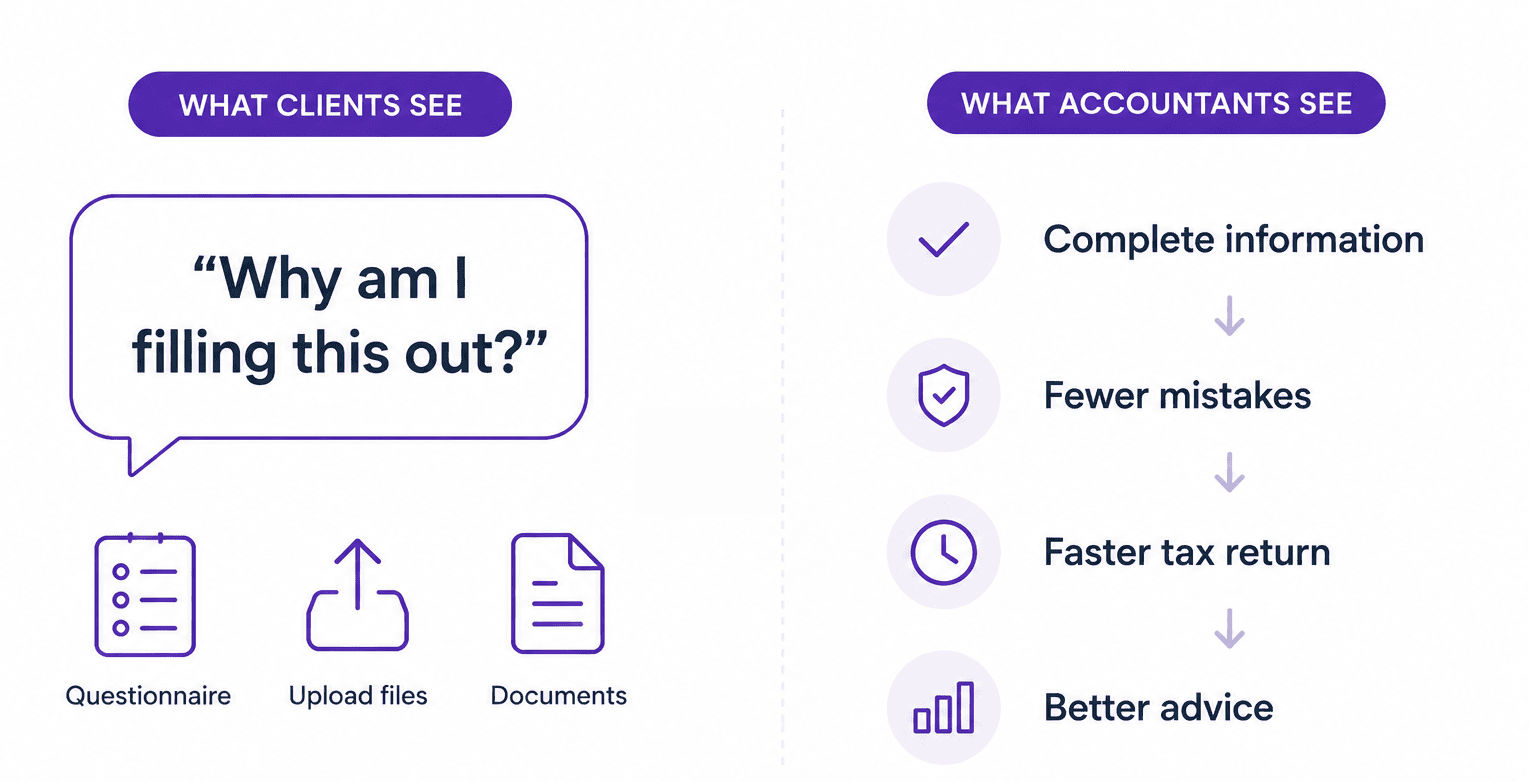
Why it stings
The complaint lands harder than a normal client grumble because you know how much went into the form:
- Hours spent designing and refining templates
- Cutting questions that did not apply to most clients
- Testing the flow from the client's side
- Updating it every year as legislation changes
To make things worse, the tax return questionnaire wasn’t a vanity project, it was a practical response to a real problem. One-to-one ITR meetings no longer pay when compliance and onboarding obligations keep growing. The form was the solution.
So when a client pushes back on the very thing you built to make the process work, it feels like the fix is being blamed for the problem. That frustration is legitimate. But it's also worth separating: the complaint usually comes down to one of three things:
- the framing around why the form exists
- something about the form itself that genuinely isn't working
- the simple fact that change is hard for long-term clients
All three are fixable.
Reframe 1: The same questions, either way
Here’s the thing: the questionnaire didn’t create the questions. The tax return did.
Everything on that form is something you would have asked in a meeting anyway, such as employment income, deductions, changes in circumstances, assets bought or sold. The only difference is the client answers at their own pace, on their phone or laptop, instead of sitting across from you while the clock runs. One practitioner put it plainly:
"It’s the same questions I would ask in a meeting."
That is not a deflection, it’s the accurate answer. Bear in mind that the form isn’t a substitute for your work. This is just the way you gather what you need to do the work.

Reframe 2: You charge for judgement, not data entry
A client filling in their income sources is not preparing their own tax return any more than a patient filling in a medical history form is diagnosing themselves. The information goes in and the professional judgement comes after.
That’s the distinction most clients have never had explained to them. They see a form, they fill it in, and the connection between their answers and your analysis is invisible. Part of the fix is simply making that connection visible, before the complaint arrives, rather than after.
Reframe 3: Make the meeting the priced option
If a client genuinely would rather talk through everything on a call, that is a completely reasonable preference. Just make clear it is billed at your hourly rate. In a recent discussion among Australian tax agents, one practitioner described their approach:
"I let them know that filling it in makes preparation more efficient, and that it is an hourly charge for us to sit there and ask each question. They usually choose to fill it in."
This also reframes the dynamic neatly. Instead of defending the form, you are giving the client a genuine choice. That shifts the tone from complaint to decision, and most clients make the sensible one.
Not just the framing? Fix the form then
Sometimes the framing is fine and the form is the problem. If a client says the questionnaire feels like work, it’s worth asking honestly: does it?
A common culprit is asking clients to transcribe numbers that are already printed on a source document. Payment summaries, bank statements, dividend notices - these documents already exist. Asking a client to copy figures off them into a form adds friction without adding anything useful.
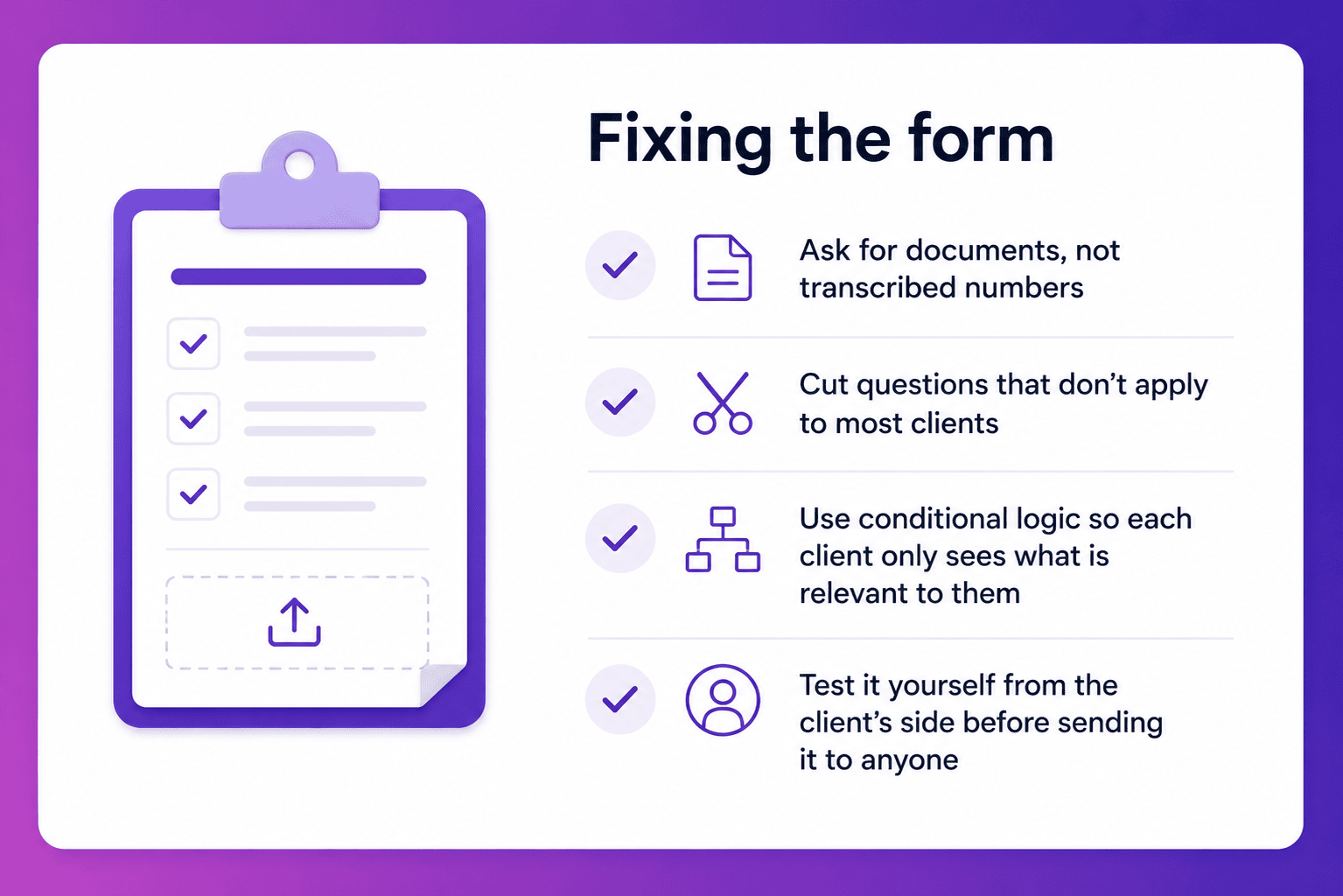
The second issue is relevance. Generic forms ask everyone about everything, which is what makes them feel long and impersonal. For instance, a client who has never had an investment property doesn’t need three questions about rental income. Here’s the practical checklist for a form worth defending:
- Ask for documents, not transcribed numbers
- Cut every question that doesn’t apply to the majority of your clients
- Use conditional logic so each client only sees what is relevant to them
- Test it yourself from the client's side before sending it to anyone
That last one matters more than it sounds. One accountant in an Australian practitioner forum noted that after going through an unrelated online form that asked irrelevant questions, they went back and audited their own. It looked different from the other side.
It’s mainly a change problem, not a tool problem
If you’ve rolled out a questionnaire and the complaints are coming in, it’s worth checking who they are coming from. In most cases, it’s existing clients, the ones who remember when you just had a chat and sorted it out together. New clients, who have no prior reference point, tend to take a clean intake process at face value and get on with it.
One tax agent summed it up in an online discussion:
"Clients hate change. The only complaints I have had are from existing clients. New clients love it."
That doesn’t mean ignoring the pushback from long-term clients, but it does mean the problem is not necessarily the tool or even the form. It’s the transition. A short note explaining why the process has changed, what the client needs to do, and what happens next goes a long way.
Frame it as a convenience for them, because for most clients, it genuinely is.
The protection angle
There's one more reason to keep the questionnaire that doesn't come up enough: it protects you. A completed intake form is your due-diligence record.
If a client later claims you missed a deduction or failed to account for something, the form shows exactly what they declared. For example, the ATO and TPB require you to ask certain questions every year regardless. The questionnaire is just the efficient way to do it while creating a paper trail in the process.
Know when it's not worth it
Not every client is the right fit for this process, and it's worth being honest about that. Some simple ITR clients will never see the value in a structured intake. For them, a tax return feels like a transaction, and no matter how well you frame the questionnaire, the response is always some version of “might as well use MyGov.”

You can spend time and energy winning them over, or you can price the service in a way that reflects the real cost, and accept that some will leave. Several firms in practitioner discussions have made the call to stop taking standalone ITR clients altogether. It's not for everyone, but the logic is sound: if the margin isn't there and the complaints keep coming, the form isn't the problem worth solving.
Related: Tax return automation: Save time and scale with ease
Scripts you can copy when clients push back
It’s definitely worth having a ready answer when the complaint comes up. Here are a few that practitioners actually use:
- On what the form is for: It's the same questions I would ask in a meeting, just done at your own pace instead of in a billable session.
- On what you're actually charging for: There’s a big difference between interpreting an answer and completing a tax return. You're supplying the facts. We're applying the judgement, spotting what you'd have missed, and taking responsibility if something's wrong.
- On the alternative: You're welcome to do it over a call instead. That's billed at our hourly rate, so most clients find the form is the quicker and cheaper option.
- On why the form exists at all: Before we get started each year, we send a short intake form rather than booking a meeting straight away. It means you can work through it at your own pace, we get everything we need in one go, and your return gets done faster.
Feel free to adapt the wording to your voice, but the core of each one is the same - you are paying for professional judgement, not data entry, and the questionnaire is how that judgement gets applied accurately.
A better form fixes most of this
If the complaints are coming from a form that asks for transcribed numbers, covers questions that don't apply, and only works well on a desktop, the tool is making the problem worse. The fix isn't just better framing, it's better intake.
Content Snare is built for exactly this workflow. It collects documents rather than asking clients to re-key numbers, uses conditional logic so each client only sees questions relevant to their situation, and works on any device without requiring a login. Most clients complete it in a single session without a follow-up needed.
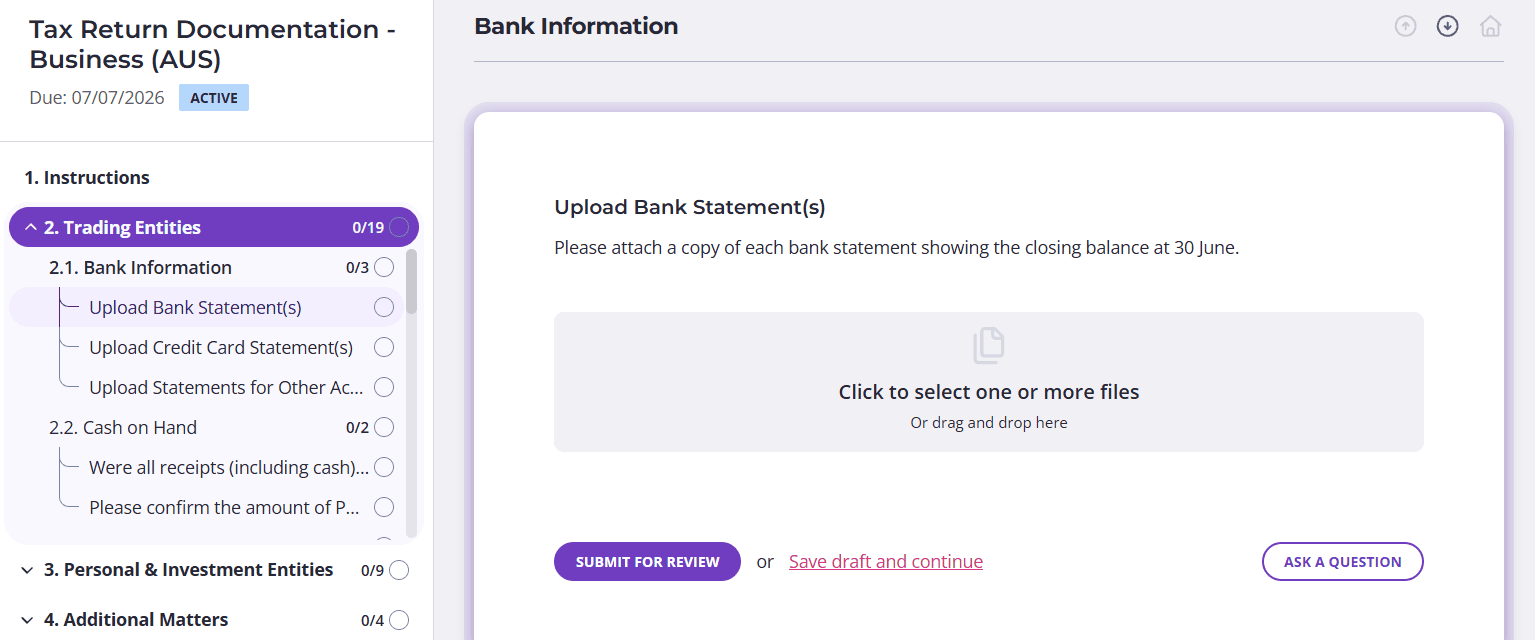
For firms doing volume ITR work, that last part matters. Fewer incomplete submissions, less chasing, and a questionnaire that feels like a reasonable ask rather than a burden. The complaint doesn't disappear entirely, but it comes up a lot less when the form is doing its job properly.
Customise a ready-made intake form and send your first request in minutes.