
In a recent episode of the Between Two Ledgers podcast, we hosted Amy Holdsworth, founder of Clarity Street, to talk about the less visible side of running an accounting firm. Amy works closely with practices to bring structure to the way work moves through their teams, helping firms improve delivery through clearer workflows and stronger internal processes.
This article takes a closer look at some of the themes from that conversation. We’ll focus on how firms can rethink the way responsibilities are distributed across their teams and where small operational shifts can have a huge impact on day-to-day performance.
ABOUT
Amy Holdsworth
Amy Holdsworth is the founder of Clarity Street, where she helps accounting firms improve operations through better systems and internal processes.
Tech is only 10% of the problem
Early in the conversation, Amy points out that most firms reach out because they believe they’ve got a tech issue. They think the apps don’t talk to each other properly and believe the workflow tool isn’t working the way they expected. In her opinion, tech becomes the obvious thing to blame because it’s visible and tangible. But once they start digging into how work moves through the firm, it’s usually not the software causing the slowdown:
“They think that they’re contacting us because they have a problem with their tech… but realistically, that’s about 10% of what their problems are. The other 80 to 90% is people and process related.”
Amy explains that the real issue is who’s doing what, how jobs get handed off, how information gets requested from clients, and whether the right people are spending time on the right things. Tech is often just the entry point for the conversation, while most of the friction comes from the way the team operates around it.
What ops really means in an accounting practice
A big part of the discussion focuses on what ops really involves inside an accounting firm. It’s a title that gets thrown around a lot, but it can mean anything from admin support to full-on practice management depending on the firm.
Amy’s take is pretty simple: if someone is qualified to prepare financials or give tax advice, then everything else that keeps the firm running probably shouldn’t sit with them. That includes work like:
- Onboarding
- Managing workflow
- Requesting information from clients
- Invoicing
- Job setup
Simply put, ops is less about doing the accounting and more about making sure the accounting actually gets done. Amy calls out invoicing as one of the biggest examples:
“If there is an accountant doing an invoice, stop it right now. Accountants should never be doing invoicing.”
Though it’s true these tasks only take a few minutes on their own, those minutes add up quickly across dozens of jobs. This is particularly painful when they’re handled by the person who’s meant to be doing the core work. Amy points out that it’s not the complexity of the accounting that slows things down, but the number of small steps that sit around it.
Mapping where time is lost in the workflow
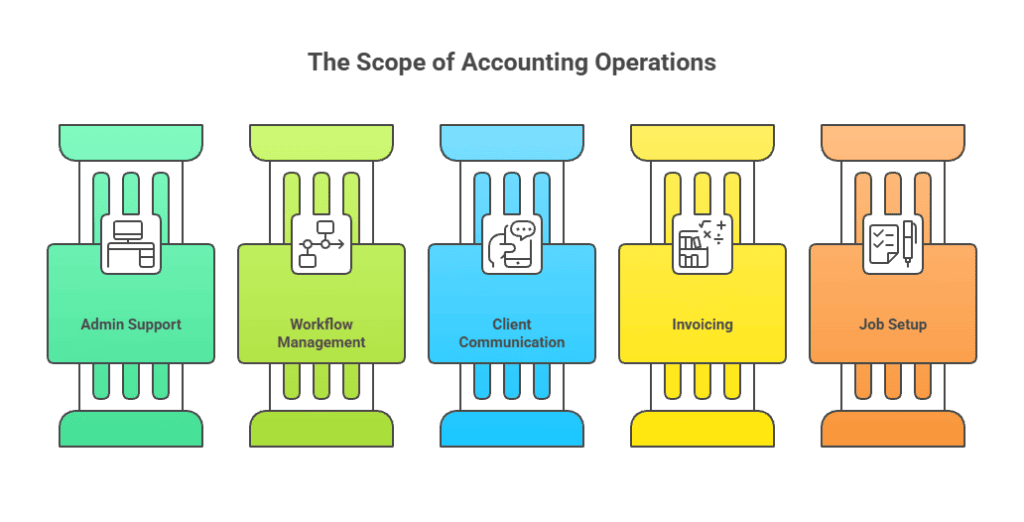
As soon as you map out the full lifecycle of a typical job, it should become clear how many steps fall outside the actual accounting work. Things like requesting documents at the start, following up with clients when something’s missing, setting up the job internally, or sending out fee proposals can quietly eat into hours that would otherwise go toward billable work.
Why ‘busy’ is a bad goal for firms
At another point in the episode, the conversation shifts to something that comes up in almost every firm: being busy. It’s often treated as a badge of honour, or even a sign that things are going well. Amy pushes back on that pretty quickly:
“Busy dictates I’m important. Just because you’re busy doesn't mean you're productive. It doesn't mean you’re financially stable or that you're actually profitable as a business.”
In Amy’s opinion, this is an easy trap to fall into. When accountants are tied up chasing documents or formatting invoices, it can feel like progress is being made simply because something is happening.
However, being busy doesn’t necessarily mean the firm is efficient. In many cases, it’s just a sign that the wrong people are spending time on the wrong tasks. This gets too many accountants buried in low-value work.
Letting go of delivery tasks
A lot of the hesitation comes down to trust, or the feeling that no one else will do it quite the same way. Though it’s true that letting someone else handle part of the process can feel like losing control of the outcome, holding on to everything often creates the bottlenecks that limit growth in the first place.
Amy suggests focusing less on how something gets done and more on whether the outcome meets the intended standard. Different team members might approach a task in different ways, but that doesn’t automatically make the result worse:
“If the desired outcome is achieved, then that’s all you’re kind of looking for.”