
Most accounting and bookkeeping firms that go remote hit the same wall eventually. The systems that worked when everyone could jump on a five-minute call stop working once the team doubles, then doubles again. Conversations that used to happen naturally start happening behind closed doors, and leaders are left wondering if the culture can survive the growth.
Kayleigh Graham has lived through exactly that shift. She joined Telleroo, a bulk payments platform built for accountants and bookkeepers in the UK, when the company had seven or eight employees. Four years later, Telleroo is a fully remote team of 40 spread across the UK, Europe, and the Philippines. On the Between Two Ledgers podcast with host James Rose, Kayleigh walked through what actually broke as the team scaled, and what they built to fix it.
ABOUT KAYLEIGH GRAHAM
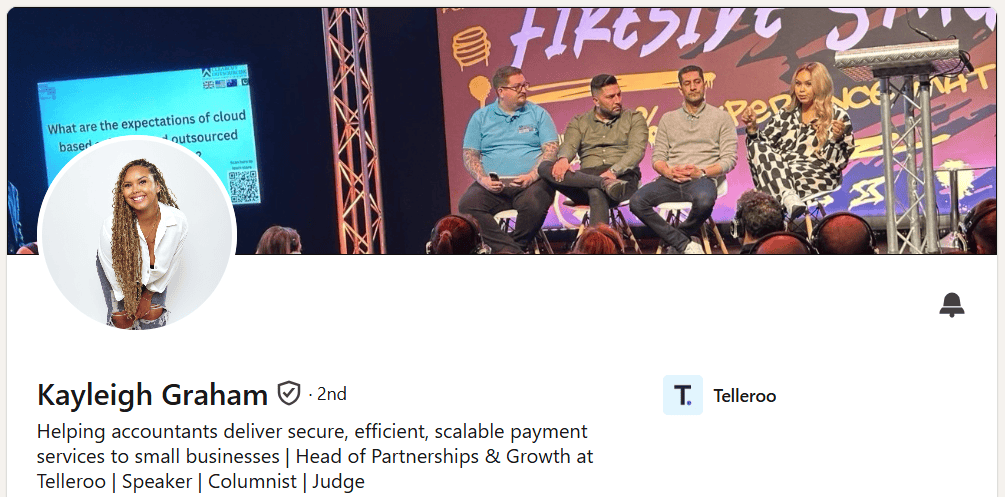
Kayleigh Graham is Head of Partnerships & Growth at Telleroo, a fintech company automating supplier and payroll payments for accountants and bookkeepers. She's a respected voice in the accounting space, sharing insights through columns and speaking engagements.
When seven people become 20…and then some
In Telleroo's early days, the whole team could fit on a single call. Everyone joined to hear the same thing and then people got back to work. According to Kayleigh, that setup held up fine until the team passed roughly 15 people, at which point group calls stopped being efficient and started eating everyone's week.
The first fix Telleroo tried was smaller meetings, with a handful of people responsible for passing information out to the rest of their teams, but that didn't work either. Instead of solving the bottleneck, it left teams operating in silos, each with a slightly different picture of what was going on. The problem got worse as those teams kept growing. As Kayleigh put it:
"It was when we got to around the 20-ish, early 20s mark, we went - Hmm, we probably need to put some time and work into how this is gonna work moving forward."
That realisation is what pushed Telleroo to stop patching the problem and actually rebuild how information moved through the company, starting with what got communicated and to whom.
Fixing how information moved
The first thing Telleroo tackled was structure. Rather than layering on more meetings, the team started asking a blunt question of every recurring call: could this have been a Slack message? Most of the time, the answer was yes, and entire meetings got stripped out of the calendar.
What survived the cull was a biweekly full-company update and a separate weekly management meeting built around OKRs. Leadership conversations, including harder ones about payroll timing, stayed contained to the separate management meeting. Kayleigh was direct about why that separation matters:
"As the team grows, information does get filtered, need to be filtered potentially slightly, and it's not even so much the conversation isn't a conversation we'd have with the team, it's probably the way in which the conversation is had."
Getting the structure right solved half the problem. The other half was deciding what to actually be transparent about, which is where Telleroo's approach to money comes in.
Why Telleroo shares its bank balance with the whole team
The detail that tends to stop people in their tracks is that every employee at Telleroo can see the company's bank balance, not just revenue or high-level metrics, but the actual number sitting in the account.
Kayleigh said the habit started almost by accident, back when the team was small enough that everyone could have worked the number out themselves anyway. It took on more weight once Telleroo began working toward its own EMI licence with the UK's FCA, which required holding a set cash balance. Every month, a portion of profit went into that pot, and watching the number climb became a shared marker of progress rather than a source of anxiety.
That openness was tested directly when the balance dropped low at one point, before an expected payment had come in. Rather than hide it, the team turned it into a planning exercise, working through what could wait until the cash landed:
- Holding off a legal fee due that week until the following one
- Timing a contract payment to land just before signing, rather than earlier
- Flagging any new spend so leadership had visibility before it went out
That kind of visibility is what kept the moment from turning into panic. For firms managing their own cash flow visibility with clients, the parallel is worth sitting with.
Retreats as a culture investment, not a perk
Structure and transparency handle the day-to-day, but Telleroo also leans on something harder to schedule: time together in person. Once a year the whole team, contractors included, flies into one location.
Kayleigh didn't pretend it was cheap. She weighed the cost against running an office instead and landed on the same conclusion each time - the best people for the roles Telleroo needs aren't confined to a 20-mile radius of London, so the spend goes toward retreats rather than a lease.
"Are we better off as a business? Absolutely. Because I simply refuse to believe that all of the best talent to fill the roles that we need is within a 20-mile radius of an office in London."
The format has shifted over time too, from work-heavy agendas with meeting rooms and presentations to something built around shared activities like food tours and spa days. The payoff shows up afterward in how the team communicates, with a visible rise in Slack activity and a shift in tone that Kayleigh says is obvious within days of everyone getting home.
For accounting firms weighing whether remote work can hold together as they grow, Kayleigh concludes that it can, but only with deliberate structure behind it, not by accident.
"Office work didn't work until it worked. The same is true of remote work. It does take work. You do have to be willing to put that work in and to iterate and get there, but when you do, it is the best thing you'll ever do for the business."