
Most accounting firms know they need automation, but many don’t know where to start or how to do it without adding more tools and complexity. However, industry leaders say you probably already have everything you need to make big efficiency gains.
We recently spoke with Isaac Perdomo, Co-Founder of Opzer and one of the leading voices in accounting automation, to find out what actually works in the real world. In this conversation, Isaac shares how firms can get measurable results like cutting admin time by focusing on better processes and smarter use of existing software.
Accounting firm automation: Start with process, not tools
Source: Isaac @ Opzer
Most people jump straight to tools when thinking about automation in accounting firms. They consider what app to buy, what integration to set up, or what workflow software to use. On the other hand, Isaac claims that’s putting the cart before the horse.
The right starting point is understanding your process.
Take the time to map out how work actually gets done in your accounting practice before automating anything. For example, you should answer these questions:
- How do we onboard a client?
- How do we close out a month?
- How do we deliver a tax return?
Once those steps are clear, it becomes much easier to see where automation can help and where it would only add confusion. Here’s how Isaac explains it:
“You start with understanding your process at its core before you start thinking about automation. If the process is not clear, then your automation professional or agency is going to have a hard time even assessing what you can automate in the first place.”
Note: Use what you already have
A common misconception about automation is that you need to overhaul your entire tech stack to make progress. In reality, many accounting firms already have powerful automation features sitting inside the tools they use every day. The trick is learning to take full advantage of them.
Isaac says it’s “not rare that we go into a firm and we literally add no new tools that the team has to learn.” What they really do is focus on connecting existing systems like Xero or QuickBooks and turning on the automations that are already built in. Things like bank rules or scheduled reports might seem boring, but they seriously cut down hours of manual work.
Simple accounting firm automation quick wins
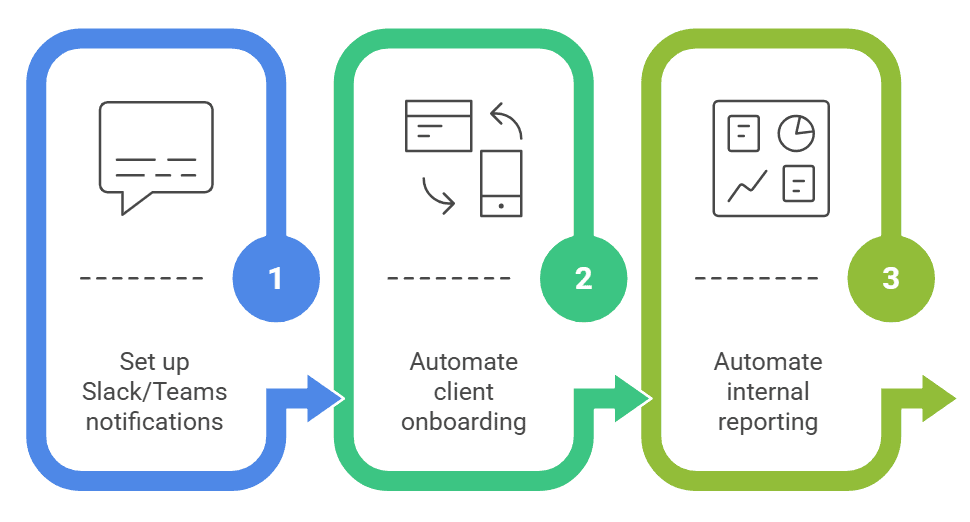
An easy way to build confidence with automation is to start small. Here are a few low-risk wins Isaac recommends for accounting firms:
- Set up Slack or Teams notifications: Activate instant updates whenever a new lead comes in or a client signs up. This keeps your team in sync without relying on endless email back-and-forth.
- Automate client onboarding: You can automatically create the client’s folders, send a welcome message, and launch your onboarding checklist when a proposal is accepted.
- Automate internal reporting: Use tools like Airtable or Looker Studio to pull and update key metrics automatically. That means no more chasing data or manually updating dashboards each week.
Starting with these quick wins can help your team see immediate results and build a foundation for more advanced automation later.
Pro tip: Keep AI in perspective
AI is the talk of the town right now, and it’s easy to feel like you’re falling behind if you’re not using it in your accounting practice. But as Isaac points out, it’s important to stay grounded:
“I’m scared about people believing that AI is a magic bullet. AI might be the greatest thing in the world, just like the internet was back in the days, but maybe I would call it a little bit too early.”
The truth is that most accounting firms will see bigger gains if they improve their existing processes and adopt small but reliable automations first. According to Isaac, AI tools can already play a role in tasks like data extraction, reporting, or communication, but they work best as part of a larger system and not as a standalone fix.
Measure what matters
When accounting firms invest in automation, they tend to focus on the number of tasks completed or hours saved. However, Isaac suggests looking at efficiency in a more meaningful way. His go-to metric is simple: production divided by time. This shows how much value your team produces for every hour worked. In practical terms, it means tracking metrics like:
- Effective hourly rate
- Revenue per employee
- Client-to-staff ratio
That way, businesses can clearly see the impact of automation instead of relying on gut feel.
Isaac has seen real results with this approach. For example, a tax firm he worked with boosted its effective hourly rate by 47% after refining workflows and automating key parts of its process.
Turning insight into action
Automation doesn’t have to be overwhelming, and you definitely don’t need a full tech overhaul to see results. As Isaac Perdomo tells us, meaningful efficiency comes from clear processes and smart use of what you already have. Here’s a simple playbook to get started:
- Document your processes
- Measure efficiency
- Seize the potential of existing tools
- Automate simple tasks
- Build up gradually
The key here isn’t to make a perfect process, but rather to make gradual progress. Isaac sums it up very nicely:
“Start simple, maximize what you already have. You’ll be surprised how far you can get.”