
Most firms prioritize cost or industry-specific features when choosing accounting software, but one factor should outweigh them all: security. Every tool you adopt becomes a gateway to your clients’ most sensitive data. If that data is compromised, the consequences aren’t just technical, but also financial, reputational, and sometimes even, legal.
According to the Thomson Reuters Institute 2023 Risk & Compliance Report, 82% of professionals identify data and cybersecurity risks as a top concern, so they want to understand exactly how their tech stack protects client information.
This article breaks down what you need to know to assess the security of the tools you use, and how to make risk-aware decisions.
Before we get into that, let’s explore one important question.
Why should security be a non-negotiable in accounting software?

Security failures in accounting software expose real people and businesses to harm. When a platform lacks proper safeguards, it puts every document uploaded and every financial detail entered at risk. In practical terms, this could include:
- Unauthorized access to your client’s tax file number
- A compromised business bank account
- Leaked payroll data
- Identity theft
For accounting firms, the cost of these breaches is substantial. A recent report by Access points out that cybercrime costs small practices an average of $46,000 annually, while the losses approach $100,000 for medium-sized firms.
Let that sink in.
We aren’t talking about abstract figures here - they represent everything from damaged client relationships to lost revenue and hours spent managing the fallout.
In some jurisdictions, the implications go even further. In Australia, for example, the Privacy Legislation Amendment Bill 2022 introduced stronger penalties for firms that fail to protect client data. When clients trust you with their most sensitive information, it’s your responsibility to confirm that the tools you use are built to protect it.
Key security certifications in accounting technology
One of the most reliable (and quickest) ways to assess whether a platform meets high security standards is to look at its certifications. More specifically, ISO 27001 and SOC 2 are generally considered to be the gold standard in the accounting industry.

ISO 27001 is an internationally recognized standard for information security management systems. When a platform is ISO 27001 certified, it means its approach to information security has been independently reviewed and verified against global best practices. For accounting professionals, this translates into practical safeguards like secure document collection, encrypted storage, access controls, and clearly defined audit trails.
On the other hand, System and Organization Controls 2 (SOC 2) is particularly relevant for cloud-based financial software. It evaluates how a service provider handles data across five trust principles:
- Security
- Availability
- Processing integrity
- Confidentiality
- Privacy
Choosing tools with these certifications proves that you’re doing your best to protect accounting client data and demonstrate due diligence. Besides that, these certifications follow regulatory frameworks like GDPR or the Australian Privacy Principles, depending on your jurisdiction, which further reduces compliance risks.
How permissions and access control keep client data safe
Even with strong system-wide security, firms still face risks from within, especially when too many people have access to too much data. This is why role-based access control is so important in accounting systems, as it allows practices to define who can see, edit, or share specific types of information based on their role.
Related: The modern accounting system
For instance, junior team members shouldn’t have the same level of access as partners, while bookkeepers don’t need to see personal identification documents unless it's part of their role. The more precisely you can define access, the safer your client data will be. The good thing is that some accounting platforms build granular permissions directly into their core features.
Content Snare, for example, allows you to set user roles for collecting documents and communicating with clients. You can allow team members to send requests, approve or reject answers, or only view information:
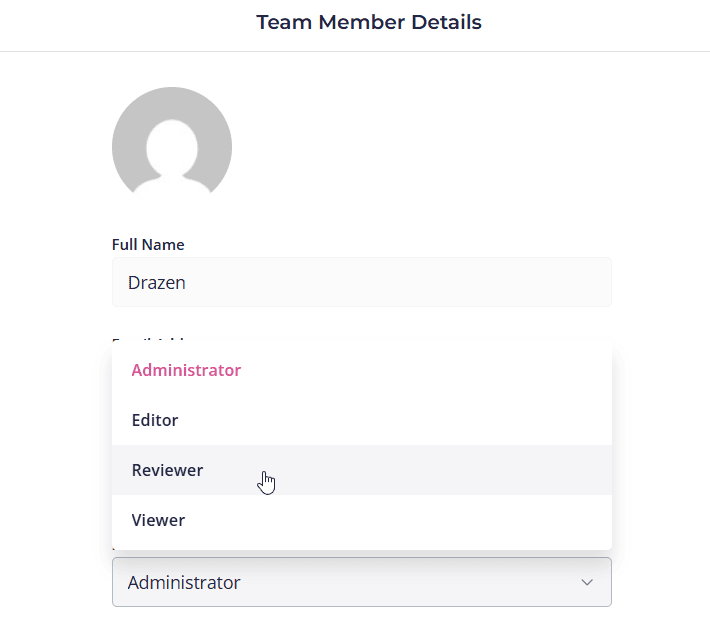
This way, Content Snare lets you build a smarter accounting data collection process. The platform is also ISO 27001 certified, which is the global standard for information security, and trusted by over 1,600 firms worldwide across industries like accounting, legal, and finance.
As NGR Accounting notes:
“What our clients like is that the documents are being uploaded safely, it gives us that extra security around personal information. That’s really important from a cybersecurity perspective.”
Another strong example is Translucent, which offers advanced permission settings tailored for firms managing multiple entities. It’s designed to give teams access only to the entities or functions they need, nothing more:
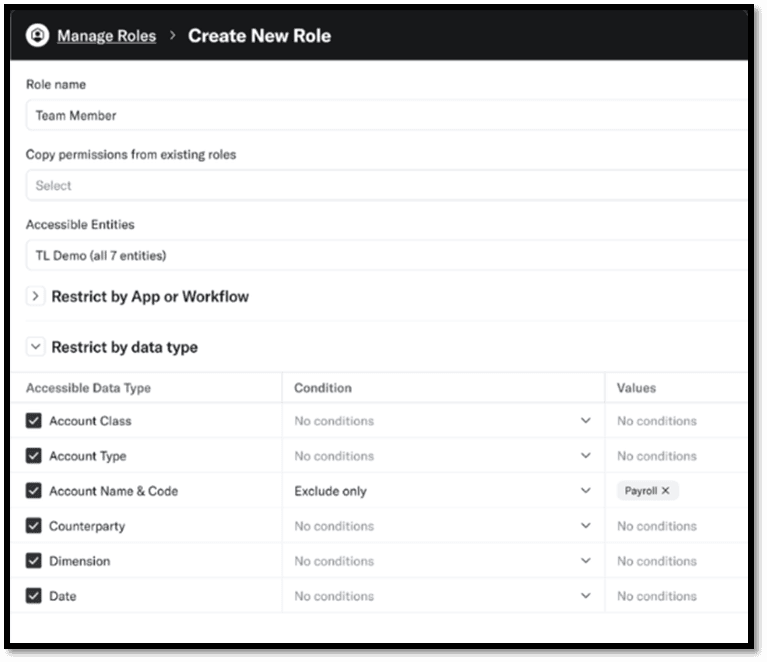
As a SOC 2 certified provider, Translucent also meets the highest benchmarks for data security and integrity. This is particularly important for cloud-native bookkeeping and reporting tools. In addition, it offers you a free intercompany matrix for Xero and QBO.
Choosing the right tools: Security as a key factor
When evaluating software for your practice, it’s natural to focus on features that promise speed or convenience, but you should also find software that improves data security in accounting.
Asking the following questions can help you identify whether a tool is built with security in mind:
- Does this platform meet my compliance requirements?
- Can I manage user access at a granular level?
- Are audit logs and data history clearly documented and accessible?
- How does the tool handle sensitive data during transfer, storage, and deletion?
Security needs also vary depending on how your practice operates. For example, firms that focus on high-volume document collection or identity verification (such as during tax season or for onboarding new clients) demand tools with secure forms, automation, and customizable workflows.
In this case, Content Snare is the obvious choice because it’s purpose-built for accounting firms to simplify document collection, client onboarding, and ID verification. The system provides secure document handling and communication, along with role-based permissions and ISO 27001 certification, which is perfect for accounting firms gathering sensitive files.
Related: How Content Snare keeps your data safe
On the other hand, if your firm works across multiple entities or needs to consolidate and report on data from various systems, Translucent provides robust features for managing complexity without compromising security. With advanced permissions and full SOC 2 compliance, it makes for a modern accounting system that enables teams to work across multiple books with control and transparency.
The bottom line is that the right tool should align with your business processes while giving you confidence that client data is protected at every stage.
Wrapping up: Making security your competitive advantage
Accountants often see security as a defensive measure or something they do to avoid problems, but it is also a point of differentiation for modern accounting and bookkeeping firms.
Firms using tools that meet recognized security standards prove that client data is in capable hands. In an industry built on trust and precision, that assurance can set you apart. If you're reviewing your current tech stack or exploring new tools, start by asking how each one protects client data.
And if you’re already prioritizing security in your workflows, share that with your clients - they’ll value the transparency.
FAQ
What security certifications should accounting software have?
ISO 27001 and SOC 2 are the standard certifications when it comes to accounting tools, but you might also consider platforms with GDPR compliance (for European data protection) or CSA STAR (Cloud Security Alliance) certification, which offers additional transparency for cloud-based services.
How do accounting firms securely collect client documents?
Accounting firms can securely collect client documents online by using platforms that combine end-to-end encryption, user authentication, and access controls. Tools like Content Snare offer ISO 27001-certified protection alongside advanced security features such as multi-factor authentication, password management, session security, and throttling to prevent unauthorized access. With granular permissions and secure, customizable forms, firms can streamline data collection while ensuring sensitive information stays protected, all within a user-friendly interface.